




In India, the rainy season (monsoon) is often called the real “Finance Minister.” When the country gets good rain, farmers grow healthy crops, the economy grows, and the prices of everyday goods stay low. Unfortunately, this year, weather experts are noticing a serious lack of rain.
Let’s break down how the monsoon normally works and look at the five main reasons why it is struggling this year.
How the Monsoon Usually Works
The word “monsoon” simply means a seasonal change in the direction of the wind. During the summer, winds change direction and blow from the sea toward the land, carrying huge amounts of water vapor.
For these rain clouds to smoothly cover India, the weather needs to set up a perfect pathway:
Northern India needs to get very hot to pull the ocean winds inward.
High-altitude dry winds (Westerlies) need to move away from the country.
Other high-altitude winds need to help push the rain clouds forward.
Usually, the monsoon covers the whole country in about a month and a half. But this year, the winds are weak, slow, and lack moisture.
The 5 Weather Problems Blocking the Rain
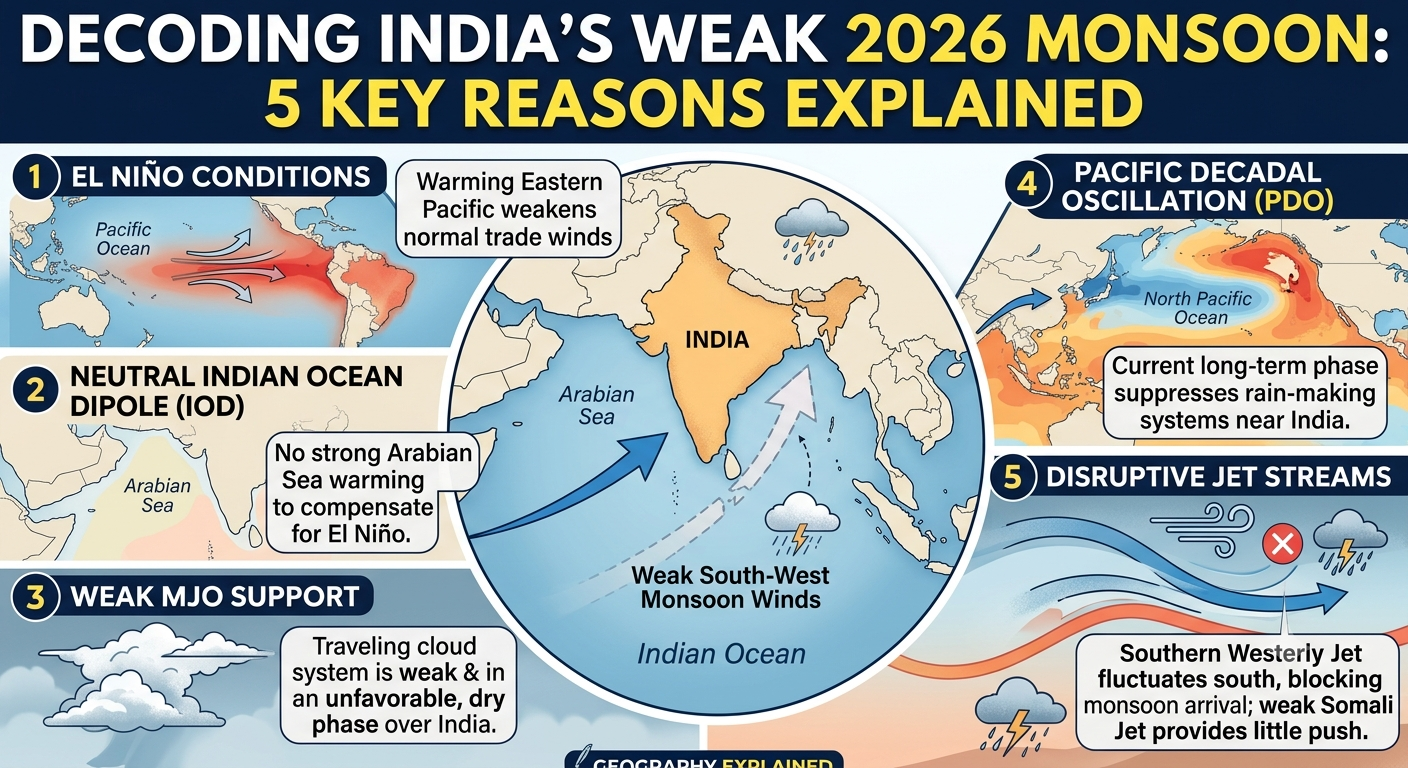
Why is the monsoon failing this year? Scientists say it is due to a mix of five different global weather problems happening at the same time:
1. The El Niño Effect
El Niño happens when the water in the Pacific Ocean gets unusually warm. This completely messes up global wind patterns. For India, El Niño acts like a roadblock—it weakens the winds that bring rain clouds from the ocean, leading to dry conditions and less rainfall.
2. No Extra Help from the Indian Ocean (Neutral IOD)
Sometimes, even if El Niño causes a problem, the Indian Ocean can save the day. If the Arabian Sea is warmer than the Bay of Bengal, it creates extra moisture for the monsoon. This helpful event is called a “Positive Indian Ocean Dipole.” Sadly, this year, the ocean temperatures are balanced (neutral), meaning the monsoon isn’t getting any backup.
3. A Weak Traveling Cloud System (MJO)
There is a massive, moving weather system of clouds and rain that travels around the Earth’s equator every few weeks (known as the Madden-Julian Oscillation). When it passes over India, it brings heavy downpours. Right now, this system is very weak and is sitting in a spot that is actually preventing rain clouds from building up over India.
4. Pacific Ocean Patterns (PDO)
Long-term changes in the Pacific Ocean’s temperature also affect India’s weather. Right now, these ocean patterns are preventing rain-making storm systems from forming near Southeast Asia. Normally, wind currents push those storms toward Eastern India to give them plenty of rain, but this year, those storms are missing.
5. Disruptive High-Altitude Winds
High up in the sky, dry and cold winds are supposed to move out of the monsoon’s way during summer. This year, they are acting stubbornly, constantly dipping down into India. When this dry air hits the wet monsoon clouds, it literally dries them up and destroys them. Furthermore, another set of winds that usually pushes the monsoon from behind is also much weaker than usual.
Why This Matters
These five weather issues have combined to create a major lack of rain. Because India’s economy is heavily based on farming, a dry monsoon can cause serious problems. It leads to smaller crop harvests, which can hurt businesses and even cause the stock market to drop. Unless the global weather patterns shift soon, the country may have to prepare for a difficult, dry year.