




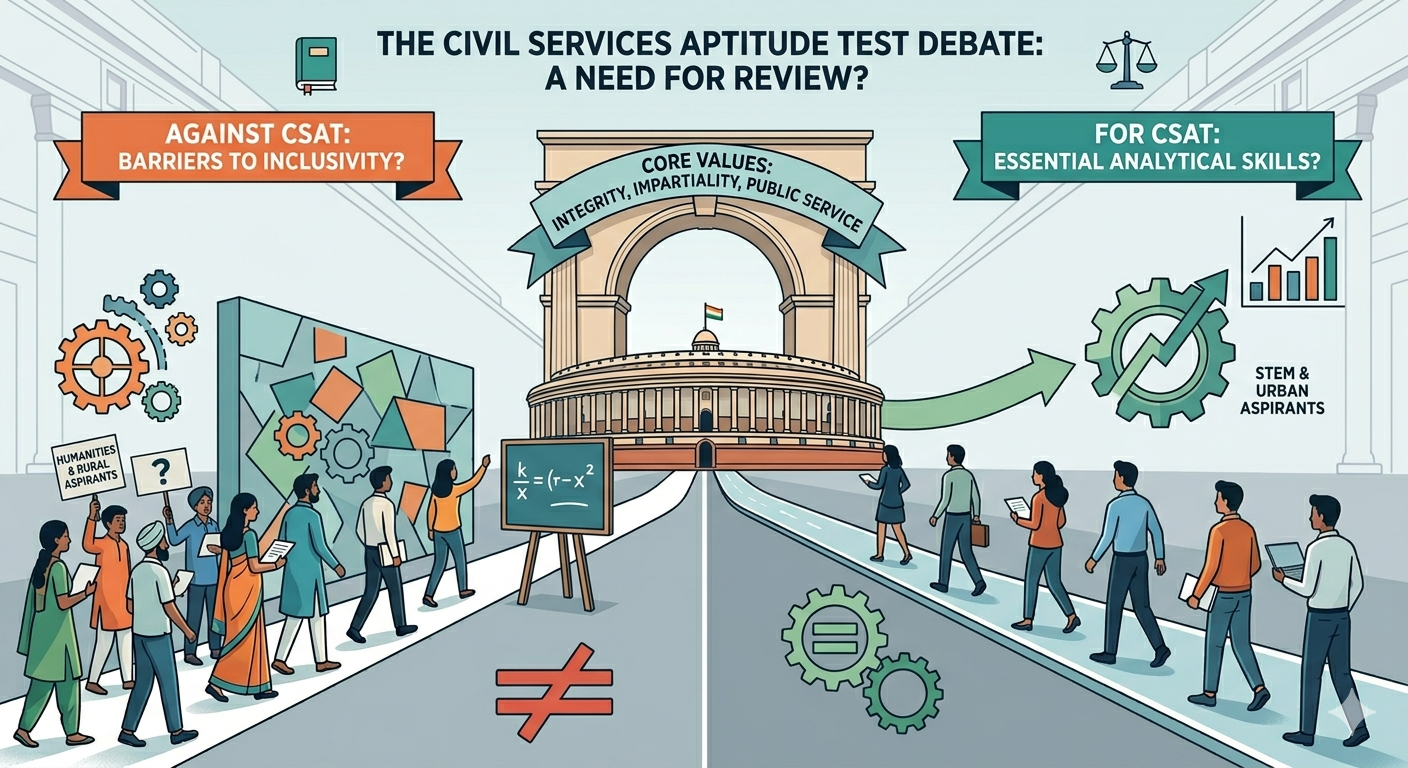
The Civil Services Examination is the premier gateway for selecting a nation’s top administrators. However, the inclusion of a preliminary Aptitude Test has sparked intense debate over fairness, accessibility, and the ideal skill sets needed for modern governance. Recently, a Parliamentary Standing Committee recommended a thorough review—or even the abolishment—of this test.
Here is a breakdown of the ongoing debate surrounding the examination structure.
The Evolution of the Exam
The exam pattern has continuously evolved to manage rising applicant numbers and changing administrative needs. Introduced in 2011, the Aptitude Test was designed to evaluate analytical, numerical, and linguistic abilities.
However, following concerns that the paper favored students from urban, English-medium, and STEM (Science, Technology, Engineering, and Mathematics) backgrounds, it was modified in 2015. It is now a “qualifying” paper, meaning candidates only need to score 33.5% to pass to the next evaluation stage.
The Case Against the Aptitude Test
Critics, including members of the Parliamentary Committee, argue that the test acts as a “silent eliminator,” heavily tilting the scales against certain demographics.
Disadvantaging Humanities and Rural Candidates: With a large portion of questions focused on math and complex analysis, the test acts as a major roadblock for students from arts, humanities, and non-English speaking backgrounds.
STEM Dominance: The current system has resulted in an estimated 60% to 65% of successful candidates coming from engineering backgrounds, potentially limiting diversity of thought within the civil services.
Unequal Opportunity: Critics argue the test penalizes individuals who possess strong leadership and administrative potential but lack specialized mathematical speed.
The Case For the Aptitude Test
Proponents offer a robust defense, asserting that the test’s analytical rigor is non-negotiable for modern administration.
Baseline Competency: The mathematical questions are generally at a high-school level. Proponents argue that a 33.5% passing threshold is a reasonable expectation for the brightest minds aiming to run a country.
Data-Driven Governance: Today’s civil servants must be able to read charts, analyze statistics, and practice evidence-based policymaking. Basic numerical and analytical abilities are fundamental requirements, not optional skills.
The Talent Pool Reality: Competitive STEM fields naturally attract top-tier talent early on. Proponents argue that even without this specific test, STEM graduates would likely continue to dominate the selections due to their rigorous academic conditioning.
Core Values Over Test Scores
While experts disagree on the mechanics of preliminary screening, there is a unified consensus on the core values required for future civil servants.
To achieve long-term development goals, the civil service must be more than just an intellectual elite; it must be an ethical backbone. Candidates from any background can learn technical skills on the job, provided they possess unwavering integrity, impartiality, and a dedication to distributive justice.
Conclusion
The debate highlights a critical challenge: selecting a nation’s most capable minds while ensuring the process remains inclusive and representative of a diverse populace. Whether the examination board decides to overhaul or retain the current system, the ultimate goal remains unchanged—to forge a framework of administrators who are analytically sharp and deeply committed to public service.