


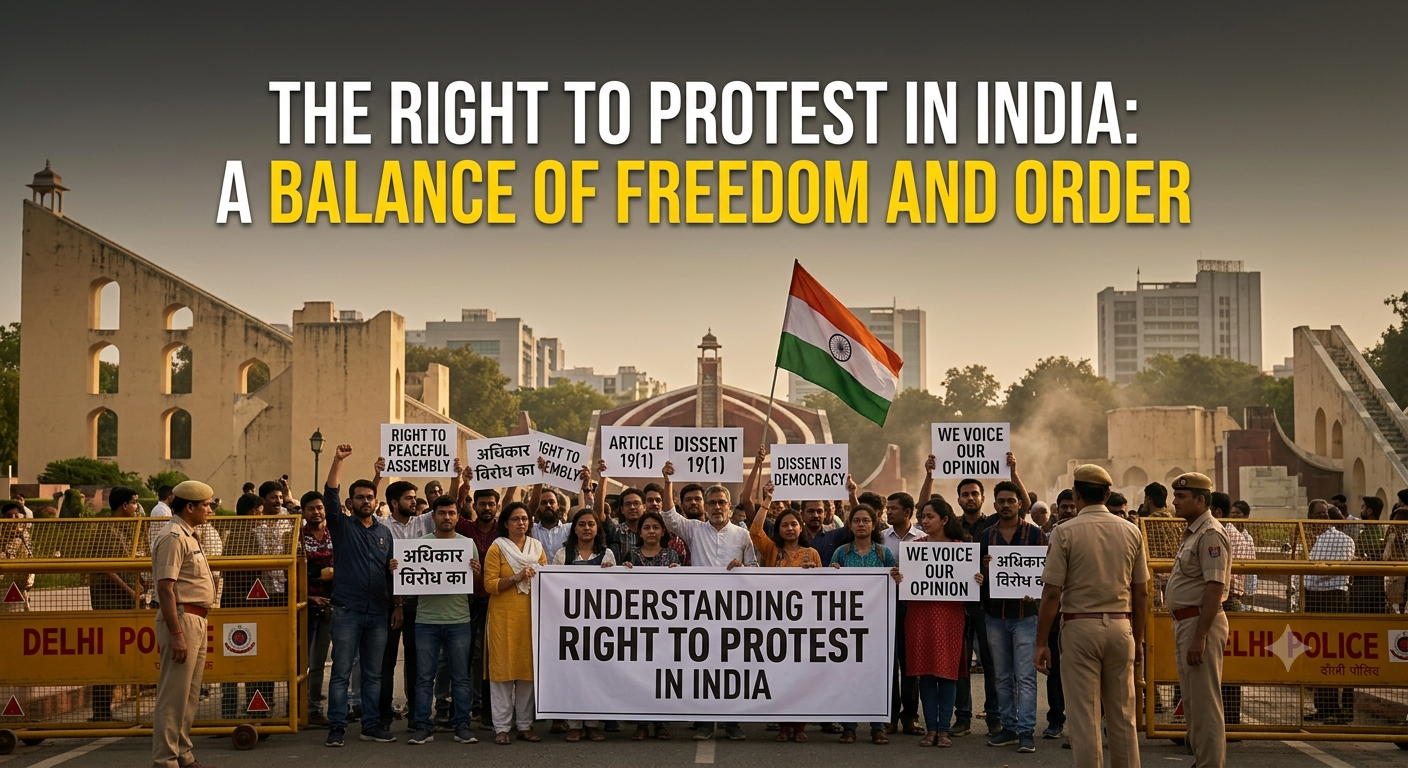
When people gather to protest, the police often step in with barricades or rules. This makes many wonder: if we live in a free country, why do we need permission to raise our voices? Here is a simple breakdown of how the right to protest works in India, the rules around it, and how the courts view it.
More Than Just Voting
Democracy is about much more than just casting a vote during elections. While voting is important, citizen participation is just as vital. People need to be able to share their views, question leaders, and peacefully protest. In a healthy democracy, expressing disagreement is completely normal and necessary.
Where the Right Comes From
You will not find the exact phrase “right to protest” written in the Indian Constitution. Instead, this right is built from two basic freedoms given to citizens under Article 19:
The freedom to speak and express your thoughts.
The right to gather peacefully without any weapons.
Together, these allow citizens to hold marches, public campaigns, and peaceful demonstrations.
Why There Are Limits
Even though we have these freedoms, they are not limitless. The government can apply “reasonable restrictions” to keep everyone safe and maintain order.
This creates a balancing act. Protesters have a right to march, but other people also have the right to get to work, children need to reach school, and ambulances need clear roads. The framers of the Constitution knew that society needs both freedom and order to function properly. Therefore, your freedom to protest ends where another person’s basic rights begin.
Rules for the Police
Local authorities and police can manage protests to prevent violence or public disturbance. They can set rules regarding the time, location, noise levels, or crowd size.
However, the police cannot stop a protest just because the people are criticizing the government. Any action the police take to limit a protest must pass three tests:
Legal: The police must have a clear law that gives them the power to act.
Necessary: They should only use force if simple steps, like warnings, have failed.
Balanced: The force used must not be too harsh compared to the actual situation.
What the Supreme Court Says
Over the years, the Supreme Court of India has shared important rules regarding protests:
No Total Bans: The government can manage and regulate public meetings, but it cannot completely ban them.
Finding a Balance: The right to protest peacefully is crucial, but it must not completely disrupt the lives of local residents and travelers.
Keep Roads Clear: Public roads and highways cannot be blocked forever. Protests should happen in areas specifically meant for them.
Two Different Views: Gandhi and Ambedkar
India’s modern approach to protests tries to find a middle ground between the ideas of two great leaders:
Mahatma Gandhi believed that protesting peacefully against injustice is a moral duty. He felt that non-violent protests make a democracy stronger.
B.R. Ambedkar cautioned against taking to the streets too often. He argued that because independent India has its own courts, parliament, and voting system, citizens should use these official channels to solve problems instead of causing public disruptions.
The Final Word
In a working democracy, both the right to protest and the state’s duty to maintain order are essential. Citizens must be free to question the government, and the government must be open to criticism. The ultimate goal is to strike a perfect balance: the government’s rules must not silence the people, and the people’s protests must not create public chaos.