




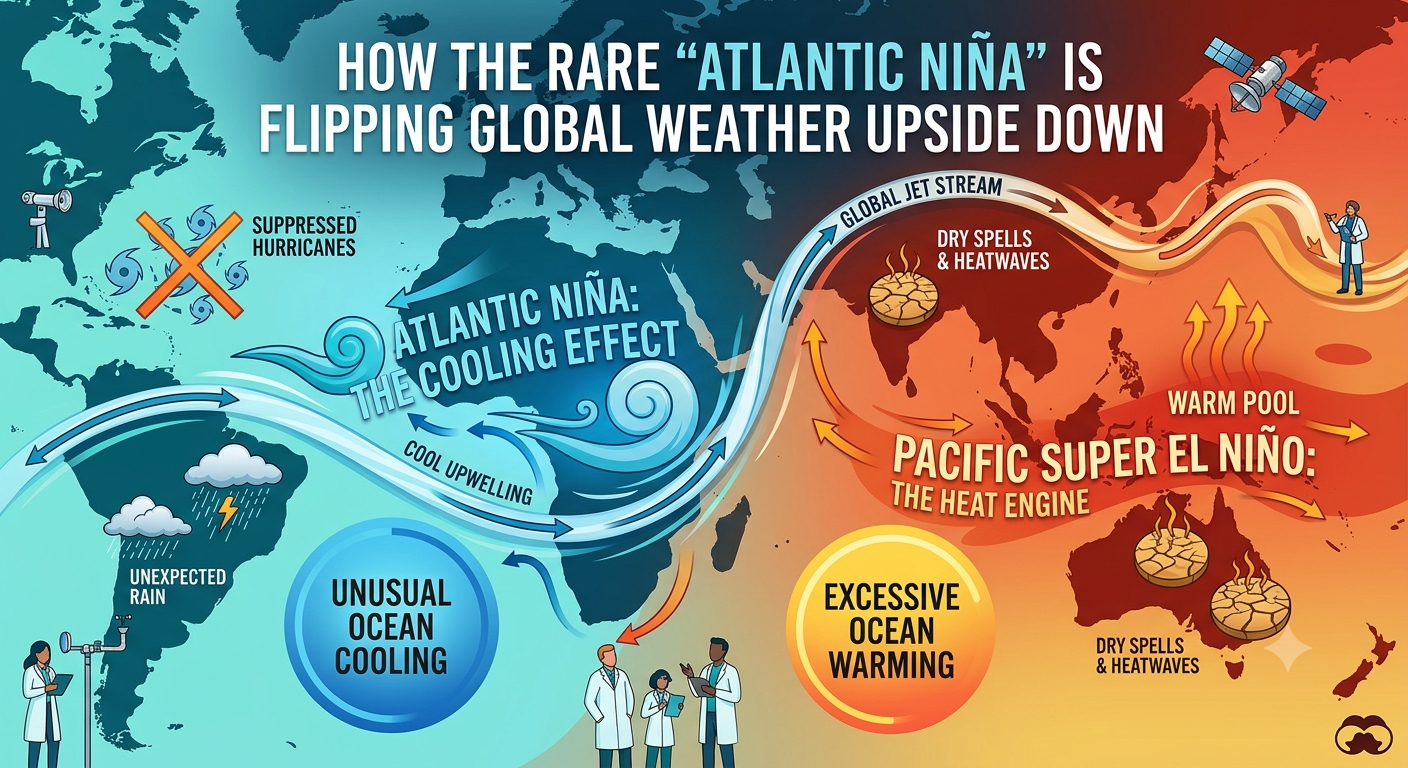
The world’s oceans are acting a bit strangely right now. While most meteorologists usually focus on the Pacific Ocean’s “El Niño,” there is a very rare event happening in the Atlantic Ocean called the Atlantic Niña.
What makes this situation truly wild is that both events are happening at the exact same time. This oceanic clash is completely flipping normal global weather patterns backward, affecting everything from hurricanes to monsoons.
Here is a simple breakdown of what is happening and why it matters.
What is the Atlantic Niña?
In simple terms, an Atlantic Niña is an unusual cooling of the ocean water near the west coast of Africa. While cooling events in the Pacific (called La Niña) happen all the time, this Atlantic version is extremely rare.
How does it happen?
Strong winds blow across the Atlantic Ocean, pushing the warm top layer of water away from Africa and over toward South America.
Because the warm water is pushed away, freezing cold water from deep down in the ocean rises up to take its place.
This makes the surface of the Atlantic Ocean much cooler than normal.
The Pacific Giant: Super El Niño
To understand why this is a big deal, we have to look at what is happening on the other side of the world in the Pacific Ocean. Right now, a “Super El Niño” is taking place.
Normally, ocean winds push warm water toward Asia. But during an El Niño, these winds get weak or blow in the completely wrong direction. The warm water gets stuck near South America instead. The ocean gets so hot that it throws massive amounts of heat and moisture into the air, which messes up the fast-moving winds high up in the sky (the jet streams).
How This Ocean Clash Changes the World
When you combine a freezing Atlantic with a boiling Pacific, the world’s weather gets very confused. The normal flow of wind and rain goes backward, causing huge changes across the globe:
Fewer Hurricanes: This is actually great news for the Americas. Hurricanes need warm ocean water to grow. Because the Atlantic is unusually cold right now, storms do not have the fuel they need to build up. Plus, the crazy winds caused by the Pacific El Niño act like a giant fan, blowing the tops off any small storms before they can turn into dangerous hurricanes.
Less Rain in Africa: Because the ocean is cold, less water evaporates into the sky. This means fewer rain clouds form, leading to very weak seasonal rains across West Africa.
Dry Spells in India and Asia: Normally, warm ocean waters bring heavy, essential monsoon rains to India, Southeast Asia, and Australia. But with the warm water stuck on the wrong side of the world, these areas are left facing long, dry heatwaves.
Unexpected Rain Elsewhere: Because the rain has to fall somewhere, places that are usually drier—like the southern United States and parts of Brazil—end up getting unusually wet weather.
The Bottom Line: The Earth’s oceans are deeply connected. A simple shift in the wind and a slight drop in ocean temperature off the coast of Africa is enough to stop hurricanes in their tracks while simultaneously causing dry spells thousands of miles away in India.