




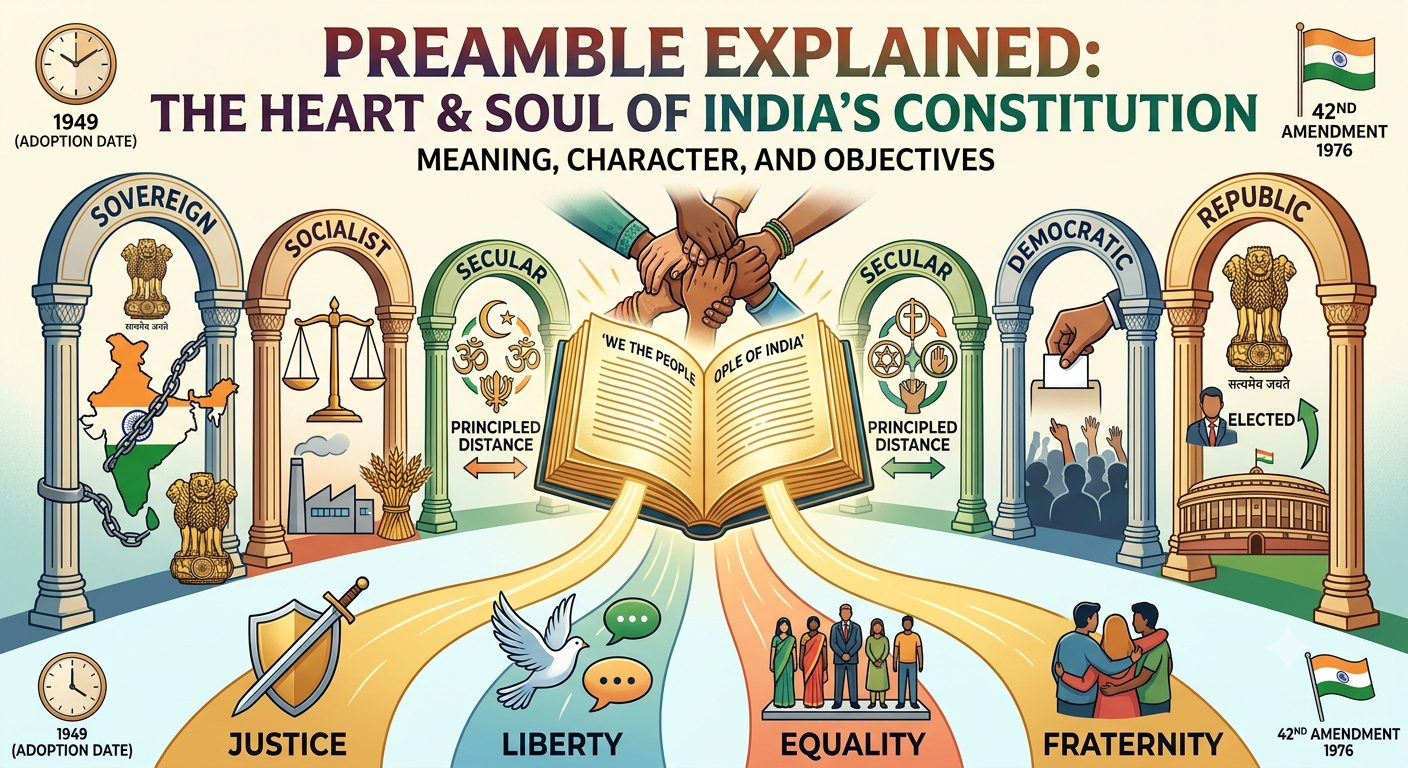
Just as a book features a preface to introduce its contents, the Indian Constitution begins with a Preamble. This introductory statement serves as a brief summary of the foundational values and philosophy that govern the nation.
Here is a simplified guide to the history, meaning, and key terms of the Preamble to the Indian Constitution.
Where Did It Come From?
The Preamble is deeply rooted in the “Objectives Resolution.” This blueprint was presented to the Constituent Assembly by Jawaharlal Nehru on December 13, 1946, and was officially adopted on January 22, 1947.
The Preamble is structured to deliver four key pieces of information:
Who gives the Constitution its power.
The defining character of the Indian nation.
The ultimate goals of the country.
The exact date it was adopted.
1. The Source of Power: “We the People”
The document famously starts with, “We the people of India.” This establishes the principle of “popular sovereignty.” It simply means that the true authority of the government does not come from a king or a foreign ruler, but directly from the citizens of India.
2. The Character of the Nation
The Preamble uses five specific words to describe India’s identity: Sovereign, Socialist, Secular, Democratic, and Republic.
Sovereign
This means India is completely independent. It is not controlled by any outside force and has the absolute authority to make its own rules—both internally (laws within the country) and externally (foreign policies).
Socialist
Added to the document in 1976 (via the 42nd Amendment), this highlights India’s goal to reduce the wealth gap and ensure economic fairness. Instead of strict government control, India practices “Democratic Socialism,” meaning both private businesses and government-run services exist side by side. It is a unique mix inspired by both Marxist ideas (protecting laborers) and Gandhian values (promoting rural development and social harmony).
Secular
Also added in 1976, this means India does not have an official national religion. India practices “positive secularism.” Instead of completely ignoring religion, the government respects all faiths equally. It keeps a fair distance from religious affairs but will step in if it is necessary to protect social justice or equality.
Democratic
In a democracy, the people hold the power. Because India is so large, it uses an “indirect” or representative parliamentary system. This means that adult citizens (anyone 18 or older, regardless of their background) vote to elect leaders who will make important decisions on their behalf.
Republic
A republic is a system where the head of state is chosen through an election, rather than inheriting the position through a royal bloodline. In India, the President is elected, proving that the highest offices in the country are open to its citizens.
3. The Nation’s Goals
The Preamble outlines four main aspirations for the country:
Justice: This means fairness for everyone. It includes social justice (no discrimination based on background), economic justice (reducing the wealth gap), and political justice (equal voting and political rights). This idea was inspired by the 1917 Russian Revolution.
Liberty: Citizens have the freedom to think, speak, and practice their faith as they choose. However, this freedom is not limitless; it can be restricted if it threatens the country’s safety or public order.
Equality: Ensuring everyone is treated with dignity and has a fair, equal chance to succeed in life through education and jobs.
Fraternity: This simply means a sense of brotherhood. It ensures that individuals can live with dignity while keeping the nation both mentally united and geographically whole.
(The ideals of Liberty, Equality, and Fraternity were inspired by the 1789 French Revolution).
4. The Date of Adoption
The Preamble clearly states the exact date the Constituent Assembly finalized and adopted the Constitution: November 26, 1949.
Can the Preamble Be Changed?
The legal standing of the Preamble has evolved over the years through two major Supreme Court cases:
Berubari Union Case (1960): The Supreme Court originally ruled that the Preamble was not officially a part of the Constitution.
Keshavananda Bharati Case (1973): The Court changed its mind, ruling that the Preamble is a part of the Constitution. However, they clarified that you cannot take the government to court solely based on what the Preamble says.
Because it is officially part of the Constitution, it can be amended. However, the Supreme Court created the “Basic Structure Doctrine,” which means the government cannot change the core foundational features of the document (like its secular or democratic nature).
To this day, the Preamble has only been changed once—during the 42nd Amendment in 1976, which added the words Socialist, Secular, and Integrity.