




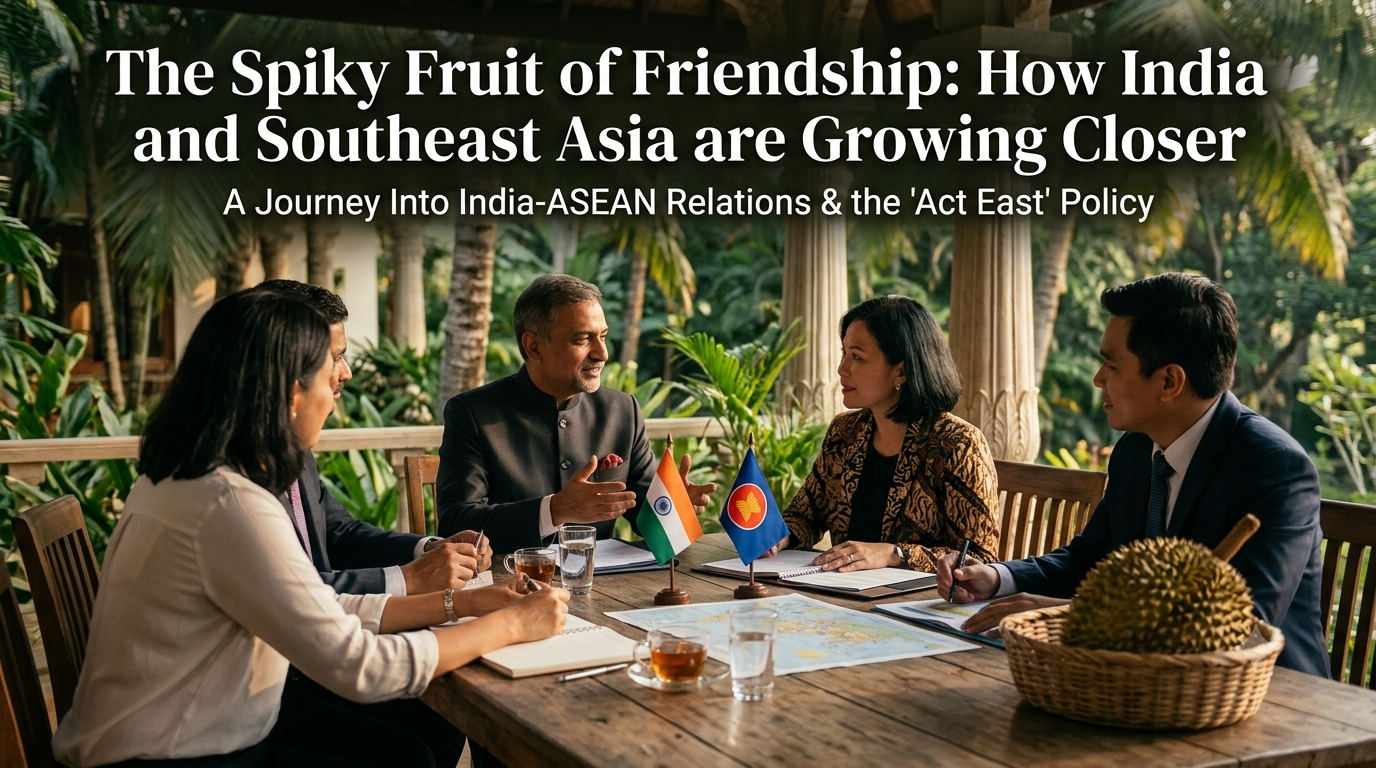
Understanding the relationship between India and Southeast Asian nations (known as ASEAN) can be compared to eating a durian. Former Indian .The durian has a tough, spiky shell and a notoriously strong smell, making it difficult to handle at first. However, once you get past the rough outside, the fruit is rich and rewarding. In the same way, building deep ties between India and ASEAN takes hard work to overcome complex political challenges, but the shared history and future benefits make it deeply worthwhile.
From Looking to Acting
For a long time, India’s approach to Asia was called the “Look East” policy. Started in the 1990s, this plan mostly focused on doing business and trading with wealthy countries like Japan and South Korea.
Recently, this shifted to the “Act East” policy. Instead of just looking at trade, India is now actively participating in the region. This new approach places ASEAN right at the center. It involves much more than just money; it includes military cooperation, cultural exchanges, and stronger political ties. Today, India and ASEAN even hold joint naval exercises and discuss maritime security, which was unheard of decades ago.
Standing Out Next to China
China is an economic giant in Southeast Asia, and India cannot currently match its financial power there. However, India offers something different: trust and a peaceful history.
Unlike other global powers, India never colonized Southeast Asia. Instead, the two regions share deep cultural and historical links, visible in ancient monuments and shared ancient stories. Furthermore, as China becomes more aggressive in nearby waters like the South China Sea, Southeast Asian countries are looking for a reliable, peaceful partner to help keep things balanced. India fits this role perfectly because it is seen as a helpful friend, not a military threat.
A Post-Pandemic Bond
The COVID-19 pandemic proved India’s reliability. When Southeast Asian countries needed medicine and vaccines and others could not provide them, India stepped up to help. Because of this, ASEAN countries are now looking to partner with India in three main areas:
Healthcare: Ensuring a steady supply of medicines and health security.
Food Security: Relying on India for food supplies to make sure their populations have enough to eat during crises.
Digital Technology: Learning from India’s successful digital payment systems rather than relying solely on Chinese technology.
Working Together Simply
Dealing with ASEAN can be tricky because it is a group of 11 different countries, and they often disagree with each other. Ambassador Singh suggests a strategy of not waiting for perfect agreement. If a few countries in the region want to work with India on specific projects—like green energy, business investments, or technology—India should move forward with them individually rather than waiting for the entire bloc to reach a consensus.
Building Real Connections
Despite strong government ties, regular citizens in ASEAN and India still need to connect more. Recent surveys show that Southeast Asians do not yet view India as a top place to visit or study. Very few students from the region come to Indian universities, and tourism remains low.
To make the relationship truly successful, the focus must shift to everyday people. By boosting tourism, sharing educational opportunities, and treating each other as equal partners, India and ASEAN can peel back the tough outer shell and enjoy a deeply rewarding partnership for years to come.