


Most people in India have to pay income tax on their earnings. But did you know there is one state where residents can earn massive amounts of money and legally pay zero income tax? That state is Sikkim. This is not tax evasion; it is a special right protected by the Constitution of India.
Here is a simple breakdown of why this happens, the history behind it, and the current debates surrounding it.
The History Behind the Rule
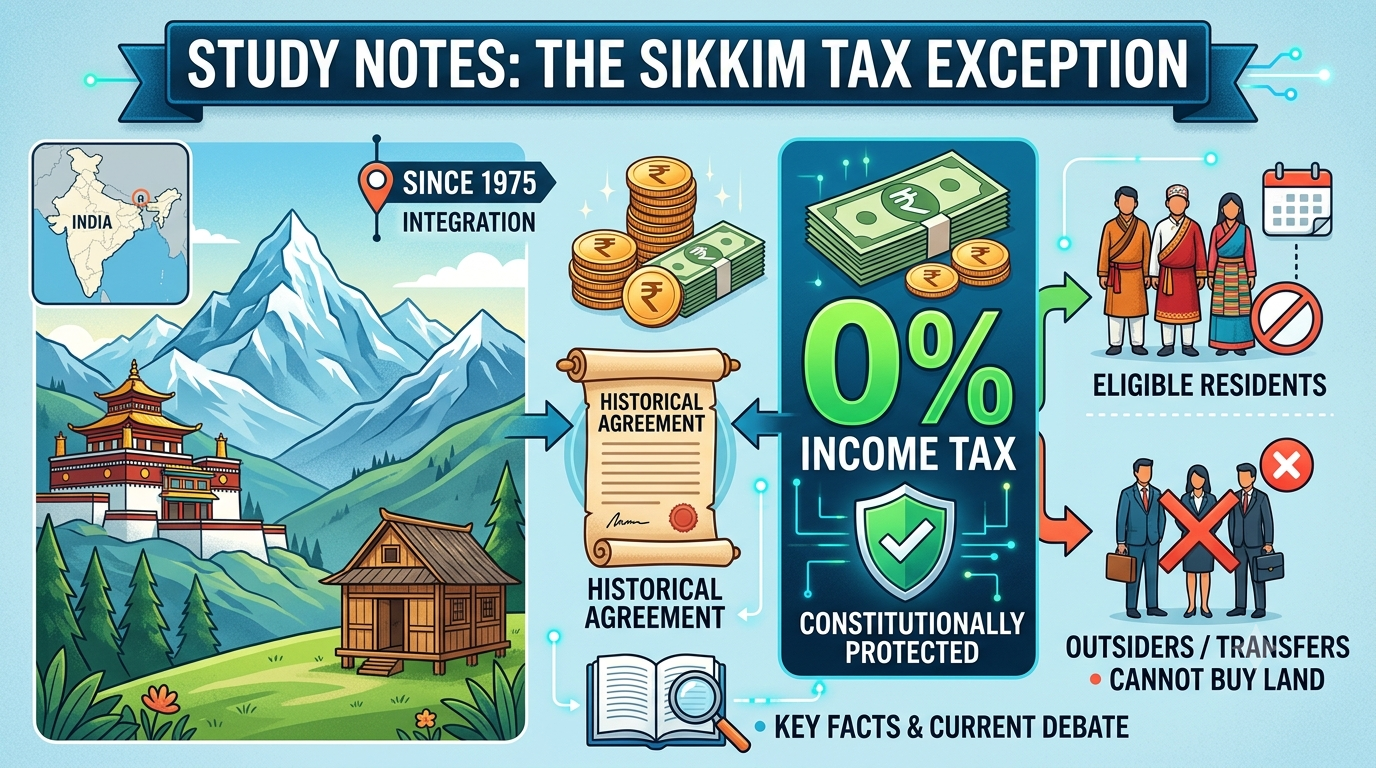
Before 1975, Sikkim was not a part of India. It was an independent kingdom ruled by the Chogyal kings. The people there had their own rules and did not pay personal income tax.
Due to rising security threats from neighboring countries, India and Sikkim agreed to merge. On April 26, 1975, Sikkim officially became India’s 22nd state. However, Sikkim had one major condition for this merger: India must respect its old laws, protect its identity, and keep its traditional tax exemptions unchanged.
Key Constitutional Protections
To honor this historical promise, the Indian government created special legal shields. These are essential facts for anyone studying Indian polity or preparing for competitive exams:
Article 371F: This rule in the Constitution guarantees that all of Sikkim’s old laws stay in place unless the Indian Parliament explicitly changes them.
Section 10(26AAA): Added to the Income Tax Act, this section legally frees the original residents of Sikkim from paying any income tax.
The 2013 Supreme Court Ruling: The court decided that the tax-free rule applies not just to native Sikkimese subjects, but to any Indian who had permanently settled in the state before the merger date of April 26, 1975.
Can Anyone Move to Sikkim to Save Tax?
The short answer is no. The government has made the rules very strict so outsiders cannot misuse the system:
The Strict Cut-Off Date: Only families who were officially recorded as living in Sikkim before April 26, 1975, receive this benefit.
Transfers and Postings: If you are transferred to Sikkim for a job—such as working for the central government, the Army, a bank, or a private company—you still have to pay standard Indian taxes.
Property Rules: People from outside the state are not legally allowed to buy land in Sikkim, making it impossible to move there simply to dodge taxes.
The Modern Debate: Should it Change?
Today, this 50-year-old rule is causing some debate among financial experts.
The Risks: Authorities worry that wealthy outsiders might misuse this system by creating fake businesses (shell companies) using the names of Sikkim residents to hide illegal money. Additionally, some argue that as India moves toward a “One Nation, One Tax” system, everyone should pay their fair share.
The Trust Factor: On the other hand, removing this rule means breaking a major historical promise. Keeping the trust of border states is incredibly important for national unity and security.
Summary
Sikkim’s zero-tax rule is a fascinating example of how history, national security, and constitutional law come together. Ultimately, to read the quality and write the article is to know the world about you and your knowledge. Exploring these unique governance structures helps build a stronger understanding of how diverse and complex the Indian democratic system truly is.