




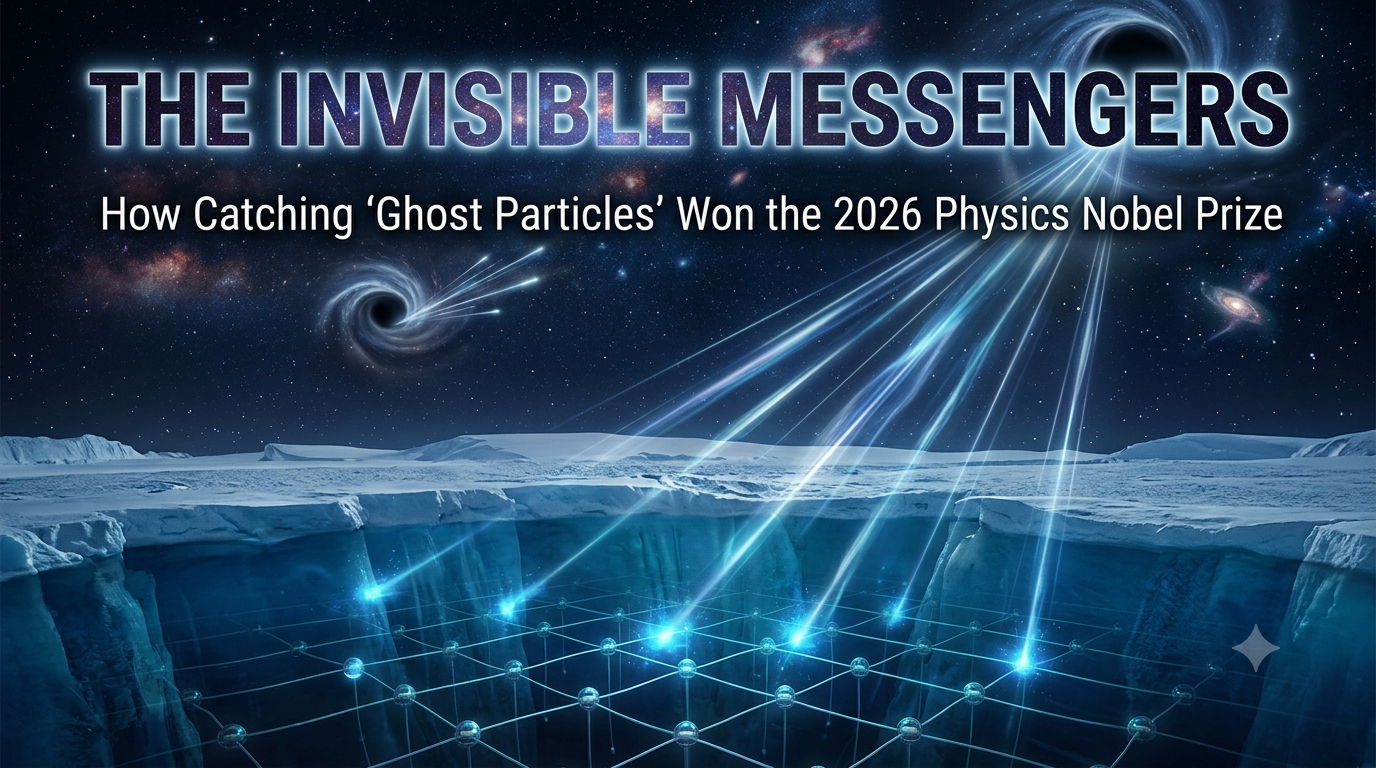
Did you know that right at this very moment, billions of tiny, invisible particles are zooming right through your body? You can’t feel them, and they don’t hurt you. They are called neutrinos, but scientists often call them “ghost particles.”
Recently, a scientist named Francis Halzen won the 2026 Nobel Prize in Physics because he figured out an incredibly clever way to catch and study these space ghosts.
What Are Ghost Particles?
To understand why this is a big deal, we need to look at what makes neutrinos so special:
They are mostly empty: They have no electric charge and weigh almost nothing at all.
They pass through everything: They can fly straight through solid walls, mountains, and even the entire Earth without ever bumping into anything.
These particles are born in the most extreme places in the universe. Some come from our Sun, while others travel across billions of lightyears from exploding stars and giant black holes.
The Problem: How Do You Catch a Ghost?
Because neutrinos fly right through matter, catching them is extremely hard. It’s like trying to find one specific drop of water in the middle of a raging ocean.
However, scientists knew one secret: on very, very rare occasions, a neutrino will accidentally bump into an atom. When it does, it makes a super tiny, faint flash of blue light. To actually see this microscopic flash, scientists needed a place that was totally dark, extremely quiet, and massive.
A Brilliant Idea: A Telescope Made of Ice
In 1988, Francis Halzen came up with an idea that sounded crazy at the time. He suggested using the deep ice at the South Pole in Antarctica.
Deep underground in Antarctica, the ice is crushed under so much pressure that all the air bubbles are squeezed out. It becomes completely clear, just like glass. This idea led to the creation of the IceCube Neutrino Observatory.
Scientists drilled deep holes into the ice and buried thousands of special light sensors in a massive, one-kilometer block of clear ice. Their job was simple but hard: wait in the dark for a rare neutrino to bump into the ice and record the tiny flash of blue light. By 2013, the machine worked perfectly and successfully caught these particles coming from deep space.
Why Does This Matter?
Before this, humans could only look at the universe using normal light. The problem is that light can easily get blocked by thick clouds of space dust. Other cosmic rays get bent by magnetic fields in space, so we can’t tell exactly where they came from.
Neutrinos are different. Because nothing stops them, they travel in a perfectly straight line. When one hits the ice in Antarctica, scientists can trace that straight line all the way back into deep space to see exactly what created it.
A New Way to See Space
Thanks to Francis Halzen’s brilliant idea to turn a block of frozen ice into a telescope, we now have a brand-new way to study the stars. This new science is called Neutrino Astronomy. It allows us to track down hidden black holes and distant galaxies, helping us solve mysteries of the universe that were once completely invisible.