




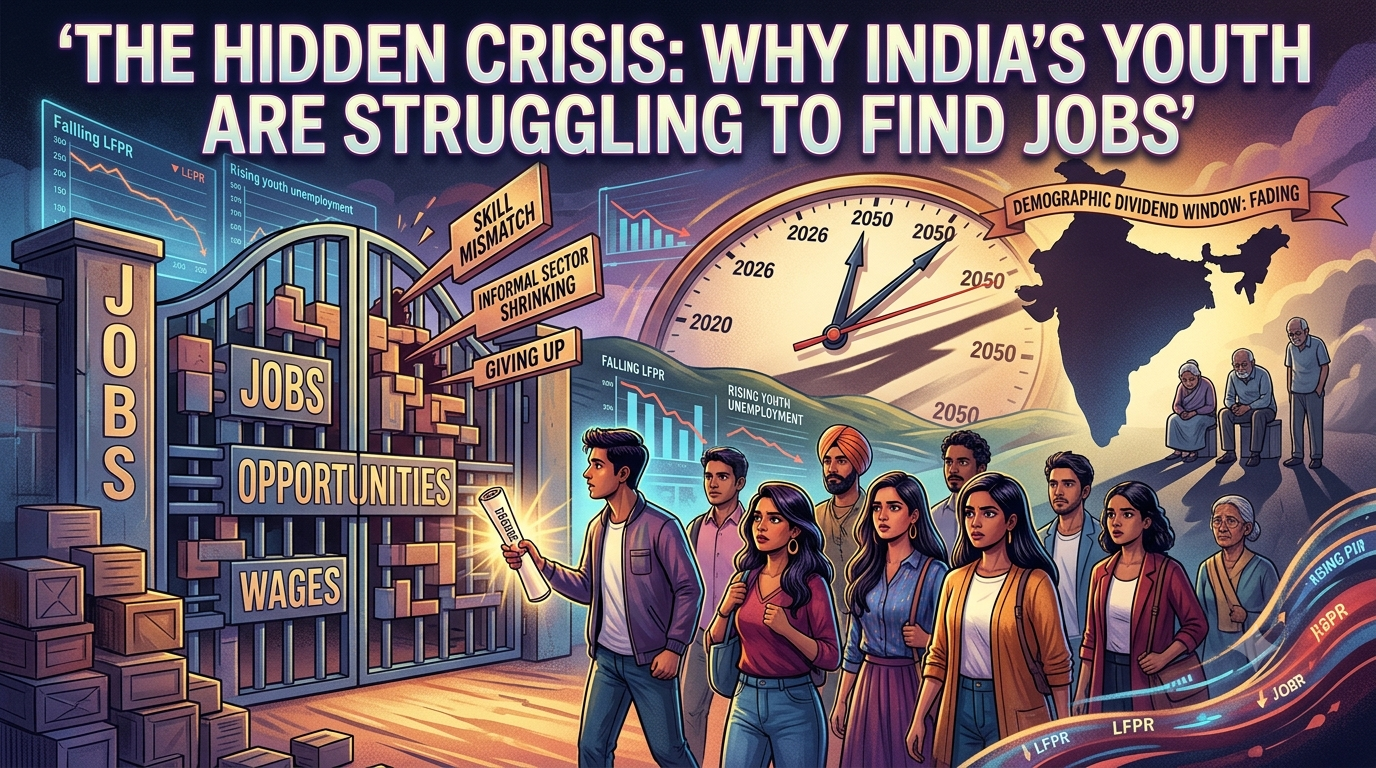
While recent student protests over exam leaks have made headlines and even led to political changes, a much larger, silent crisis is brewing underneath: a massive shortage of jobs for young Indians.
Students are spending years getting educated, but when they finally step out into the real world, the jobs simply aren’t there. While a protest might not immediately shake the national economy, millions of jobless youth certainly will.
Here is a simple breakdown of what is really happening with jobs in India right now.
The Confusing Numbers: Good News on the Outside, Bad News on the Inside
If you look at the big picture, the job market looks like it is slightly improving. The overall unemployment rate for people over 15 actually dropped a tiny bit over the last year.
But when you zoom in on the youth—specifically people between 15 and 29 years old—the story completely changes. Unemployment for this age group has shot up significantly (from around 13.8% to 16.2%). This is deeply worrying because India has a very young population, with an average age of 29. The very people who should be the most productive are the ones struggling the most to find work.
People Are Simply Giving Up
Economists look at something called the “Labor Force Participation Rate.” This is basically the percentage of people who are either working or actively trying to find a job.
Over the last year, this number has dropped, meaning fewer young people are out there looking for work. Normally, if fewer people are looking for jobs, the unemployment rate naturally goes down. But in India, we are seeing the exact opposite: fewer people are looking, yet the youth unemployment rate is still going up.
What does this mean? It means the economy is failing to create new jobs fast enough, and many young people are getting so discouraged that they are simply giving up on the job search altogether.
Jobs Are Shrinking Everywhere
This isn’t just a problem in one specific area; it is happening across the board:
States are hurting: Many states, including the capital city of Delhi and states like Telangana, have seen huge jumps in unemployment over the last couple of years.
Informal jobs are vanishing: Millions of unorganized or informal jobs have disappeared.
Salaries are stuck: For those who do have jobs, pay raises have slowed down dramatically compared to a few years ago.
The “Education Penalty”
Perhaps the most confusing part of this crisis is how education affects your chances of getting hired. Everywhere else in the world, more education equals a better chance at a good job. In India, it is currently the reverse.
People who have only finished 10th or 12th grade actually have an easier time finding work than those with higher degrees. The highest unemployment rates are seen among people with PhDs, master’s degrees, and bachelor’s degrees.
Out of tens of millions of young graduates in India, over a crore (10 million) are completely jobless. Many graduates are looking for comfortable, “white-collar” office jobs, but only a tiny fraction (around 3.7%) actually manage to secure them. The skills students learn in college often don’t match what businesses are looking for.
The Clock is Ticking
Right now, India has a “demographic dividend”—a fancy way of saying we have a massive, energetic youth population that can drive the economy forward.
But this won’t last forever. By the year 2050, the average age in India is expected to rise to 38. If today’s young people don’t get jobs, build wealth, and pay taxes now, the government will struggle to support them when they get older.
India only has a short window of time to fix this. If the country doesn’t create enough jobs to utilize its young workforce today, it risks getting stuck in an economic rut, missing its chance to become a fully developed, wealthy nation.