



Imagine sitting in a chair, and right after you leave, someone aggressively scrubs it and performs a ritual to “cleanse” the area. You would naturally wonder: Was the chair really that dirty, or do they think there is something fundamentally wrong with me?
When an act of “cleansing” is aimed at a person’s social background or caste, it becomes a serious legal and constitutional issue. This exact dilemma is at the center of a recent controversy in Haldwani, Uttarakhand.
What Happened in Haldwani?
In August 2026, a senior politician belonging to the Dalit community gave a speech at a public ground in Haldwani. Shortly after the event wrapped up, a right-wing group arrived at the same location and performed a purification ritual (a shuddhikaran yagna).
This sparked immediate anger. Critics argued that the ritual was a direct insult to the politician’s caste, implying that a Dalit leader’s presence had “polluted” the space. The organizers completely denied this. They claimed they were simply restoring the religious sanctity of the ground because objectionable slogans were shouted and the area was left messy.
This situation raises a difficult legal question: Where is the line between practicing your religion and practicing illegal caste discrimination?
The Deep History Behind “Purification”
To understand why this incident caused such a strong reaction, we have to look at India’s history.
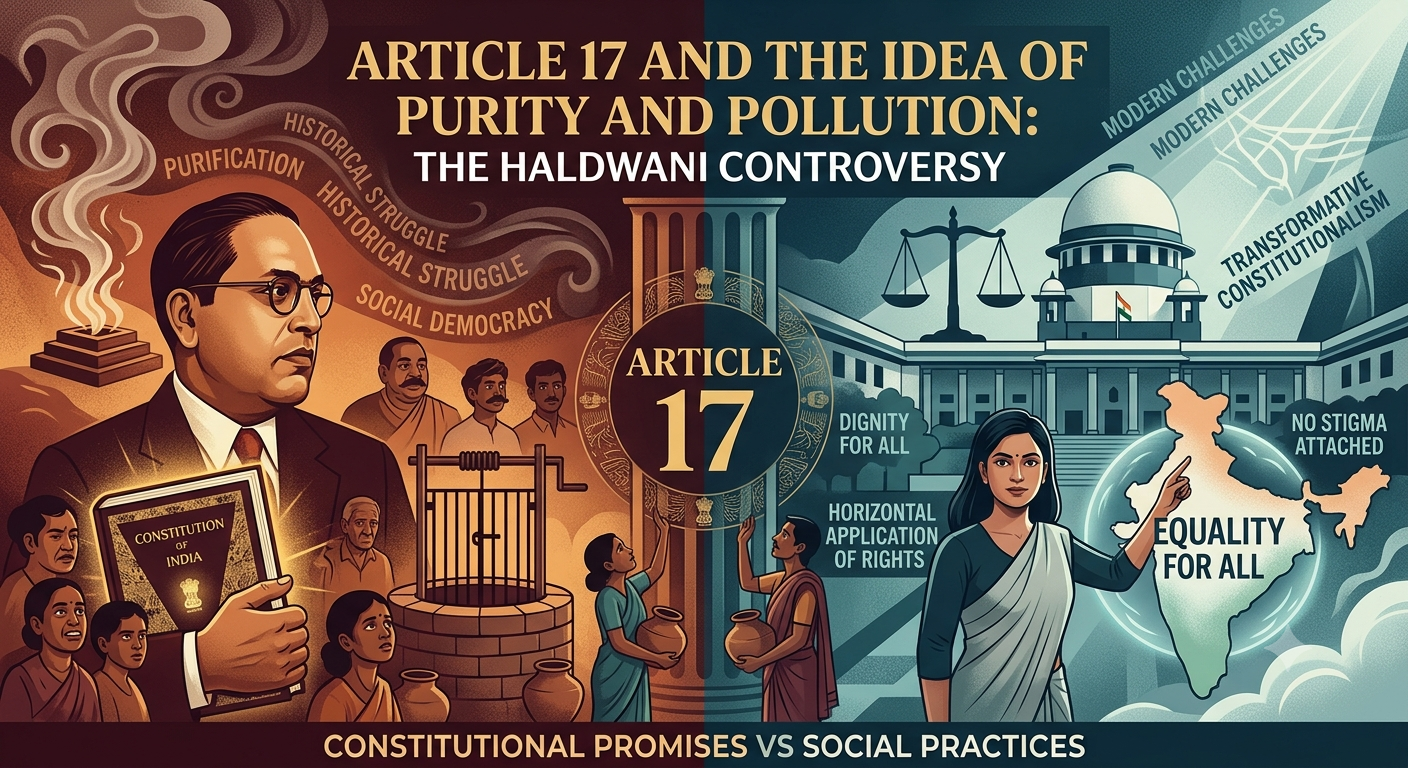
In 1927, Dr. B.R. Ambedkar led a famous civil rights march to a public water tank in Mahad. At the time, Dalits were banned from using it. When Dr. Ambedkar and his followers drank the water to claim their equal rights, dominant caste groups responded by performing a ritual to “purify” the tank.
They weren’t worried about germs in the water; they were acting on the harmful, traditional belief that contact with certain castes is spiritually polluting. Untouchability isn’t just about refusing to touch someone; it is also about treating a person’s very presence as a contamination.
How Article 17 Protects Dignity
To destroy this oppressive system, the creators of the Indian Constitution wrote Article 17. This rule is short but incredibly powerful: it completely bans untouchability in all its forms.
Here is why Article 17 is so unique:
It applies to everyone: Most fundamental rights protect you from the government. Article 17 protects you from private citizens, businesses, and organizations too. No one can say, “We aren’t the government, so we can do what we want.”
No religious excuses: Some laws have exceptions, but Article 17 has none. You cannot use tradition, custom, or religious freedom to justify treating someone as an untouchable.
It adapts to modern times: The Constitution deliberately never defined the exact word “untouchability.” Discrimination is sneaky and changes forms over time. By leaving it broad, the law ensures that whether someone is denied water in the 1920s or targeted by a modern “cleansing” ritual today, the core offense is still illegal.
What the Courts Say
Indian courts have repeatedly stepped in to protect human dignity over the years.
No Stigma Attached: In a major 2024 Supreme Court case regarding caste-based labor in prisons, the court made a massive ruling: no stigma can be attached to the mere existence, touch, or presence of any human being.
Equal Access: In older cases, courts have struck down rules that forced Dalits to undergo special purification rituals before entering temples, proving that equal access cannot come with degrading conditions.
Balancing Religion and Equality
India is a free country, and citizens have the right to practice their religion, perform rituals, and use holy water. The Constitution does not have a problem with faith.
However, religious freedom cannot be used as a mask for caste discrimination. The government’s job is not to judge if a ritual is religiously correct, but to ensure it isn’t being used as a weapon to humiliate another citizen.
Conclusion
So, did the Haldwani incident break the law? Legally, that depends entirely on the evidence.
Performing a ritual on its own is not a crime. However, if an investigation proves that the organizers performed the ritual specifically to send a message that the Dalit leader’s presence contaminated the space, it crosses the line from a religious act to a constitutional crime under laws like the SC/ST Atrocities Act.
The Indian Constitution settled this debate decades ago: no citizen is untouchable, and no one’s birth is a pollution.