




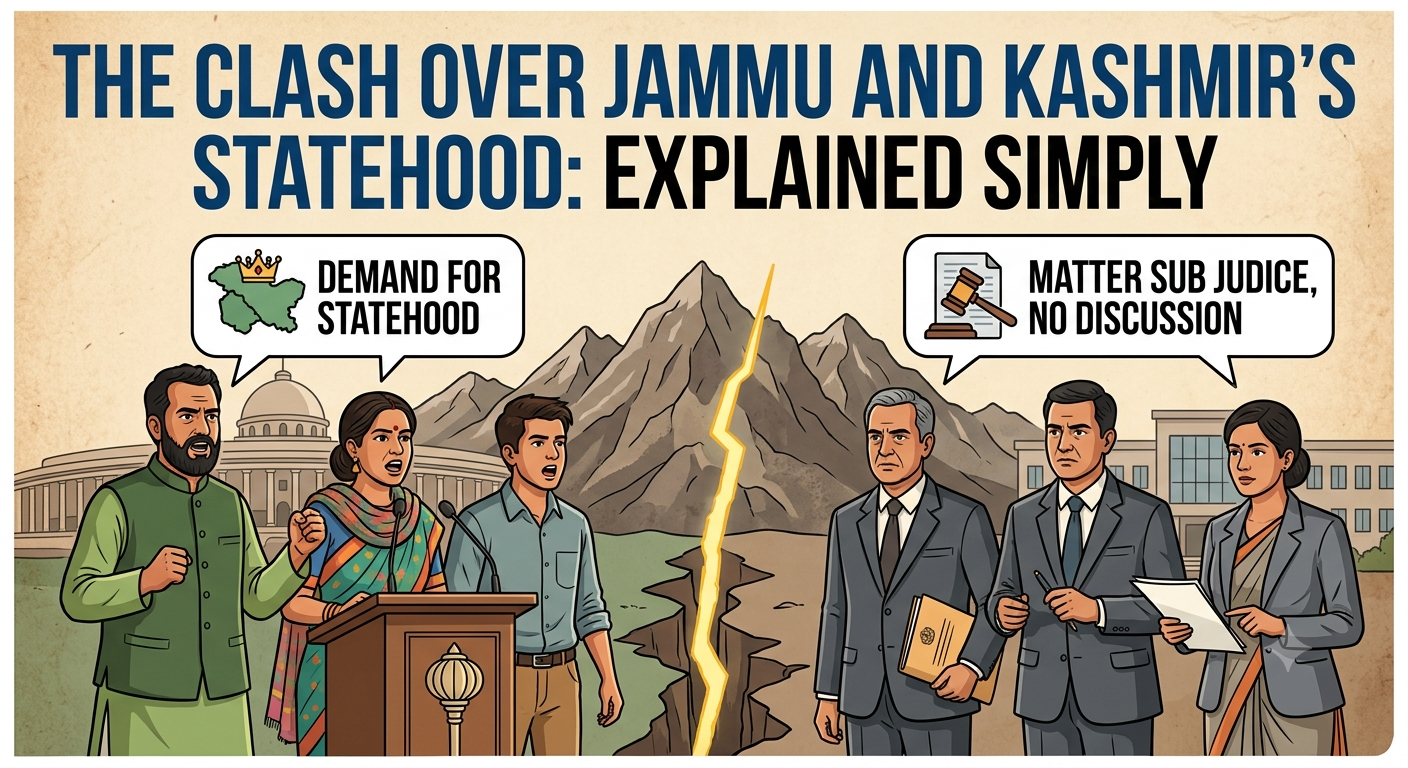
Leaders in Jammu and Kashmir (J&K) have been asking to become a full state again since 2019. Recently, they tried to take a formal step toward this goal, but it led to a surprising clash. Instead of political parties fighting, this time it is a conflict between elected leaders and government officers (bureaucrats).
Here is a simple breakdown of what happened, why it matters, and what it means for the region.
What Exactly Happened?
The current Chief Minister of J&K, Omar Abdullah, brought forward a formal proposal (called a resolution) in the local parliament, asking the central government to give J&K its statehood back.
The assembly accepted the proposal, which meant the leaders were going to debate and vote on it. However, before they could even talk about it, two top government officers—the Chief Secretary and the Law Secretary—stepped in. They wrote letters saying the assembly shouldn’t discuss the topic because the issue is currently being looked at by the courts.
Why Are People Upset?
This action by the officers caused a massive uproar because it breaks a basic rule of democracy: the separation of powers.
Officers Trying to Control Leaders: Government officers are meant to follow and apply the laws, not make them. The assembly is a place where elected leaders make decisions. When officers try to stop a discussion in the assembly, it looks like they are interfering with the powers of elected leaders.
Skipping the Boss: To make matters more complicated, the Chief Minister is also the Law Minister. This makes him the direct boss of the Law Secretary. Yet, the Law Secretary sent the letter without telling the Chief Minister first.
Why Does J&K Want Statehood Back?
To understand why this is a big deal, we have to look back at 2019. That year, J&K lost its special rules and was turned from a full “State” into a “Union Territory” (UT).
While a state has a lot of power to run its own affairs, a Union Territory has much less. Right now in J&K, the Lieutenant Governor—who is appointed by the central government—controls major areas like the police and public safety. The elected leaders want statehood back so they can have the full power to govern their region and answer to the people who voted for them.
What Happens Next?
The officers argue that since the courts are looking into J&K’s status, the leaders shouldn’t talk about it. But others argue that while courts decide what is legal, the assembly is just trying to express what the people want.
Meanwhile, the Central Government has promised that J&K will become a state again at the “right time.” However, they haven’t given an exact date, noting that security and peace in the area must be considered first.
The Big Picture
This event is more than just a disagreement over a meeting. It brings up a huge question for democracy: should unelected government officers have the power to stop elected leaders from doing their jobs? How this is handled will shape the future of how laws and politics work in Jammu and Kashmir.