

The V-Dem (Varieties of Democracy) Index is a major global report that checks the health of governments around the world. It looks beyond the surface to see if a country is truly democratic or if it is slowly moving toward strict, one-sided control.
Recently, the 2026 report was discussed in the news, bringing up important points about the current state of India’s democracy.
The Basics: Democracy vs. Autocracy
To understand the report, it is helpful to know the difference between two opposite styles of government:
Autocracy: This is a system where one person or a very small group holds all the power. They like to control everything and do not allow others to question their decisions.
Democracy: This system is built on sharing power. The government is run “by the people and for the people.” Instead of one person holding all control, power is spread out among different levels of government and the citizens.
India’s Score in 2026
The 2026 V-Dem report shows that democratic rights in India have been slowly decreasing.
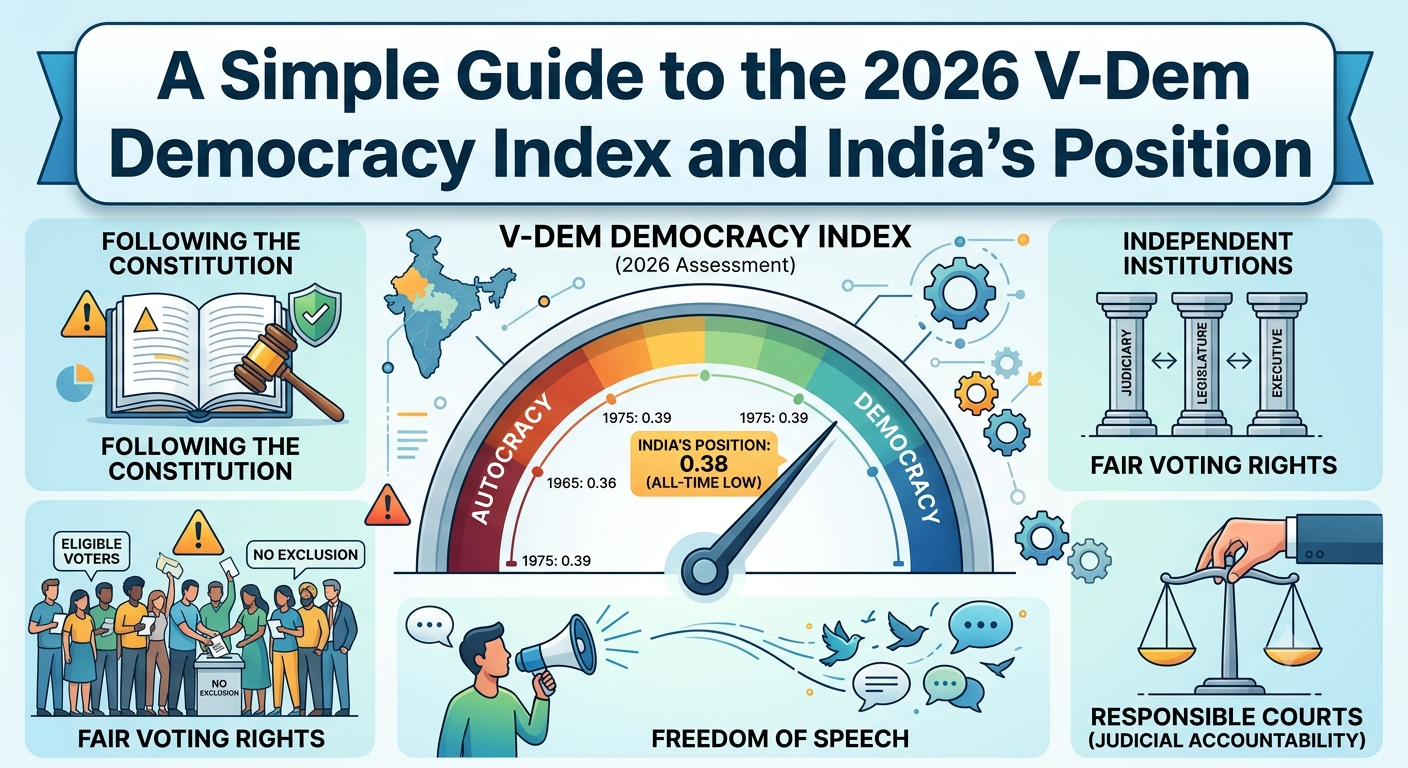
To give a clear picture, the report compares today’s numbers with the past. In the year 1975, India’s score on this index was 0.39. In the 2026 report, that score has dropped to 0.38.
While a drop of 0.01 might look very small, it actually points to a slow, continuous decline over the years. According to the data, this score represents an all-time low for democratic rights in the country.
What Does the Report Check?
The V-Dem index doesn’t just look at whether a country holds elections. It looks at how the country runs on a daily basis. Here are the main areas where a country needs to do well to be considered a strong democracy:
Following the Constitution: A true democracy respects its rulebook (the Constitution). New laws must follow these rules, and no single person should be allowed to bypass them.
Independent Institutions: Government departments and agencies need to be able to do their jobs freely. If the people making the rules are also the ones secretly controlling the watchdogs, the system becomes unfair.
Fair Voting Rights: A healthy democracy includes everyone. The report highlights the danger of “voter exclusion”—situations where regular, eligible citizens suddenly find their names removed from the voting lists and are stopped from voting.
Freedom of Speech: People must be allowed to speak their minds safely. This includes the freedom to share academic ideas and cultural expressions.
Responsible Courts (Judicial Accountability): The justice system must be fair, transparent, and answerable to the public. The report noted that this is an area where India needs improvement.
Summary
In simple terms, the 2026 V-Dem Democracy Index acts like a health checkup for India’s government. It shows that while India is a democracy, there is an urgent need to protect free speech, ensure fair voting lists, and keep government institutions independent. Understanding these trends is especially useful for students and citizens who want to learn about how their country’s political system is changing.