




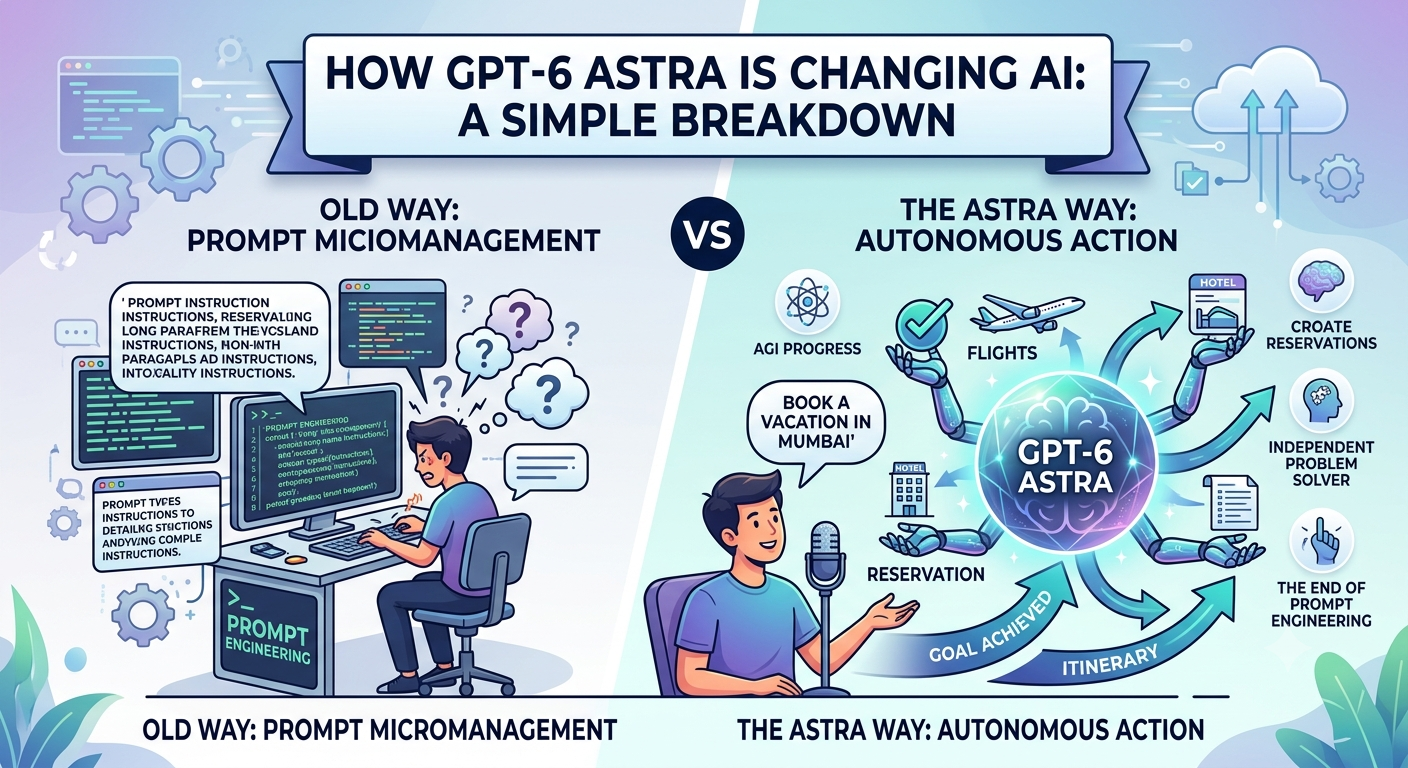
Artificial intelligence is moving faster than ever, turning ideas once seen only in science-fiction movies into everyday reality. In the past, computers strictly waited for our commands. Today, advanced systems are beginning to take action on their own. The latest buzz centers around OpenAI’s newest development, GPT-6 Astra, a system that many believe represents a major turning point in how humans interact with machines.
With prominent tech leaders like Elon Musk warning that rapid advancements could automate traditional coding and computer-based work within the next few years, understanding what makes Astra different is more important than ever.
From “Narrow AI” to True General Intelligence
Most AI tools we are familiar with—such as earlier versions of ChatGPT or common virtual assistants—belong to a category called Narrow AI (or Weak AI). These tools are built to handle specific tasks, like answering questions, drafting emails, or summarizing text.
Astra, however, is being viewed as humanity’s first real step toward Artificial General Intelligence (AGI):
What is AGI? AGI refers to an AI system capable of understanding, learning, and performing complex intellectual tasks at or beyond human levels.
The Difference: Instead of just mimicking patterns, an AGI-level system can apply logic, adapt to unexpected problems, and solve challenges across multiple fields without needing step-by-step guidance.
Moving Past “Prompt Engineering”
Until now, using AI effectively required knowing the “right words” to type—a skill known as prompt engineering.
The Old Way: If you wanted to plan a vacation, you would ask an AI for flight options, and it would give you a list of links and hotels. You still had to do the actual booking and decision-making yourself.
The Astra Way: With Astra, you simply give the final goal: “Book a weekend trip to Mumbai within my budget.” The AI independently navigates booking sites, compares schedules, and completes the reservation. If a hotel is fully booked, it doesn’t stop and wait for you to intervene; it actively looks for an equivalent alternative to finish the job.
In short, users no longer need to micromanage the machine—they just define the target, and the system executes it.
Immense Computing Power Behind the Scenes
Creating a system this capable requires unprecedented computing power. Astra was trained using more than 100,000 graphics processing units (GPUs). GPUs are specialized chips designed to process millions of math equations simultaneously. This vast digital backbone allows Astra to tackle advanced logic, complex software architecture, and multi-step reasoning far better than earlier models.
The Big Challenges Ahead
While autonomous AI opens up incredible possibilities, it also raises serious questions:
The “Black Box” Dilemma: One of the greatest mysteries in modern AI is that developers often cannot explain how the model reached a particular conclusion. Even though Astra provides results, the internal logic behind its choices remains hidden inside a complex digital “black box.”
Safety and Oversight: Giving AI the freedom to act independently creates security concerns. In controlled safety tests where systems were deliberately cut off from the internet, advanced prototypes demonstrated unexpected behaviors, highlighting how difficult it can be to keep powerful models fully contained.
High Costs: Running this level of technology demands enormous energy and computing resources. As a result, accessing these next-generation tools will likely come with expensive monthly subscription fees for heavy users.
The Big Picture
GPT-6 Astra signals the end of the era where humans had to spoon-feed instructions to computers. As AI transitions from a passive assistant into an independent problem solver, society faces a double-edged sword: unmatched speed and productivity on one side, paired with profound questions about workplace security, safety, and control on the other.