




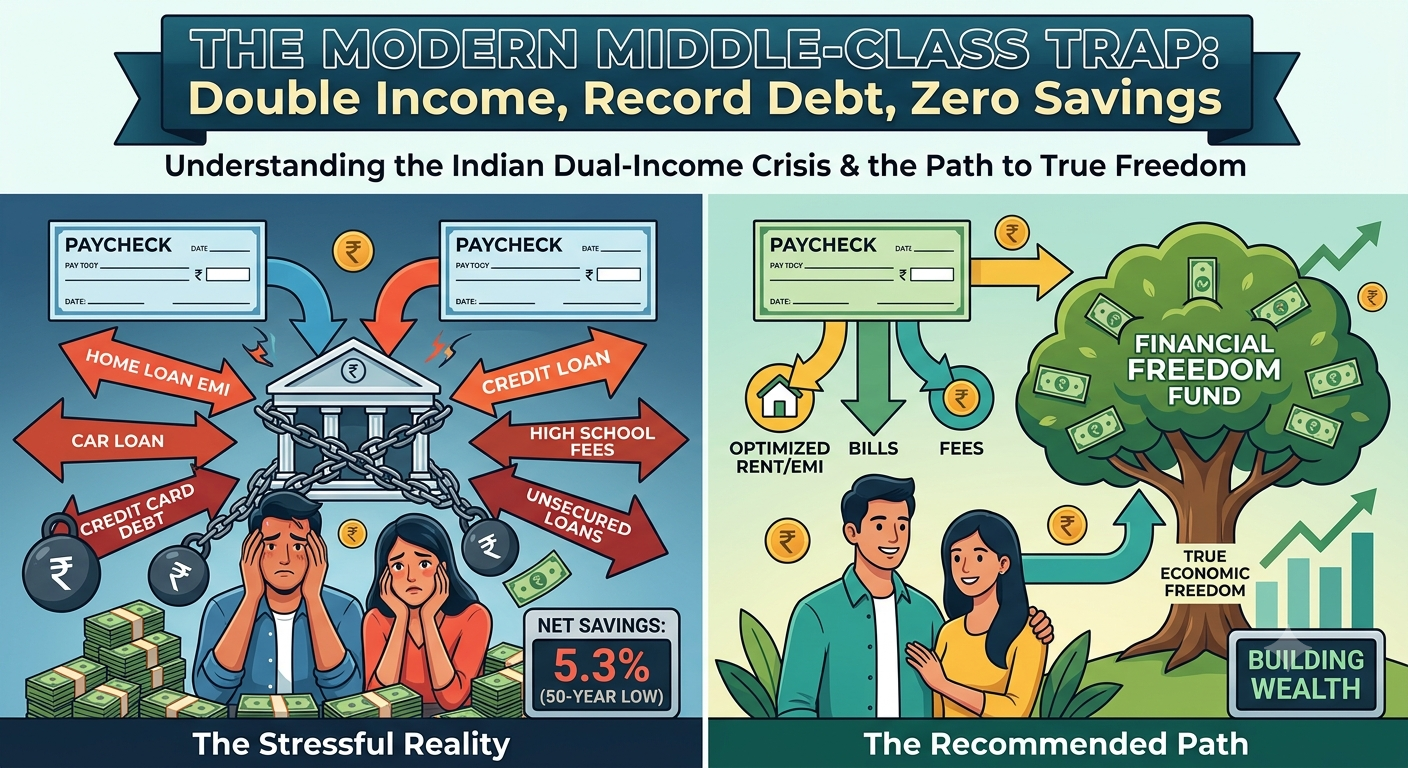
A couple of decades ago, a single paycheck was often enough to comfortably sustain a middle-class family. One income covered rent, daily groceries, and education, usually leaving enough behind to build a modest safety net in the bank. Fast forward to today, and the financial reality is entirely different.
Modern households frequently feature two working adults putting in grueling hours, yet their bank accounts tell a stressful story. Instead of doubled savings and financial security, many families are facing empty pockets and mounting financial obligations.
What the Numbers Reveal
Recent financial trends paint a concerning picture of middle-class wealth. Despite rising salaries and a growing economy, household savings have plummeted to historic lows, dropping from double digits just a few years ago to roughly 5.3% of the GDP.
At the same time, household debt is surging, currently sitting above 41% of the GDP. Families are not just failing to save; they are borrowing heavily just to maintain their current standard of living. This raises a critical question: why are dual-income households struggling to build wealth?
The Illusion of Affordability
The root of the problem often lies in a phenomenon economists call the “two-income trap.” When dual-income households became the norm, the extra money was rarely funneled into savings. Instead, it triggered a societal bidding war.
As more families suddenly had double the purchasing power, the cost of essentials—specifically housing in safe neighborhoods and access to quality education—skyrocketed. The second paycheck is not buying luxury; it is simply covering the newly inflated cost of basic, respectable living.
Furthermore, modern dual incomes often buy “eligibility” rather than true affordability. A higher combined salary makes a family eligible for a massive home loan, a premium car installment, and international school fees. However, qualifying for a loan is very different from being able to genuinely afford the lifestyle without living paycheck to paycheck.
The Missing Financial Buffer
Historically, a single-income household possessed a hidden safety net: the non-working partner. If a financial crisis hit, the stay-at-home partner could enter the workforce to generate emergency income, or take over household tasks to drastically cut expenses.
Today’s dual-income families often operate without this buffer. Both paychecks are entirely spoken for, locked into rigid monthly commitments like heavy EMIs, subscriptions, and childcare costs. If one partner loses a job or faces a medical emergency, the household’s entire financial structure is immediately at risk of collapse.
A Blueprint for True Financial Freedom
The answer to this crisis is not to step back from the workforce, as dual-income households have the potential to build incredible wealth if managed correctly. The key is to stop the market from absorbing that second paycheck.
Here is a practical framework to regain financial control:
Anchor Your Life to One Income: Design your baseline lifestyle around the higher of your two salaries. Your rent or mortgage, utility bills, groceries, and school fees should comfortably fit within this single paycheck.
Weaponize the Second Income: Treat the second salary as if it doesn’t exist for daily spending. Automate this money directly into retirement accounts, aggressive debt repayment, and an emergency fund that covers at least a year of expenses.
Rethink Your Location: Housing is the biggest wealth-killer. Instead of stretching your budget to buy in the most expensive, highly sought-after zip codes, look slightly outside these premium zones. Living just a few miles away or one transit stop further can slash your housing costs drastically, allowing you to invest the difference for an early retirement.
You cannot control the rising costs of real estate or education, but you have absolute control over your fixed monthly commitments. By refusing to inflate your lifestyle to match your combined income, you can transform that second salary from a tool for survival into a ticket to genuine financial independence.