




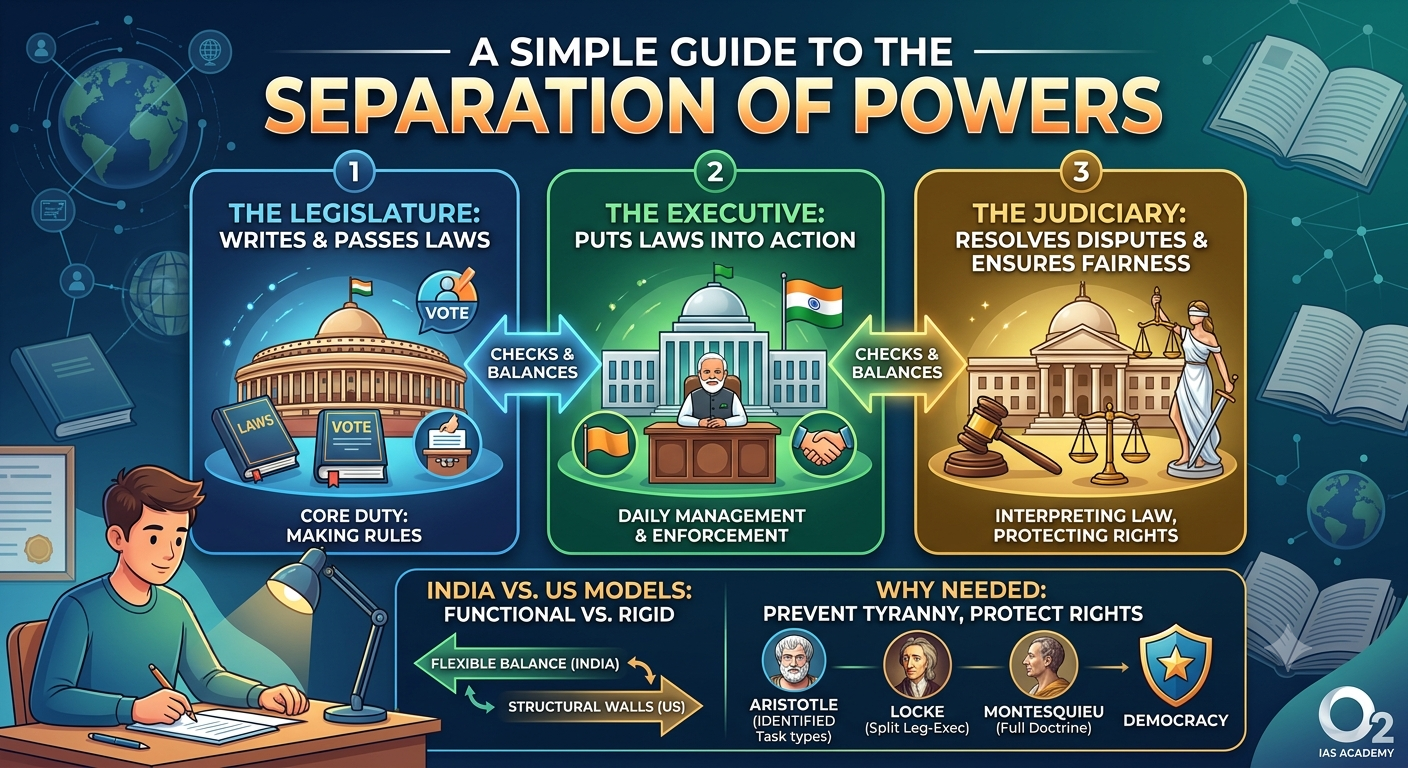
Every modern government essentially performs three main jobs. The idea behind the “Separation of Powers” is that these jobs should be handled by three distinct groups so that no single person or group gains too much control.
The Legislature: This is the branch that writes and passes the laws.
The Executive: This branch is responsible for putting those laws into action and running the country day-to-day.
The Judiciary: These are the courts that resolve disputes and ensure the laws are applied fairly.
The golden rule is that the group writing the rules should not be the same group enforcing them or acting as the judge when rules are broken.
How the Idea Developed
The concept of dividing government power didn’t happen overnight. It evolved through the ideas of several famous thinkers:
Aristotle: Long ago, he observed that a state has three different types of tasks. However, he didn’t suggest that these tasks needed to be handled by separate groups.
John Locke: Centuries later, Locke argued that the people who make the laws and the people who enforce them should be different. But he missed the final piece of the puzzle: he didn’t give the courts a separate role.
Montesquieu: He is the thinker who finalized the theory. He warned that if one single group had the power to make the rules, enforce them, and judge the rulebreakers, the public would lose their freedom completely.
Why It Matters in Today’s World
The primary goal of dividing power is to prevent tyranny and protect the rights of all citizens, including minority groups.
However, running a modern country is highly complicated. Having completely strict, rigid walls between the three branches—a model the US leans toward—isn’t always practical.
Flexibility: Sometimes, government agencies need the speed and specialized knowledge to make quick regulatory decisions, which strict separation can slow down.
Keeping Watch: Instead of totally isolated branches, a healthy democracy relies on “checks and balances.” For example, the courts must have the authority to step in if the executive branch tries to enforce a law unfairly or unconstitutionally.
Core Duties: Even with flexibility, the most important jobs—like passing major laws—must stay with the legislature and shouldn’t be handed off to the executive branch.
Summary
Unlike a rigid system, India uses a practical and flexible approach to separating powers. The three branches have distinct jobs but remain connected to keep a watchful eye on one another. Understanding this balance between strict separation and practical teamwork is the key to mastering this topic for your exams.
How familiar are you with the specific ways the Indian Judiciary acts as a “check” on the other branches of government?