




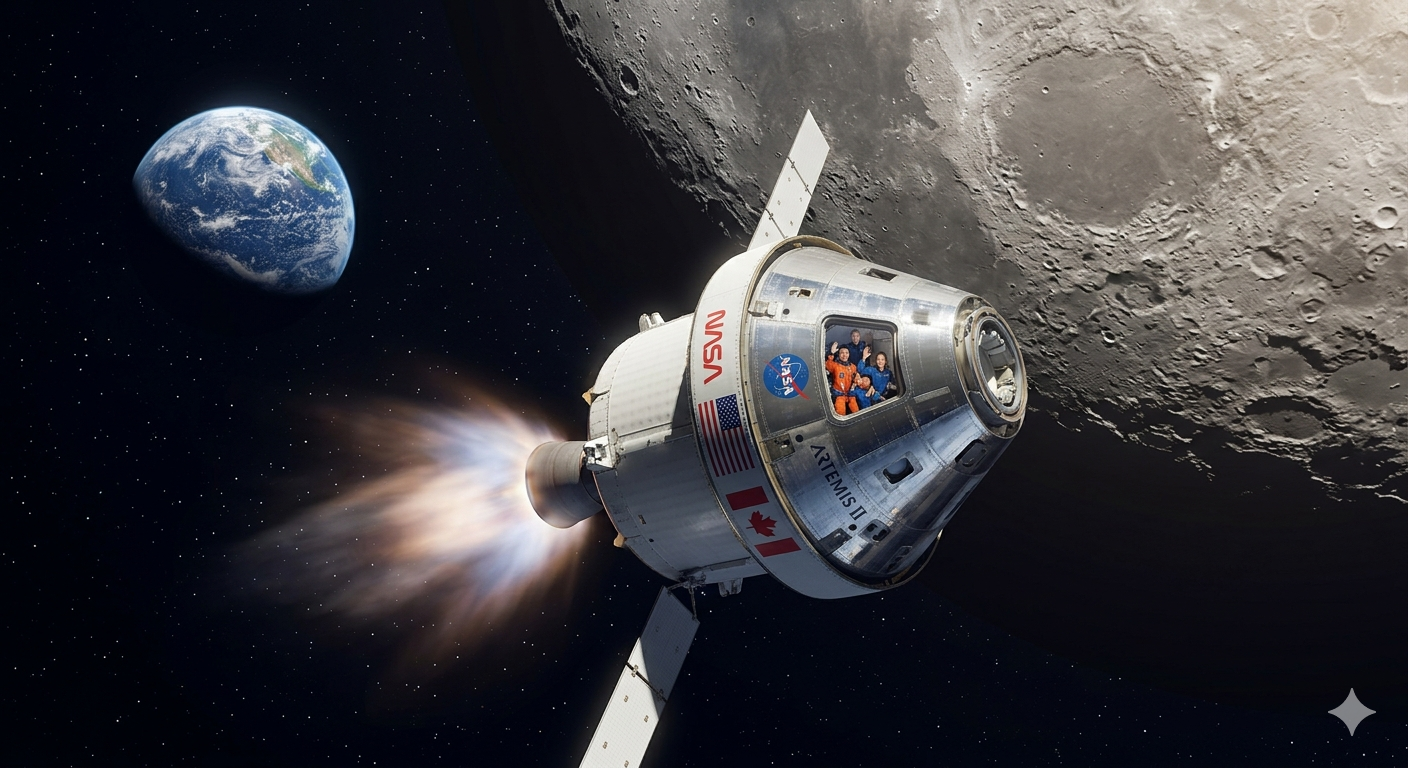
For the first time in over 50 years, humanity is heading back to the Moon. While the famous Apollo missions of the 1960s and 70s paved the way, NASA’s new Artemis II mission marks a bold new chapter in space exploration. Here is everything you need to know about this historic journey in simple terms.
What is Artemis II?
Artemis II is the first mission in NASA’s new lunar program to carry a human crew. It follows Artemis I, which was an uncrewed test flight that proved the rocket and spacecraft could safely travel to the Moon and back.
Unlike the upcoming Artemis III (which aims to land people on the surface), Artemis II is a “flyby” mission. This means the astronauts will travel around the Moon, testing all the life-support systems in deep space before we attempt a landing.
Meet the Historic Crew
The four-person crew represents a major milestone for diversity in space. The team includes:
Christina Koch: The first woman to travel into deep space.
Victor Glover: The first Black astronaut assigned to a lunar mission.
Jeremy Hansen: A Canadian astronaut, making this the first time a non-American has traveled beyond Earth’s orbit.
Reid Wiseman: The mission commander leading the flight.
The Journey: From Florida to the Pacific
The mission starts at the Kennedy Space Center in Florida. After launching, the spacecraft will first orbit the Earth to ensure everything is working correctly. Once cleared, it will head toward the Moon.
The spacecraft won’t orbit the Moon like a satellite; instead, it will use a “free return trajectory.” This is a clever safety feature where the Moon’s own gravity acts like a slingshot, naturally pulling the capsule back toward Earth even if the engines were to fail. The journey ends with a “splashdown” in the Pacific Ocean, where the crew will be recovered by the U.S. Navy.
The Technology: SLS and Orion
To get to the Moon, NASA is using two incredible pieces of technology:
The Space Launch System (SLS): Currently the most powerful rocket ever built, designed to carry heavy loads into deep space.
The Orion Spacecraft: The capsule where the astronauts live. It is built to withstand extreme radiation and the incredible heat of re-entering Earth’s atmosphere at speeds of over 25,000 miles per hour.
Why are we going back?
You might wonder why we are returning to the Moon after five decades. It’s not just about “planting flags” this time. The goals are much bigger:
A Permanent Base: NASA wants to build a long-term presence on the Moon where humans can live and work.
Gateway to Mars: The Moon will serve as a “gas station” or testing ground. If we can learn to survive on the Moon, we can eventually send humans to Mars.
Science and Research: Astronauts will study how deep space affects the human body and collect data that isn’t possible from Earth.
The New Space Race: With countries like China also planning moon bases by 2030, there is a renewed global interest in leading the way in space.
Conclusion: What’s Next?
Artemis II is the ultimate “test drive.” If successful, it clears the path for Artemis III, which will see the first woman and person of color step onto the lunar surface. We are no longer just visiting the Moon; we are preparing to stay and explore the stars beyond.