




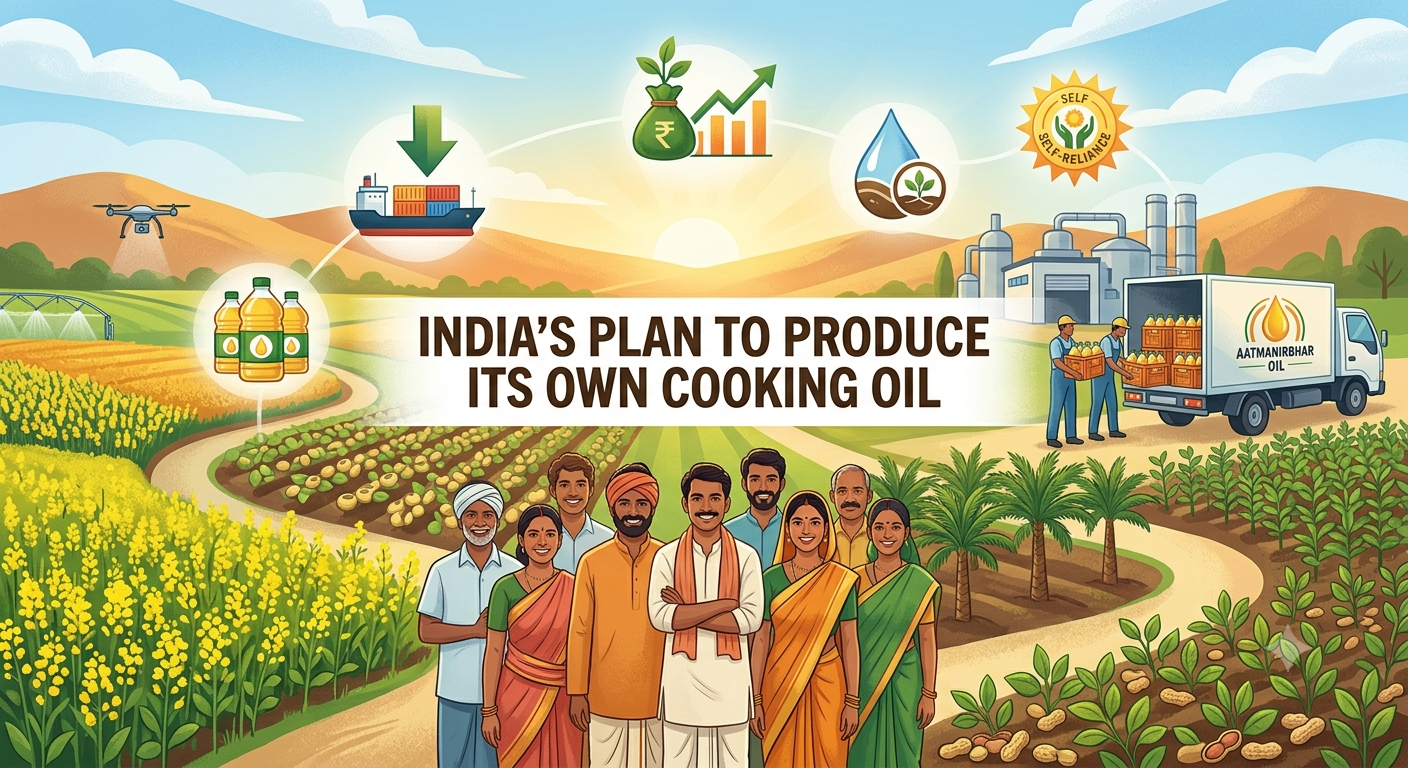
Cooking oil is an essential part of the daily Indian diet, providing necessary fats, energy, and vitamins. Growing oil-producing plants (oilseeds) is also a major way for millions of farmers to earn a living. However, India currently consumes much more cooking oil than it produces.
Today, the country only grows about 44% of the edible oil it needs. To meet the rising demand, India has to import over 56% of its oil from other countries, bringing in over 15 million tons in recent years. Relying this much on imports drains foreign money reserves and makes local food prices unstable when global supplies are disrupted. Another challenge is that about 76% of India’s oilseed crops depend entirely on natural rainfall, making them vulnerable to bad weather. Additionally, production is mostly limited to just four states: Rajasthan, Madhya Pradesh, Gujarat, and Maharashtra.
To fix this problem, the Indian government launched the National Mission on Edible Oils – Oilseeds in 2024. Backed by a budget of ₹10,103 crore, this seven-year plan aims to make India fully self-reliant in cooking oil by the year 2031. The initiative focuses on increasing the harvest of common oil crops like mustard, soybean, and groundnut, while also extracting more oil from secondary sources like rice bran, cotton seeds, and tree-borne seeds.
The mission outlines several major steps to boost domestic production:
Expanding Palm Oil: The government plans to increase oil palm farming to cover 6.5 lakh hectares by 2025-26.
Farming Unused Land: Farmers are being encouraged to grow oil crops on empty or unused agricultural land, especially in eastern parts of India.
Direct Support for Farmers: The program has set up over 600 special farming groups across the country. In these zones, farmers receive free, high-yielding seeds and training on modern, safe farming techniques.
Improving Facilities: The plan funds the creation of 65 new seed hubs and 50 storage units. It also helps build better processing centers so that less of the crop is wasted after it is harvested.
Tracking Seed Quality: A new online portal called SATHI is being used to make sure farmers get genuine, high-quality seeds.
Producing more cooking oil at home will protect India’s economy by saving the money currently spent on foreign imports. It will also create new rural jobs in farming, transportation, storage, and factory processing. Furthermore, growing oilseeds is environmentally friendly because these crops require much less water than many other plants and naturally help improve soil health. Ultimately, this mission aims to secure India’s food supply while putting more money directly into the hands of local farmers.