




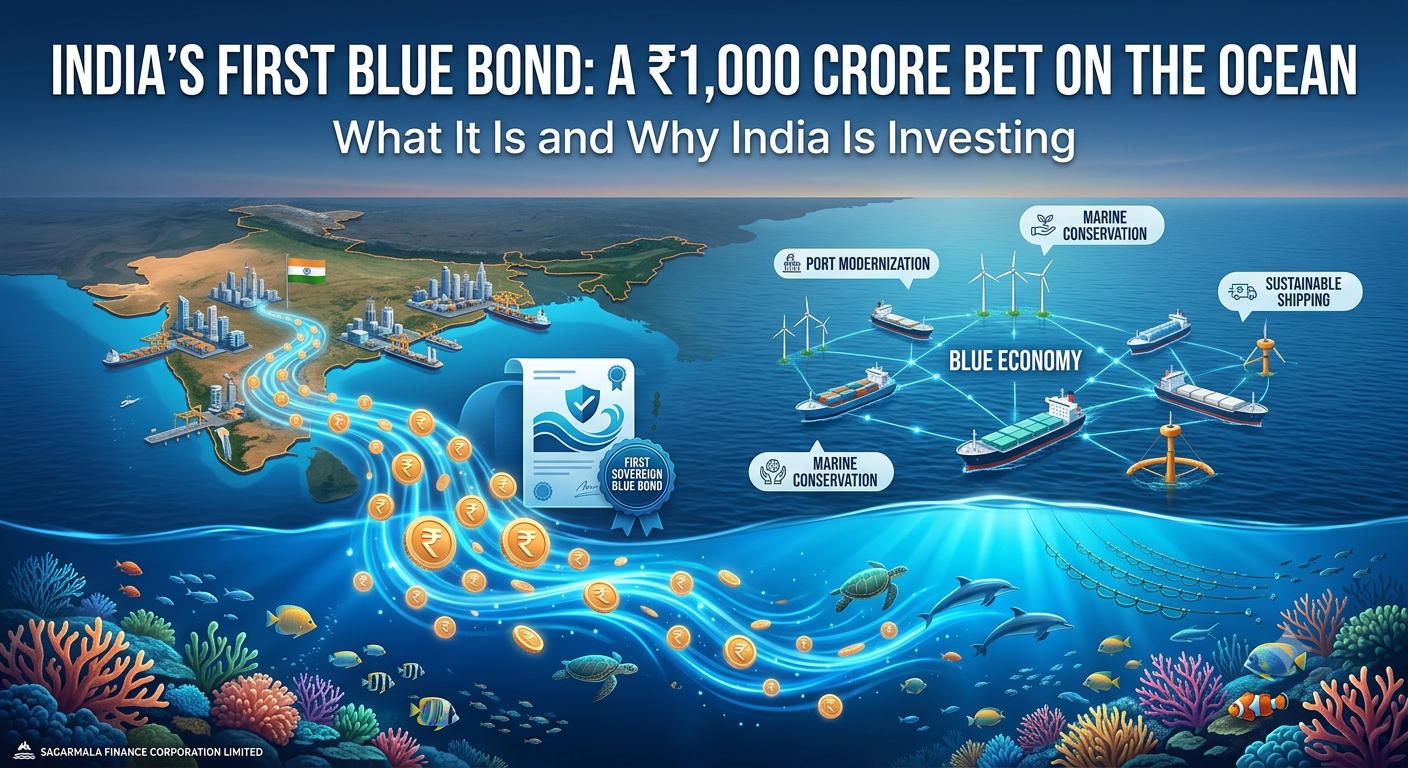
India is surrounded by water on three sides, which means the ocean plays a massive role in the country’s economy. To grow this “blue economy” without harming the environment, India is launching its very first Blue Bond worth ₹1,000 crore.
But what does this mean, and why is it important? Here is a simple breakdown.
What is a Blue Bond?
Think of a bond like an official loan or an IOU. When people or companies buy a bond, they are lending their money to an organization—like the government. In exchange, the organization promises to pay them back later, plus extra money called interest.
A Blue Bond works the exact same way, but with one strict rule: the money collected can only be used for projects that protect oceans, marine life, and coastal areas.
Why is India Doing This Now?
The Indian government is running a massive project called Sagarmala. Started in 2015, its goal is to upgrade India’s ports, make sea travel smoother, and improve the lives of people living near the coast.
However, building big things like ports takes a lot of time and a huge amount of money. The whole Sagarmala project needs around ₹6 lakh crore, and the government still needs to raise a lot of these funds. To help cover this gap, a government-backed company called the Sagarmala Finance Corporation Limited (SMFCL) is issuing this ₹1,000 crore Blue Bond.
The Benefits of Going “Blue”
Raising money this way has a few big advantages for India:
Time to Build: Big construction projects take years. Blue bonds give companies a long time to pay back the borrowed money.
Beyond Banks: Instead of relying only on banks for loans, this invites money from specific investors who care deeply about the environment.
The Hidden Risks
Even though it sounds great, blue bonds have two main challenges:
“Blue Washing”: This happens when an organization takes the money meant for the ocean but uses it for regular, non-eco-friendly projects. To stop this cheating, the government has to keep strict records to prove exactly how the money is helping nature.
Hard to Measure: It is easy to measure the success of a solar plant, but it is much harder to put a price tag on a healthy coral reef or a growing fish population. Because ocean health is tricky to measure in terms of money, some investors feel blue bonds are riskier than standard eco-friendly investments (known as green bonds).
Looking Ahead
While India is just starting, other countries like the Seychelles have been using blue bonds since 2018.
Since 95% of India’s trade (by amount of goods) travels across the sea, having modern, nature-friendly ports is an absolute must. While ₹1,000 crore is just a small drop in the ocean compared to what is fully needed, it is a massive first step. It proves that India is ready to grow its shipping businesses while taking real steps to protect our planet’s waters.