



When India wrote its Constitution, the creators included a special section called the Directive Principles of State Policy (DPSP). Inspired by the Constitution of Ireland, these principles act as a guidebook for the government. Their main goal is to help India become a “welfare state”—a country that works to ensure fairness, equality, and a good quality of life for all its citizens.
One unique thing about these rules is that you cannot take the government to court if it fails to follow them. However, the Constitution clearly states that the government must keep these goals in mind whenever it makes new laws or policies.
Why Were These Guidelines Needed?
When India gained independence, it was facing massive challenges. After nearly 200 years of British rule, the country was left with extreme poverty, hunger, and massive gaps between the rich and the poor. The people who wrote the Constitution knew the new government would need a clear roadmap to fix these deep-rooted problems and build a fair society.
The Three Main Goals of the Principles
To make things easier to understand, these guidelines can be broken down into three main categories based on what they are trying to achieve:
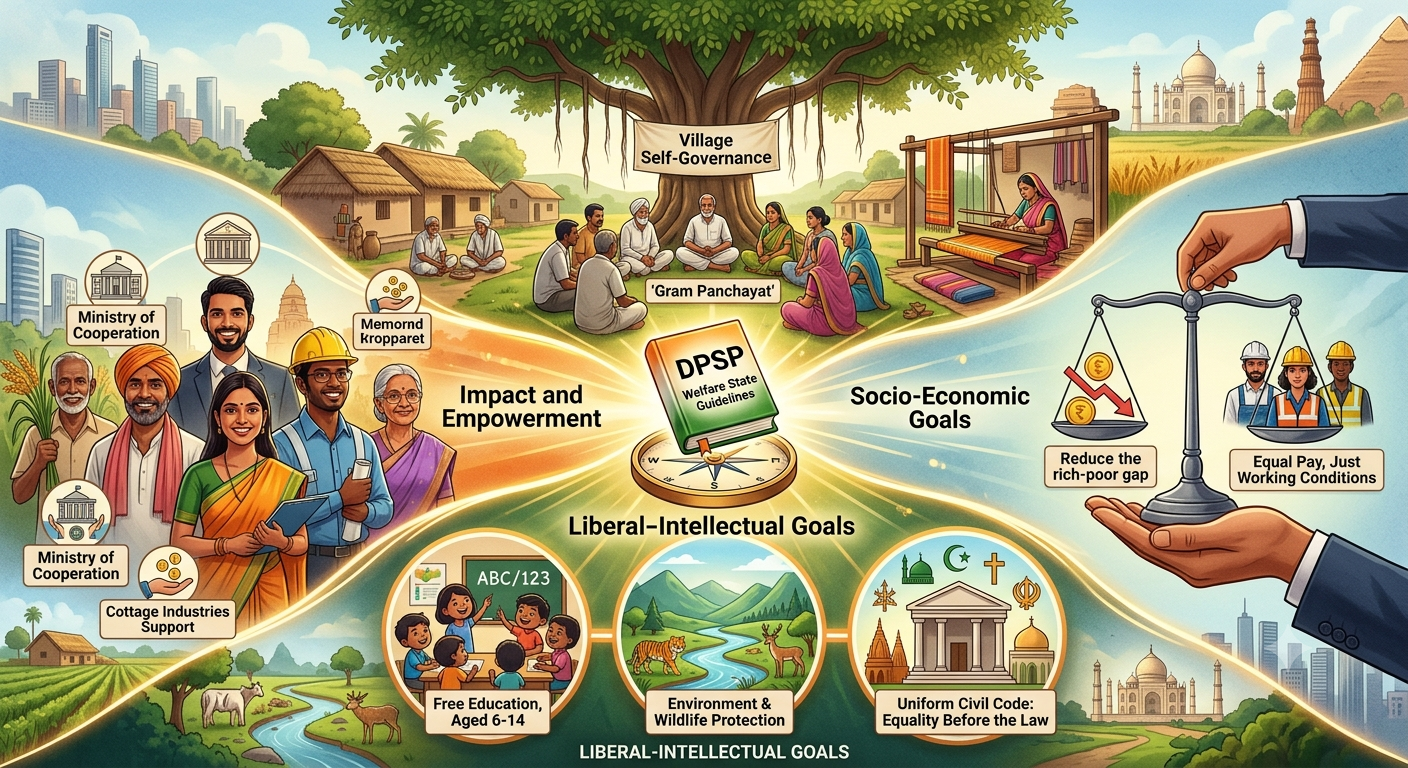
Fairness in Wealth and Work (Socio-Economic Goals): These rules tell the government to reduce the gap between the rich and the poor. They ask the government to ensure that both men and women get equal pay for equal work, that people have safe working conditions, and that wealth isn’t controlled by just a few powerful people.
Empowering Communities (Gandhian Goals): Based on Mahatma Gandhi’s ideas, these directives focus on the grassroots level. They encourage the government to set up local village councils (Gram Panchayats), support small local businesses and cottage industries, and protect the rights and education of weaker sections of society.
Modern and Progressive Ideas (Liberal-Intellectual Goals): This category pushes for a more modern country. It includes protecting the environment and wildlife, providing early childhood education, preserving historical monuments, and aiming for a Uniform Civil Code.
How the Rules Have Grown Over Time
As the country changed, the government updated the Constitution to add more important goals:
Protecting the Environment & Free Legal Help: In 1976, new rules were added to protect forests and wildlife, and to ensure poor people could get free legal aid.
Education as a Right: In 2002, a major change was made regarding education. What was once just a guideline became a strict fundamental right, ensuring all children aged 6 to 14 receive free and compulsory education.
Putting the Rules into Action
Over the years, the government has created many real-world laws based on these guidelines:
Land Reforms: The government broke up large estates owned by wealthy landlords and distributed land to poor farmers.
Local Power: The Panchayati Raj system was created in 1992, giving villages the power to govern themselves.
Protecting Nature: Strong laws like the Wildlife Protection Act were passed to save the country’s animals and forests.
Boosting Cooperatives: In 2021, the government even created a brand-new Ministry of Cooperation to help local cooperative businesses grow and succeed.
The Big Debate: The Uniform Civil Code (UCC)
One of the most talked-about guidelines is the push for a Uniform Civil Code (UCC). Right now, different religious communities in India have their own separate rules for personal matters like marriage, divorce, and inheriting property.
The goal of the UCC is to replace all these different religious laws with one single set of rules that applies equally to every citizen, regardless of their religion. The framers of the Constitution, including Dr. B.R. Ambedkar, believed this would help promote true equality and unite the country, though it remains a sensitive and debated topic today.
Why This Matters to You
Even though you can’t force the government to follow the Directive Principles, they are incredibly important for everyday citizens. Think of them as a report card. By knowing what these goals are, you can judge how well your government is performing, see where they are falling short, and use your vote to hold them accountable.