




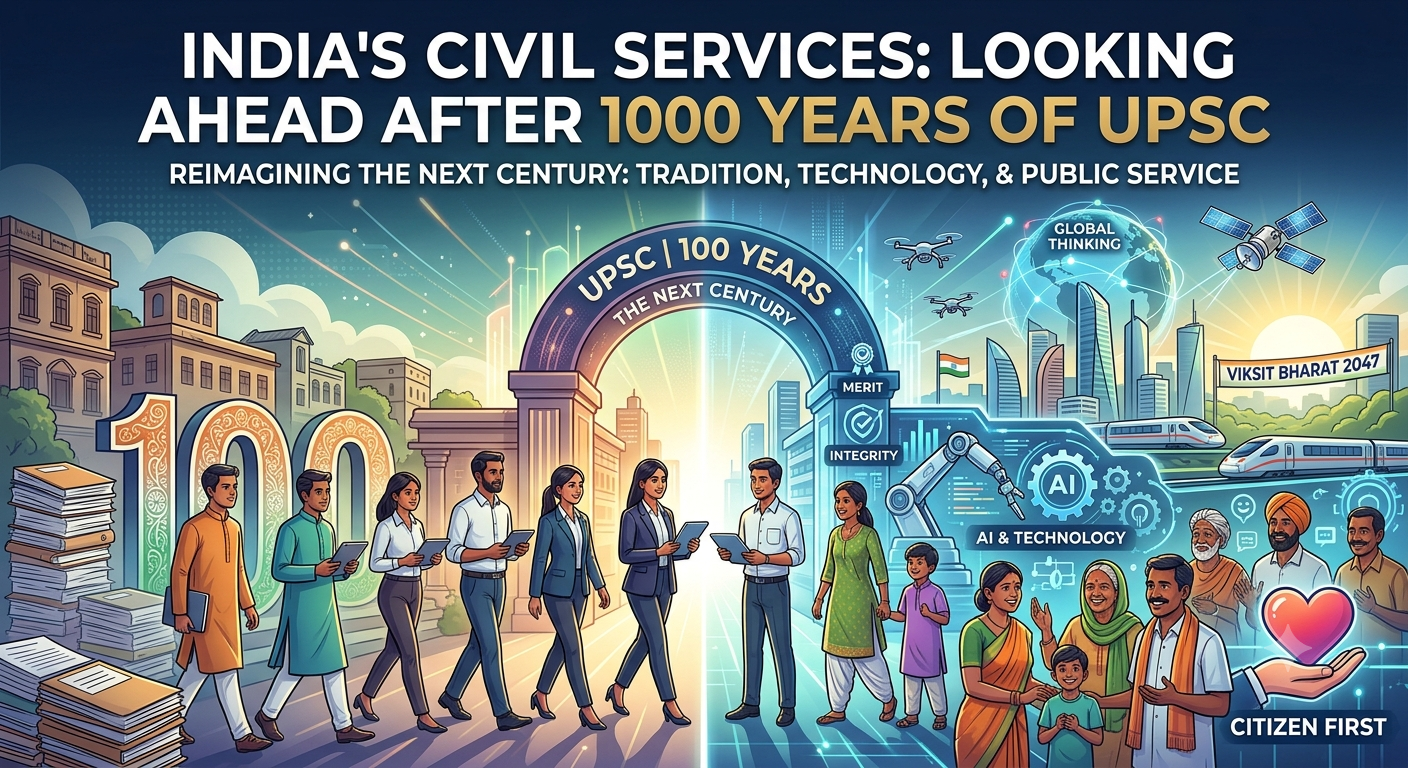
On October 1, 2026, the Union Public Service Commission (UPSC) celebrated its 100th anniversary. While the institution has a long history of selecting India’s top administrators, this milestone brings up a vital question: how must civil servants adapt for the next 100 years?
The Power of Trust
Over the last century, India has seen massive changes in leadership, rules, and technology. Through it all, the UPSC has maintained its strongest asset: the unwavering trust of millions of young aspirants. Experts agree that the institution’s reputation for fairness, independence, and merit-based selection is its greatest legacy and must be protected at all costs.
A “Citizen First” Mindset
The era of bureaucratic rule is shifting toward genuine public service. Prime Minister Narendra Modi recently emphasized that future officers must operate on two main principles: “Nation First” and “Citizen First.” Practically, this means:
Listening directly to the public’s everyday struggles on the ground.
Making government decisions easier to understand and more transparent.
Moving away from a mindset of holding power and focusing on a genuine desire to serve the community.
Upgrading How Officers Are Chosen
With millions of candidates competing for roughly a thousand jobs, the selection process needs to evolve.
Beyond Book Smarts: While written exams successfully test a candidate’s knowledge, experts believe the interview stage needs to better assess a person’s compassion, integrity, and ability to handle real-world stress.
Focusing on Character: There are suggestions to include deeper psychological testing to ensure candidates have the right “spark” and genuine enthusiasm for helping people, rather than just rehearsed answers.
Tech Skills and Global Thinking
Future civil servants will have to navigate a much more complicated world.
Artificial Intelligence: AI will be heavily used to read documents and draft policies quickly. However, officers must know how to oversee this technology so that human empathy and data privacy are never lost.
Understanding the World: Local issues like jobs, farming, and business are now deeply connected to global events. Future officers need to understand international relations and supply chains just as well as they understand local laws.
As India works toward becoming a fully developed nation by 2047, the tools and challenges of the government will completely transform. However, the core values required of a civil servant—honesty, a commitment to the people, and selection based purely on merit—must remain exactly the same.