
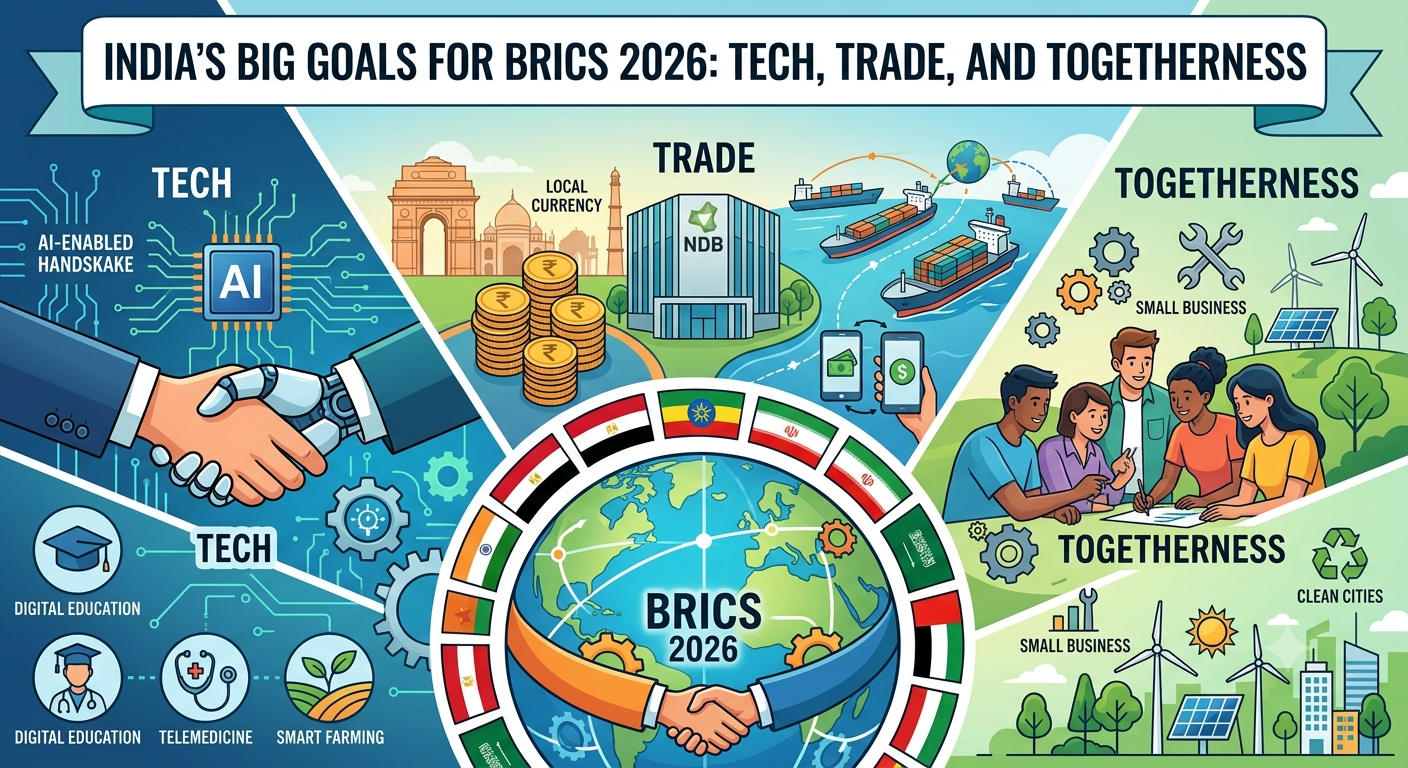
As India steps up to host the BRICS Summit in 2026, the world is facing a lot of challenges—from complex global politics to climate change and shaky supply chains. Instead of just talking about these problems, India wants to use its leadership to create real, practical solutions.
The main theme for India’s BRICS presidency focuses on four simple ideas: staying strong (resilience), thinking fresh (innovation), working together (cooperation), and protecting the future (sustainability). Here is a breakdown of what India hopes to achieve.
1. Technology That Helps Everyone
India believes that technology, especially Artificial Intelligence (AI), should be a tool that benefits everyday people, not just wealthy nations.
AI for All: Drawing inspiration from its own successful digital systems (like Aadhaar and UPI), India wants to use AI to solve basic problems in farming, healthcare, and education across developing countries.
Safe Tech: India is pushing for shared rules to make sure AI is used ethically, avoiding problems like fake news, unfair biases, and sudden job losses.
2. Fairer Trade and Financial Independence
A major goal for 2026 is to make trading between BRICS nations cheaper, faster, and less dependent on Western financial systems.
Digital Payments: By linking the digital payment systems of member countries, doing business across borders will become much easier and cheaper.
Local Money: India is encouraging the New Development Bank (the financial arm of BRICS) to give out more loans in local currencies rather than just US dollars.
Secure Supplies: To avoid shortages during global crises, India wants BRICS nations to rely on each other for essential goods like medicines, computer chips, and critical minerals.
3. Growth for the Youth and the Planet
Instead of just looking at how much money a country makes overall, India wants to focus on growth that actually improves lives.
Supporting Small Businesses: Small and medium-sized businesses are the true engines of the economy. India wants to help them grow and connect to global markets.
Youth Power: Young people shouldn’t just watch the world change; they should help build it. The focus is on giving youth the skills and funding to start their own tech and computing projects.
Going Green: Economic growth shouldn’t destroy the planet. India is pushing for investments in renewable energy and eco-friendly city planning.
4. Changing Old Global Rules
India and its BRICS partners believe that older global organizations, like the United Nations Security Council, are stuck in the past. Built in 1945, these groups give a few powerful countries the final say on global issues. BRICS is using its growing influence to demand that developing nations finally get a fair and equal voice on the world stage.
The Bumps in the Road
While the BRICS group is bigger and more powerful than ever, it isn’t without its problems. The group makes decisions by unanimous agreement—meaning everyone has to say “yes.”
Because BRICS recently added new members who have deep historical disagreements with each other (like tensions between Iran and Saudi Arabia, or Ethiopia and Egypt), getting everyone to agree on shared goals will be India’s toughest balancing act.
India’s vision for BRICS 2026 is clear: use modern technology, smart trade, and green energy to build a world where developing nations are no longer left behind.
Which of these focus areas—AI, global trade, or youth opportunities—do you think is the most important for the future of developing nations?