




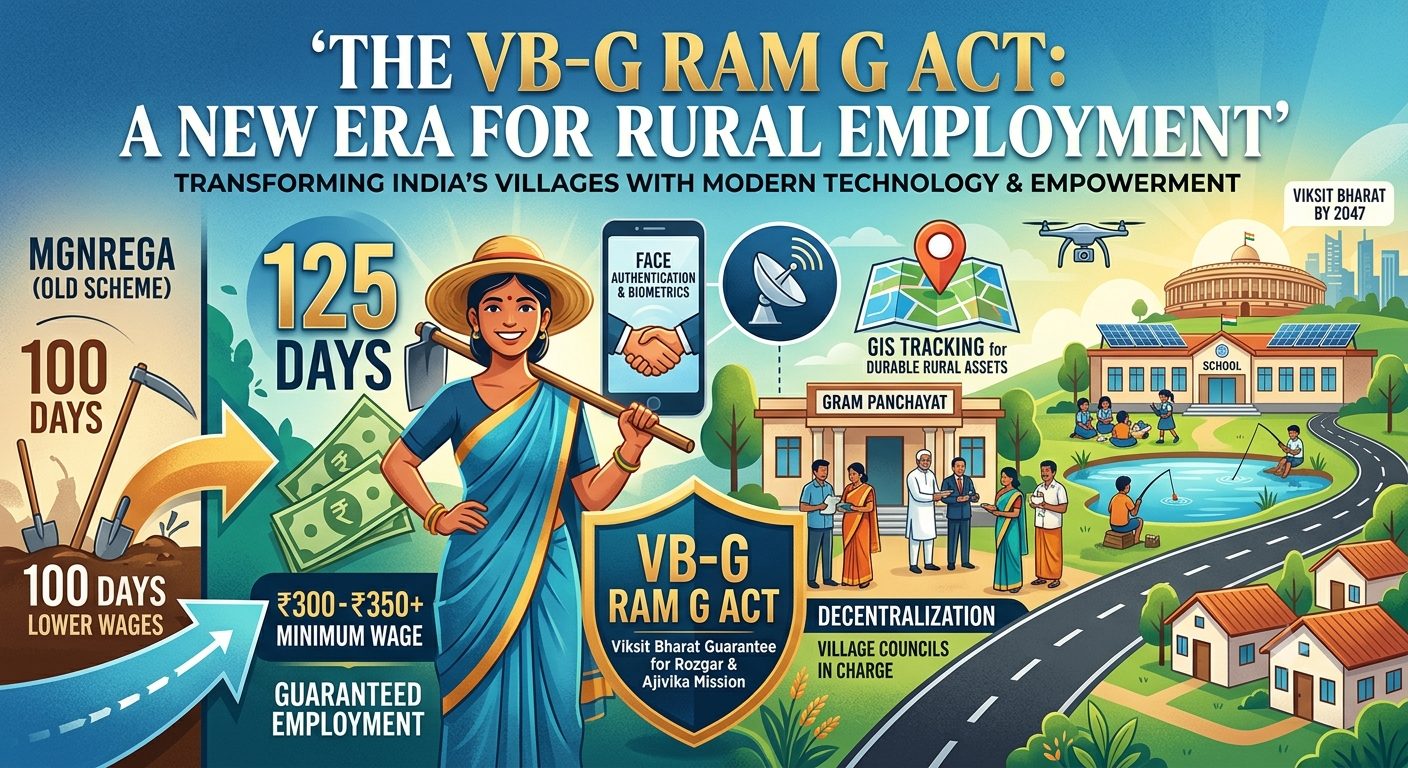
On July 1, 2026, a new law was launched to help people living in India’s villages find steady work and improve their communities. It is called the VB-G RAM G Act (which stands for Viksit Bharat Guarantee for Rozgar and Ajivika Mission).
This new program replaces the old rural job scheme (MGNREGA). Over the last twenty years, poverty in India has dropped significantly, so the government created this updated law to match the modern needs of rural workers and use new technology to stop cheating.
Here is a simple breakdown of what this new law brings to rural India:
1. More Work and Better Pay
In the past, rural workers were guaranteed 100 days of work. Because farming can be unpredictable due to bad weather, many people still had to leave their families to find work in big cities.
- 125 Days of Work: The new law increases the guaranteed work time to 125 days a year for eligible rural families.
- Higher Wages: Workers are now guaranteed a minimum of ₹300 per day, with some areas paying up to ₹350.
- Unemployment Pay: If a worker asks for a job and the government cannot provide one, the worker will still receive unemployment money.
- No More Late Pay: If the government takes longer than 15 days to pay a worker, they legally have to pay a daily late fee straight to the worker.
2. Smart Technology to Stop Corruption
In the older system, it was easy for dishonest contractors to make fake job cards or use machines instead of hiring real people. The new law uses modern technology to fix this:
- Face Scans and Fingerprints: Workers must verify their identity using facial recognition and biometrics. This means nobody else can steal their pay.
- GPS Tracking: Every new project (like a pond or a road) must be tracked using digital maps (GIS tagging) to prove the work was actually done.
3. Giving Power Back to the Villages
Instead of just focusing on creating temporary jobs, the new law focuses on building useful things for the villages, like schools, better roads, and water storage.
Local village councils (Gram Panchayats) are now in charge of at least 50% of these projects. This means the people who actually live in the village get to decide what needs to be built.
4. How It Is Paid For
The central government has set aside a massive budget of ₹96,000 crores for this program, which is more money than the old scheme had. To make sure the money is spent well, the central government and the state governments usually split the costs (60% paid by the center, 40% paid by the state). This shared teamwork makes state governments more responsible for ensuring the program runs smoothly.
A Better Future
The true goal of the VB-G RAM G Act is not just to hand out money. It is about respect. Early results show that migrant workers are already returning home because they can now find reliable, well-paying work in their own villages. By providing steady income and building better local facilities, this new law is a big step toward making rural India stronger and more developed.