




Who watches over elections to make sure they are fair? In India, it’s the Election Commission. But what happens if the head of this commission—the Chief Election Commissioner (CEC)—is accused of wrongdoing? Can the government just fire them?
The short answer is no. Removing the CEC is a very difficult process by design. Here is a simple breakdown of how it works and why the rules are so strict.
Why is it so hard to fire the CEC?
Think about a referee in a sports match. If one team could fire the referee for making a call they didn’t like, the game wouldn’t be fair.
The same logic applies to elections. If the ruling government could easily fire the CEC, the election chief might be too scared to stop politicians from breaking the rules. To protect our democracy, the Indian Constitution (under Article 324) gives the CEC special protection. Firing the CEC is just as difficult as firing a Supreme Court judge.
Valid Reasons for Removal
You cannot remove the CEC just because of a political disagreement or an unpopular decision. According to the law, there are only two valid reasons for removal:
Proved Misbehavior: Serious, proven misconduct or breaking the law.
Incapacity: Being physically or mentally unable to do the job.
The 5-Step Removal Process
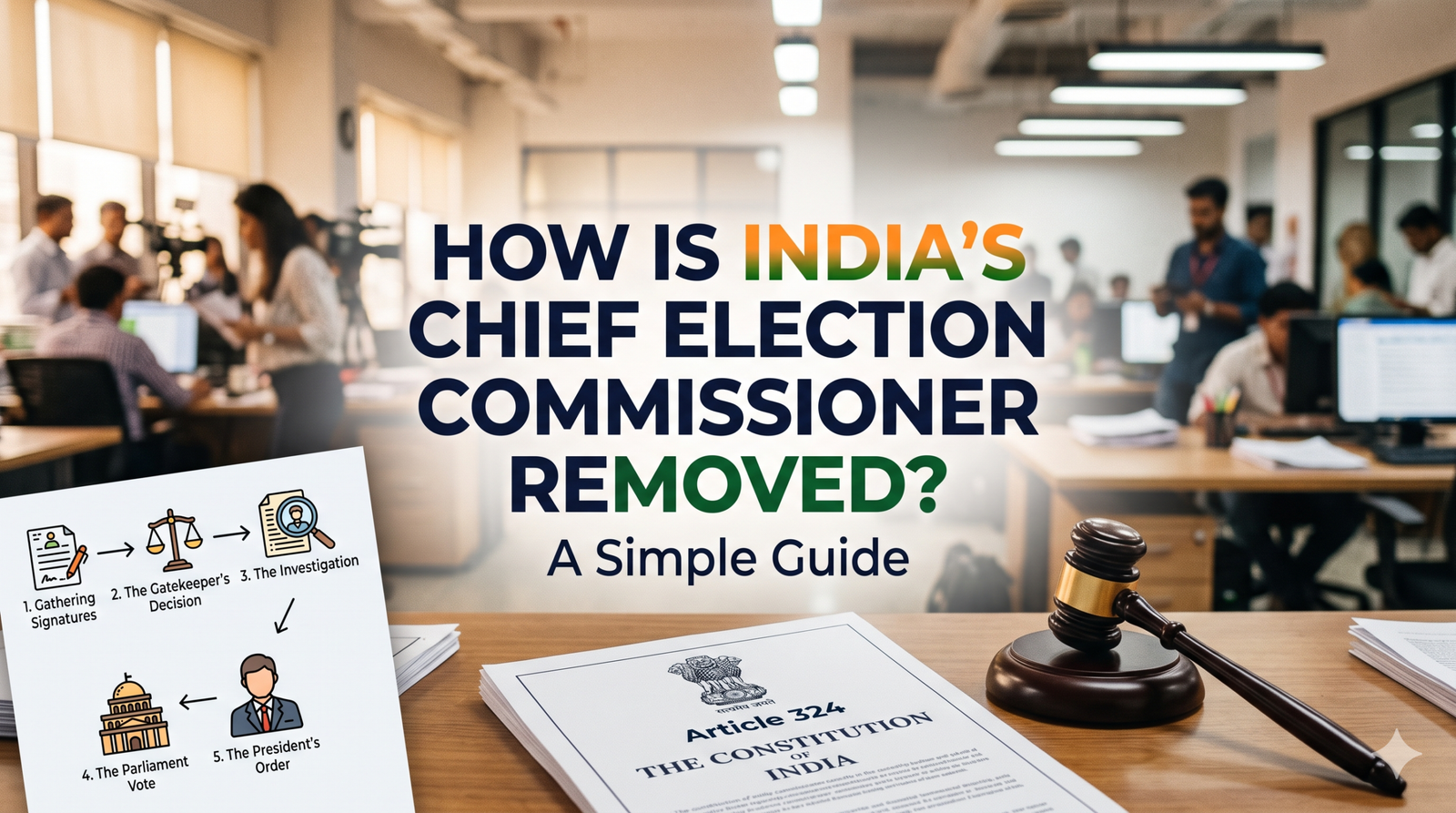
Removing the CEC takes a lot more than a simple decision by the Prime Minister. It requires a strict, five-step legal process:
Step 1: Gathering Signatures. Members of Parliament (MPs) must start the process by signing a formal notice. It requires the signatures of at least 100 MPs from the Lok Sabha (lower house) or 50 MPs from the Rajya Sabha (upper house).
Step 2: The Gatekeeper’s Decision. Once the signatures are collected, the head of the house (the Speaker of the Lok Sabha or the Chairman of the Rajya Sabha) reviews the notice. They have the power to either accept it or reject it right there.
Step 3: The Investigation. If the notice is accepted, a special three-person committee is formed. This group—usually made up of top judges and legal experts—investigates the claims to see if there is actual proof of wrongdoing.
Step 4: The Parliament Vote. If the committee finds the CEC guilty, the issue goes to Parliament for a vote. To pass, it needs a “special majority.” This means a majority of the total members of the house plus at least two-thirds of the members who are present and voting must agree. Both houses of Parliament must pass this.
Step 5: The President’s Order. If both houses vote to remove the CEC, the President of India signs the final official order, making the removal complete.
A Real-World Example: The 2026 Attempt
To understand how this works in real life, look at what happened in early 2026. Opposition politicians wanted to remove the CEC, Gyanesh Kumar.
They successfully completed Step 1 by getting more than enough signatures in both houses. They accused the election commission of acting unfairly. However, the process stopped at Step 2. On April 6, 2026, the Speaker of the Lok Sabha and the Chairman of the Rajya Sabha rejected the notices. Because it was rejected at this “gatekeeping” stage, there was no investigation and no final vote.
The Big Picture: Balance
This system exists to strike a delicate balance.
On one hand, the strict rules give the CEC the independence to run elections without fear of political bullying. On the other hand, the law ensures there is a clear path for accountability if an election chief actually abuses their power. The goal isn’t to make firing the CEC impossible, but to guarantee that it only happens fairly, legally, and with solid proof.