

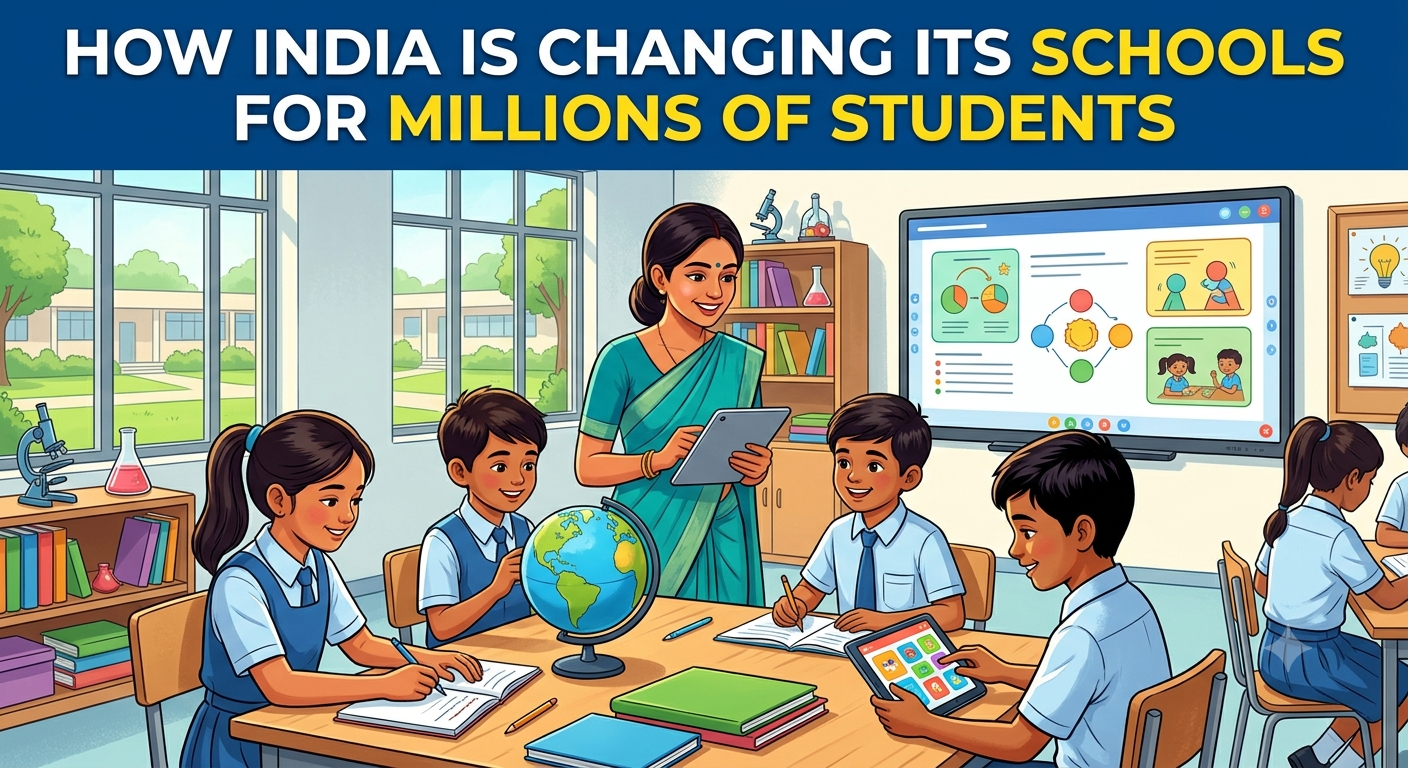
If you want to know what a country’s future looks like, look at its schools. The children sitting in classrooms today will become the doctors, scientists, and leaders of tomorrow. Recently, government reports showed that India’s school system is growing rapidly. In fact, India now has the largest school education system in the world.
A Big Record: 1 Crore Teachers
India has reached a huge milestone. For the first time, there are over 1 crore (10 million) school teachers in the country. To understand how big this is, back in 1950, India only had about 7 lakh (700,000) teachers. Today, these 1 crore teachers are teaching more than 24 crore (240 million) students. This means there is about one teacher for every 24 students, which is a great ratio. Now that India has enough teachers and schools, the focus is shifting to making sure the education is of the highest quality.
Better Training for Teachers
To improve the quality of education, the government is using the National Education Policy (NEP) 2020. This plan focuses on making teachers better at their jobs. A few major steps have been taken:
- New Training Courses: A modern 4-year course has been started to teach new teachers how to use technology and modern teaching methods.
- Online Help: An online platform has been created where experienced teachers guide thousands of newer teachers.
- Quality Checks: New standards are being tested in schools to help measure and improve how well teachers do their jobs.
More Girls in School and Science
There is also great news for gender equality. Today, more than half (54.7%) of all school teachers in India are women. Having female teachers makes many parents feel more comfortable sending their daughters to school.
The government is also encouraging older girls to study science and engineering. By reserving special seats for girls in tough entrance exams, the number of girls applying to study engineering has jumped from just 10% to over 30% in recent years.
Making Learning Fun and Less Scary
In the past, many students dropped out of school because exams were too stressful and the rules were too strict. The new education system is changing this to make learning fun:
- Mix and Match Subjects: Students no longer have to choose strict groups of subjects. If a student wants to study Biology and History at the same time, they now can.
- Learning by Playing: For younger children, schools are focusing less on writing and more on playing, listening to stories, and doing activities.
- Easier Exams: To reduce fear, board exams are being made easier to handle, and the amount of syllabus students have to memorize has been reduced.
Looking to the Future
The way school years are divided has been changed to a “5+3+3+4” system. This new structure is designed to match how a child’s brain naturally grows and learns.
Looking ahead to the next 10 to 15 years, two things will be very important: teaching children about Indian knowledge and culture, and allowing them to study in their mother tongue. Learning in their own language will give students more confidence and help them think creatively.
Conclusion
Education in India is no longer just about reading textbooks and passing tests. With the help of technology, a fresh plan, and millions of hard-working teachers, schools are focusing on building good character and real-life skills. These changes are preparing today’s students to build a strong and developed India by the year 2047.