




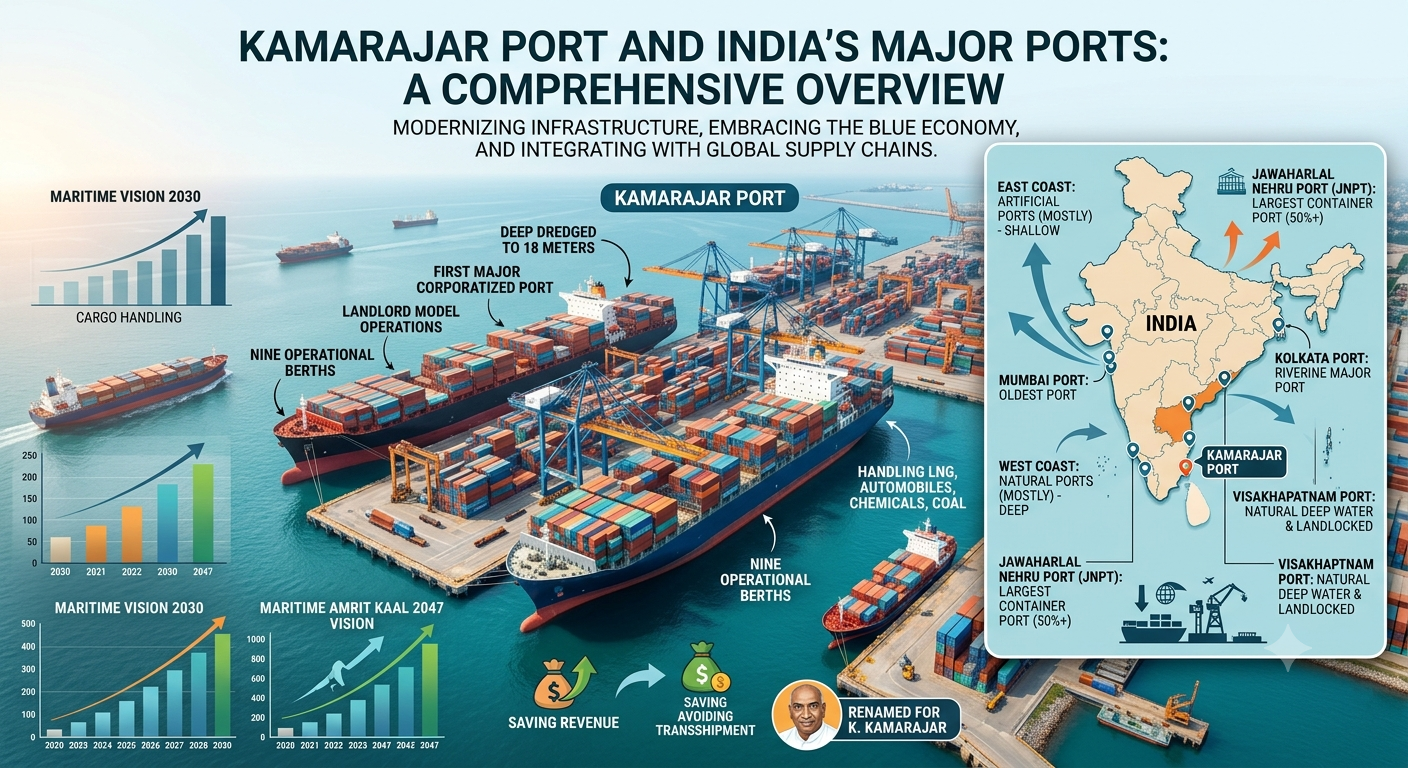
India is making massive upgrades to its coastal infrastructure to boost its role in global trade. Recently, Kamarajar Port has made headlines for completing a massive underwater digging project. This upgrade makes the port a powerhouse for India’s future trade and shipping network.
The Big Upgrade at Kamarajar Port
Located just north of Chennai on India’s east coast, Kamarajar Port recently spent about ₹440 crore to deepen its seabed. Because of this project, the port can now welcome giant international cargo ships that sit up to 18 meters deep in the water.
This is a huge achievement. These massive ships carry a large chunk of the world’s trade, and Kamarajar is now only the second major port in India (after Visakhapatnam) with waters deep enough to handle them safely.
Why is this a big deal?
Direct Deliveries: In the past, India’s waters were too shallow for the world’s biggest cargo ships. These giant ships had to drop off their goods at deeper ports in nearby countries. The goods were then reloaded onto smaller ships to be brought to India.
Saving Money: By allowing giant ships to dock directly, India skips the middleman. This saves a lot of time, prevents lost revenue, and makes trading much cheaper.
Future Goals: Upgrading ports like Kamarajar helps India meet its long-term goals for 2030 and 2047, which aim to turn the country into a major global hub for trade and the “blue economy.”
The Story Behind Kamarajar Port
Originally called Ennore Port, it was officially recognized as India’s 12th major port in 1999. It was later renamed in honor of K. Kamaraj, a well-known freedom fighter and former leader of Tamil Nadu.
Kamarajar Port operates differently from other major ports in the country. It is India’s first and only “corporate” major port. It works on a landlord model, which means the port authority acts like a landlord by maintaining the basic structures and deep waters. Meanwhile, private companies rent the space to handle the actual loading and unloading of cargo.
Though it started as a simple drop-off spot for coal, the port has grown tremendously. Today, it has nine operational docking areas and handles a wide variety of goods, including liquid natural gas, chemicals, heavy cargo, and automobiles.
A Quick Look at India’s Other Ports
India has a massive coastline stretching around 11,000 kilometers. Currently, the country operates 12 major ports, with two more being built (Vadhavan in Maharashtra and Galathea Bay in Great Nicobar).
The type of ports India has depends largely on geography:
The West Coast: The land on the western side of India dips sharply into the ocean, making the waters naturally deep. Because of this, almost all ports on the west coast are natural ports. The only exception is the Jawaharlal Nehru Port, which was built artificially to relieve heavy traffic from the Mumbai Port.
The East Coast: The eastern side of India is much shallower because rivers constantly dump sand and mud into the ocean. As a result, most ports on the east coast are artificial and require regular digging to keep them deep enough for ships. The one exception is Visakhapatnam, which is a naturally deep, landlocked port.
Other Famous Indian Ports:
Kolkata Port: The only major port in India located on a river instead of the ocean.
Mumbai Port: The oldest active port in the country.
Jawaharlal Nehru Port (JNPT): India’s largest container port, which handles more than half of all the shipping containers coming in and out of the country.