
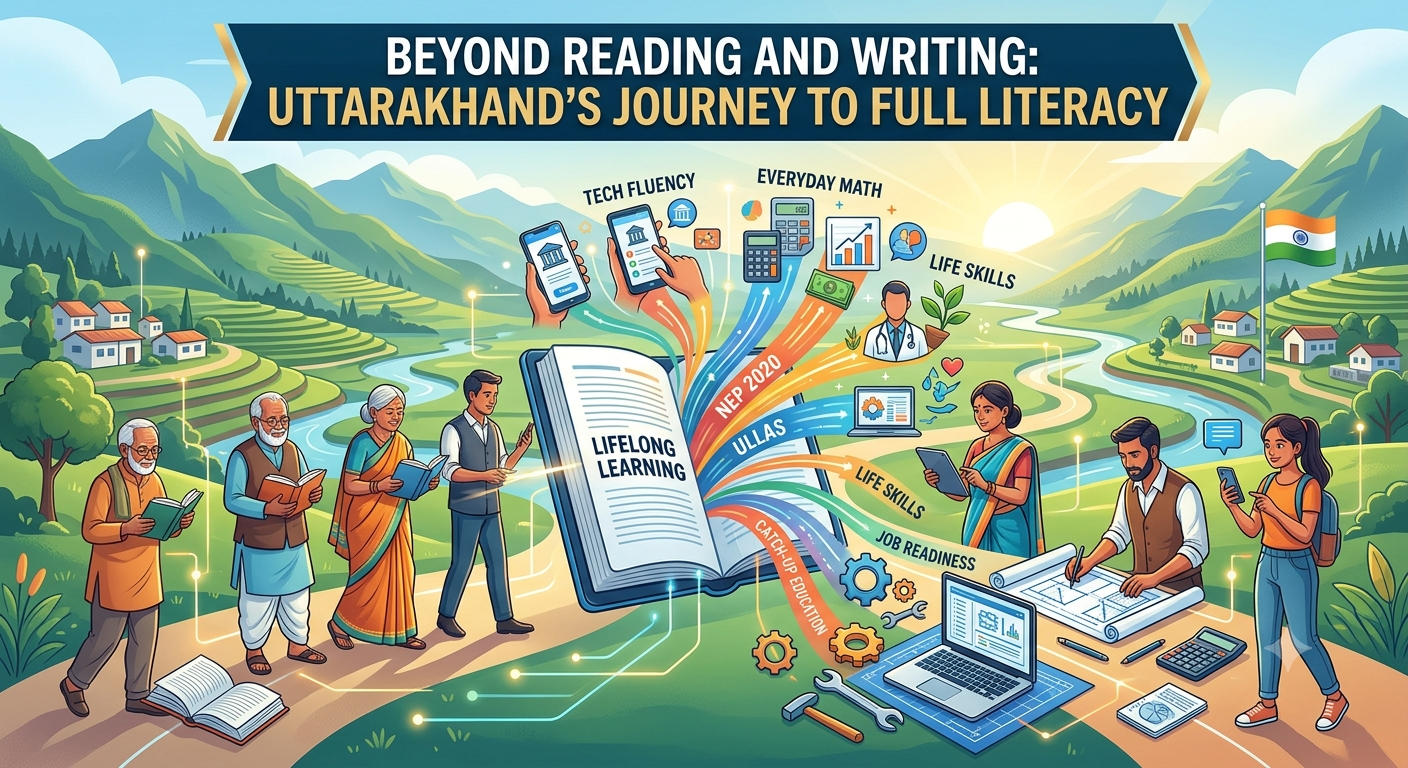
In today’s fast-paced, digital world, simply knowing how to read and write is no longer enough. If someone can read a newspaper but cannot navigate a smartphone to access government services or manage their bank account, are they truly equipped for the modern age? This question lies at the heart of India’s evolving approach to education, highlighted by Uttarakhand’s recent educational milestone.
Uttarakhand has officially become the sixth state in India to achieve “full literacy” under the National Education Policy (NEP) 2020 and the ULLAS program. It joins Mizoram, Goa, Tripura, Himachal Pradesh, and Sikkim, alongside Union Territories like Ladakh and Chandigarh, in reaching this impressive goal.
What Does “Full Literacy” Actually Mean?
For a state to earn the title of fully literate under the modern ULLAS framework, its adult literacy rate (for individuals aged 15 and older) must exceed 95%. Furthermore, the state government must show active, organized efforts to educate anyone who still lacks basic reading skills. Uttarakhand comfortably met these requirements, pushing its adult literacy rate to over 98%.
The ULLAS Program: A Six-Step Approach
Driven by the Ministry of Education, ULLAS (Understanding Lifelong Learning for All in Society) shifts the focus from childhood schooling to “lifelong learning.” It recognizes that surviving in a modern economy requires a diverse skill set. The program focuses on six key areas:
Basic Literacy: The fundamental ability to read, write, and understand a language.
Everyday Math: Knowing basic calculations like addition, subtraction, and counting.
Life Skills: Practical knowledge, including health awareness, financial basics, and problem-solving.
Job Readiness: Vocational training that helps people find employment and earn a living.
Catch-up Education: Providing basic schooling for adults who missed out during their childhood.
Tech Fluency: The ability to confidently use smartphones, the internet, and digital apps for everyday tasks.
The True Meaning of Development
India’s ultimate goal is to become a leading “knowledge economy.” To do this, every citizen must be part of the information loop.
This mirrors the ideas of renowned economist Amartya Sen, who argued that true development isn’t just about a country getting richer. Real development happens when people gain the freedom and capability to improve their own lives. Literacy is the first step toward this freedom. Without it, individuals cannot fully participate in democracy, make informed health choices, or access financial aid.
However, while literacy opens the door to these opportunities, it is not a magic solution on its own.
The Hurdles Still Ahead
Even when a state achieves near-100% literacy on paper, several real-world challenges remain:
Education vs. Comprehension: Being able to read a sentence does not always mean a person has the critical thinking skills needed to navigate complex life choices.
The Gender Divide: Historically, men have had better access to education than women. Closing this gap is vital because educating women leads to healthier families and stronger communities.
The New Digital Divide: In the past, the digital divide was about who owned a phone and who didn’t. Today, almost everyone has a device. The new digital divide is about capability. Having an internet connection is useless if a person doesn’t know how to use it safely to pay bills, apply for jobs, or avoid online scams.
Looking Forward
Uttarakhand’s achievement is a massive victory that deserves to be celebrated. It proves that dedicated educational programs can reach every corner of a state. However, the journey does not end with learning the alphabet. The next great challenge for India is ensuring that this basic literacy translates into real-world empowerment, giving every citizen the tools they need to thrive in the 21st century.