




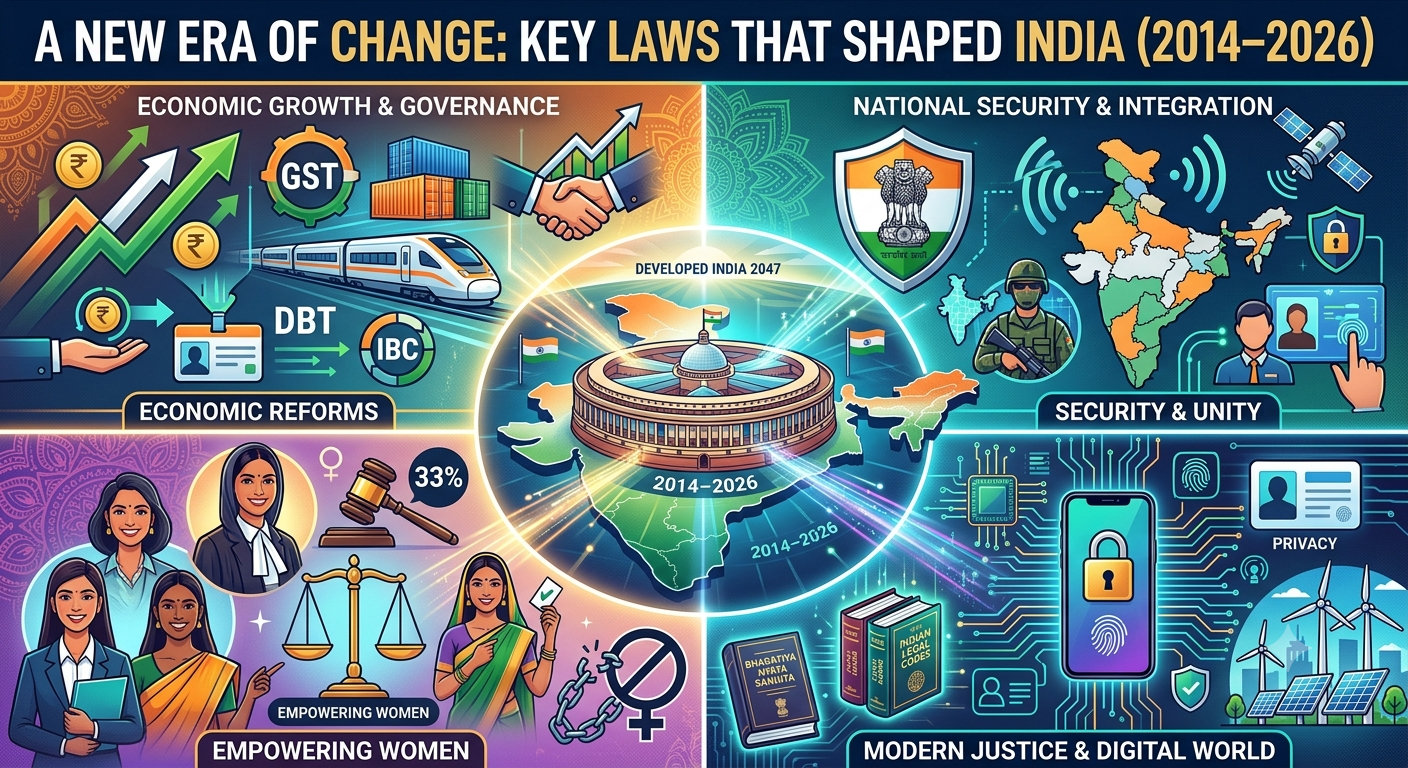
Over the past 12 years, India’s Parliament has acted as a powerful engine for national transformation rather than just a law-making body. Between 2014 and 2026, lawmakers introduced sweeping changes that have redefined India’s economy, national security, digital landscape, and commitment to social justice.
Here is a look at the major legislative milestones that are guiding India toward becoming a fully developed nation.
1. Economic Growth and Smarter Governance
A Unified Tax System (2016): The introduction of the Goods and Services Tax (GST) was a historic shift that replaced a complicated web of state and central taxes. By creating a “One Nation, One Tax” system, GST aimed to simplify business operations and curb tax evasion.
Fixing Bad Debt (2016): To tackle the mounting crisis of unpaid bank loans, Parliament passed the Insolvency and Bankruptcy Code. This modern framework drastically reduced the time it takes to resolve bankruptcies—from several years down to just 90 days—making India a more attractive place to do business.
Direct Welfare Delivery (2016): The Aadhaar Act provided legal backing to India’s biometric ID system. This allowed the government to bypass middlemen and send welfare benefits directly to the bank accounts of genuine beneficiaries, saving billions of rupees in the process.
2. National Security and Integration (2019)
Integrating Jammu & Kashmir: In a landmark move, Parliament revoked the special status of Jammu and Kashmir (Article 370). The region was fully brought under the Indian Constitution and reorganized into two distinct Union Territories to encourage regional development, investment, and national unity.
Protecting Minorities: The Citizenship Amendment Act (CAA) was passed to offer a clear path to Indian citizenship for persecuted religious minorities who fled from neighboring countries like Pakistan, Bangladesh, and Afghanistan.
Strengthening Anti-Terror Laws: Updates to the Unlawful Activities (Prevention) Act allowed the government to designate specific individuals as terrorists, rather than just organizations, giving law enforcement stronger tools to fight modern security threats.
3. Championing Women’s Rights
Outlawing Instant Divorce (2019): Following a Supreme Court directive, Parliament criminalized the practice of instant triple talaq. This legislation was a major victory for gender equality, ensuring greater dignity and legal protection for Muslim women.
Women in Politics (2023): The historic Nari Shakti Vandan Adhiniyam guaranteed a 33% reservation for women in both the Lok Sabha and State Assemblies. This amendment ensures that women will have a much stronger voice in the country’s lawmaking processes.
4. Modernizing Justice and the Digital World (2023)
Protecting Digital Privacy: With nearly a billion Indians using the internet for daily transactions, the Digital Personal Data Protection Act was introduced. This law gives citizens power over their personal data and sets strict rules for how companies must handle sensitive information.
A 21st-Century Justice System: Parliament took the bold step of replacing 150-year-old British colonial criminal laws with three new Indian codes. These updated laws are designed to be citizen-centric and are heavily focused on tackling modern issues like cybercrime, organized crime, and terrorism.
Supporting Small Businesses: To make running a business easier, the Jan Vishwas Act was passed. It removed the threat of criminal prosecution for minor, unintentional technical errors across dozens of laws, replacing them with simple financial penalties.
The Road Ahead
When viewed together, these major parliamentary decisions reflect a clear and ambitious blueprint for the future. By upgrading its economy, securing its borders, empowering its citizens, and modernizing its legal framework, India has laid a solid foundation for its vision of becoming a fully developed and self-reliant nation by 2047.