

On August 5, 2019, India made a historic decision to remove Article 370 and Article 35A, fully bringing Jammu and Kashmir (J&K) under the Indian Constitution. Now, seven years later, the conversation has shifted from the political decision itself to the real, everyday changes happening for the people living there.
Here is a look at how J&K has transformed over the last seven years.
A Return to Peace and Safety
The most important change has been the return of peace. Data shows a massive drop in violence, terrorism, and incidents like stone-pelting. Because the streets are safer, normal life has resumed. This sense of security is the foundation that is allowing businesses to grow and tourists to visit without fear.
Better Roads, Trains, and Record Tourism
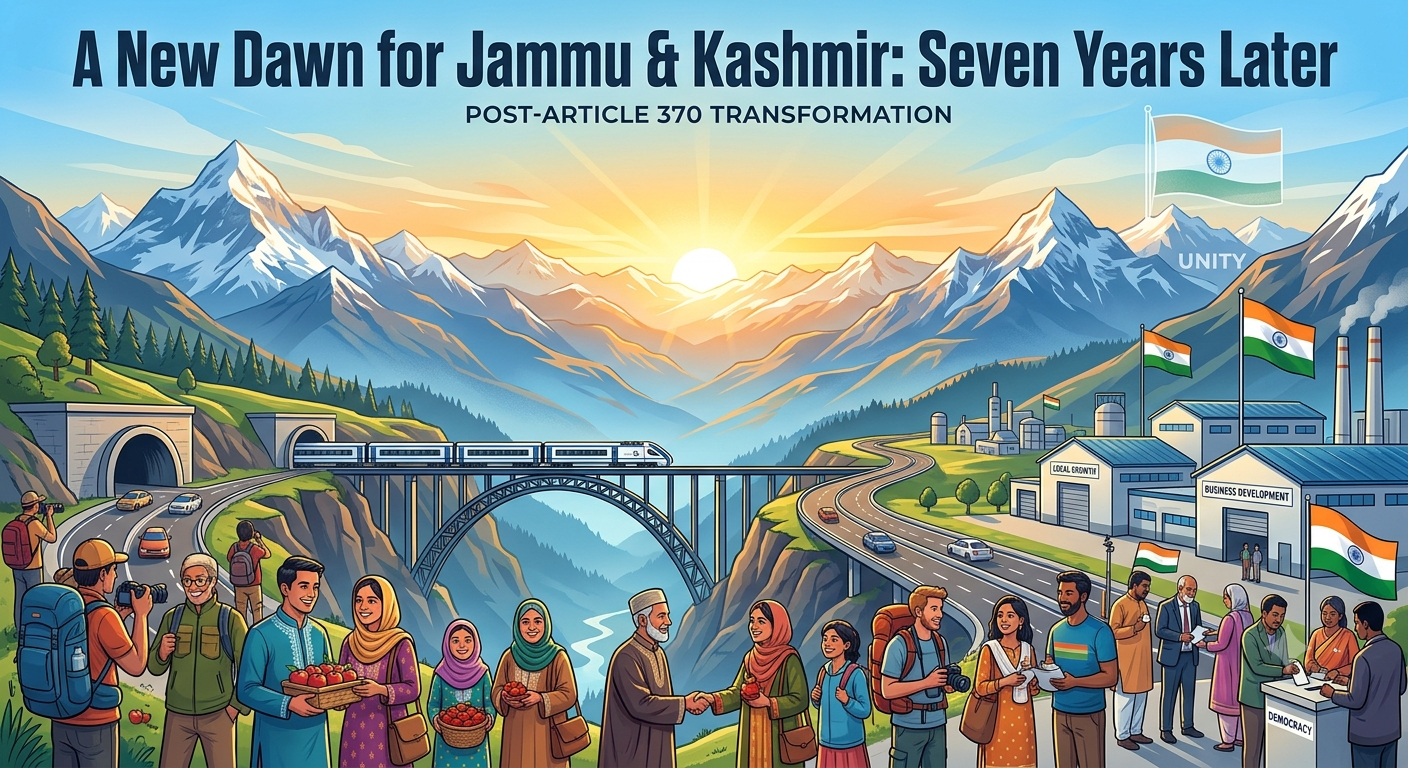
Traveling to and around J&K is easier than ever before. Big construction projects are turning into reality, including:
The new Udhampur-Srinagar-Baramulla railway line.
The world-famous Chenab railway bridge.
Modern, all-weather tunnels like Z-Morh and Zojila.
The introduction of the high-speed Vande Bharat train.
Because of this better travel infrastructure and improved safety, tourism is booming. In 2024, J&K welcomed a record-breaking 2.35 crore (23.5 million) visitors, which included thousands of foreign tourists and a huge number of pilgrims.
More Jobs and Business Growth
The local economy is waking up. In the past, business owners were hesitant to invest in the region. Today, there is a strong demand from investors across India who want to set up shop in J&K.
The government has made it much easier to start and run a business.
Billions of rupees are being invested into new industrial areas.
Nearly 10 lakh (1 million) new self-employment opportunities have been created, giving local youth a chance to build their own futures.
Equal Rights and True Democracy
Before 2019, certain old laws meant that the Indian Constitution didn’t fully apply to J&K, which allowed for unfair rules. By removing those barriers, everyone in J&K and Ladakh now enjoys the exact same rights as the rest of India.
Marginalized groups, such as Scheduled Castes (SCs), Scheduled Tribes (STs), Other Backward Classes (OBCs), and refugees, finally have equal rights and fair access to government jobs.
Local democracy is working well, giving regular citizens a real voice in how their communities are run.
Fulfilling a Historic Dream
This 7th anniversary also lines up with the 125th birth anniversary of Dr. Syama Prasad Mookerjee. He was a famous leader who strongly believed that India should only have one constitution and one flag. The changes in J&K are seen as the fulfillment of his dream to completely unite the region with the rest of the country.
The Bottom Line
Seven years after the removal of Article 370, the results are clear on the ground. By bringing peace, boosting the economy, improving travel, and ensuring equal rights for all, Jammu and Kashmir is moving forward into a brighter and more prosperous future.