



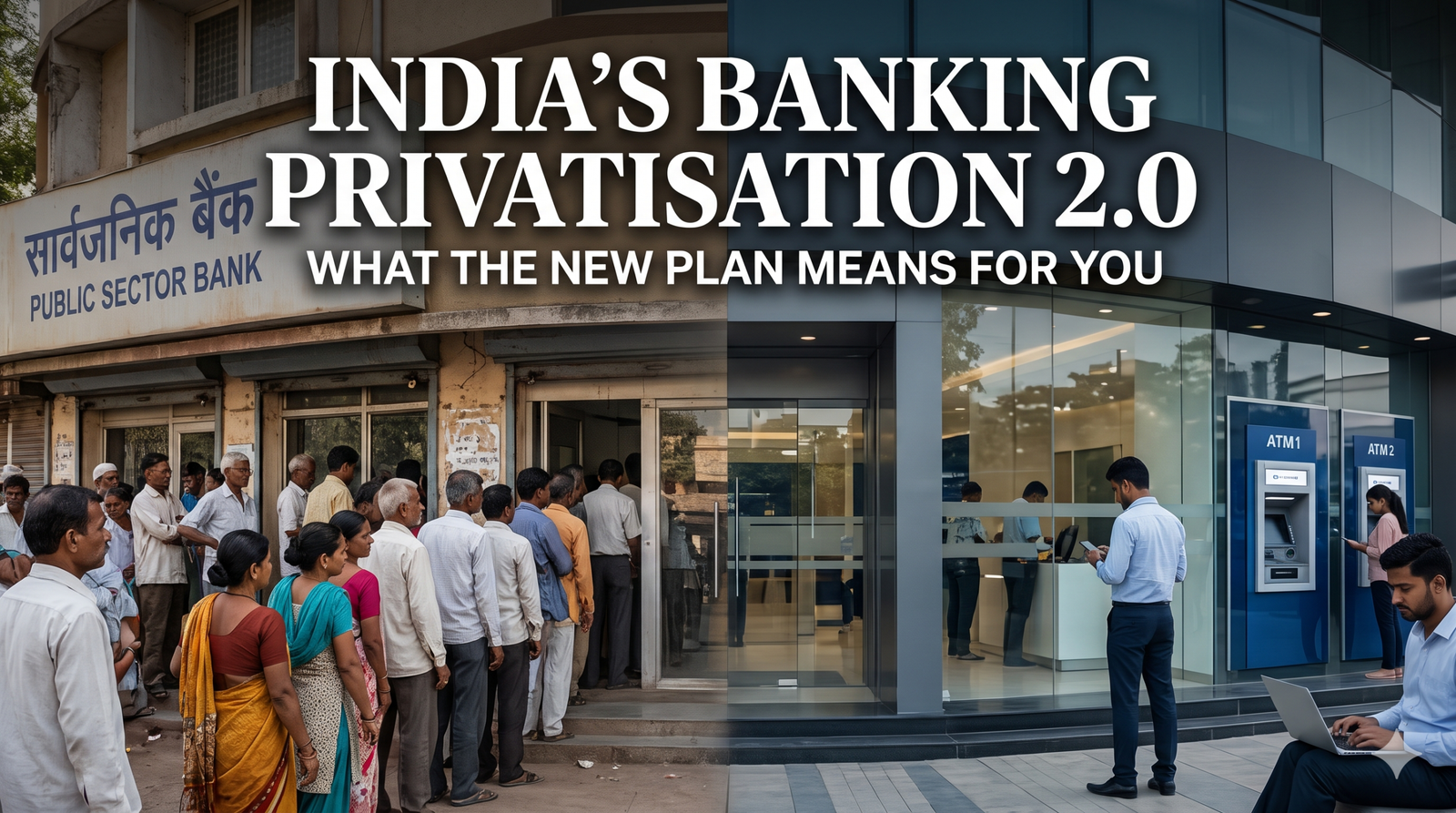
In India, government-owned banks—known as Public Sector Banks (PSBs)—have been the backbone of the country’s financial system for decades. They are the banks that reach deep into small villages and help ordinary people open accounts and save their hard-earned money. However, the Government of India is currently working on a major new plan to change how these banks operate. They want to reduce their ownership in some of these banks and completely hand over a few others to private owners.
This process can sound very complicated, but if we break it down, it is quite simple to understand. Here is a detailed look at what the government is planning, why they are doing it, and how it will affect the country.
Two Different Plans: Reducing Ownership vs. Full Privatization
First, it is very important to understand that the government is doing two different things at the same time. People often confuse them, but they are separate steps.
1. Reducing the Government’s Share (Stake Reduction)
Right now, the government owns a massive share—sometimes between 80% and 94%—of many public banks. The new plan is to bring this ownership down to exactly 75% in four specific banks:
Indian Overseas Bank
Central Bank of India
UCO Bank
Punjab & Sind Bank
In this step, the government is not completely selling these banks to private businessmen. The government will still be the “majority owner” and will control how the bank is run. They are simply selling a small portion of their shares to the general public.
2. Complete Privatization
On a completely separate track, the government is looking to fully privatize two other public sector banks. This means the government will step away, and private companies or investors will take over the ownership and management of these two banks. The government might even merge some banks together before selling them to get a better price.
Why Sell Banks That Are Making Money?
A very common question people ask is: “If these government banks are making thousands of crores in profit, why on earth is the government trying to sell them?”
It is true that banks like Indian Overseas Bank and UCO Bank have reported massive profits recently. However, the government has deeper reasons for taking this step:
Following the Rules (SEBI Guidelines): In India, there is a watchdog for the stock market called SEBI. SEBI has a strict rule that says any company listed on the stock market must have at least 25% of its shares owned by the general public. Because the government owns up to 94% of some banks, they are breaking this rule. By bringing their ownership down to 75%, they are simply following the law and allowing everyday citizens to invest in these banks.
Saving Money for the Future: When the government owns a bank, it has to constantly pump money into it to keep it strong and safe. By reducing its ownership, the government frees itself from this heavy financial burden.
Earning Extra Money Without Taking Loans: By selling shares to the public or to private buyers, the government earns a huge amount of cash. They can use this money to build roads, schools, and hospitals, without having to borrow money and fall into debt.
Making Banks Faster and Smarter: Private banks are often seen as faster and more competitive because they use the latest technology and try very hard to win over customers. The government hopes that by bringing in private ownership, these banks will become more efficient and offer better services to the common man.
The Big Roadblock: Changing the Law
The government cannot simply put a “For Sale” sign outside a public bank. It is actually a very long and complicated legal process.
Back in the 1970s and 1980s, the government passed special laws in Parliament to take over private banks and make them government property (a process called nationalization). Because these banks were created by a strict law, they can only be sold if that law is changed.
This means the government has to draft a new bill, present it in the Parliament, and get the approval of the lawmakers. They have to legally undo the old laws before they can hand over control to any private owner.