




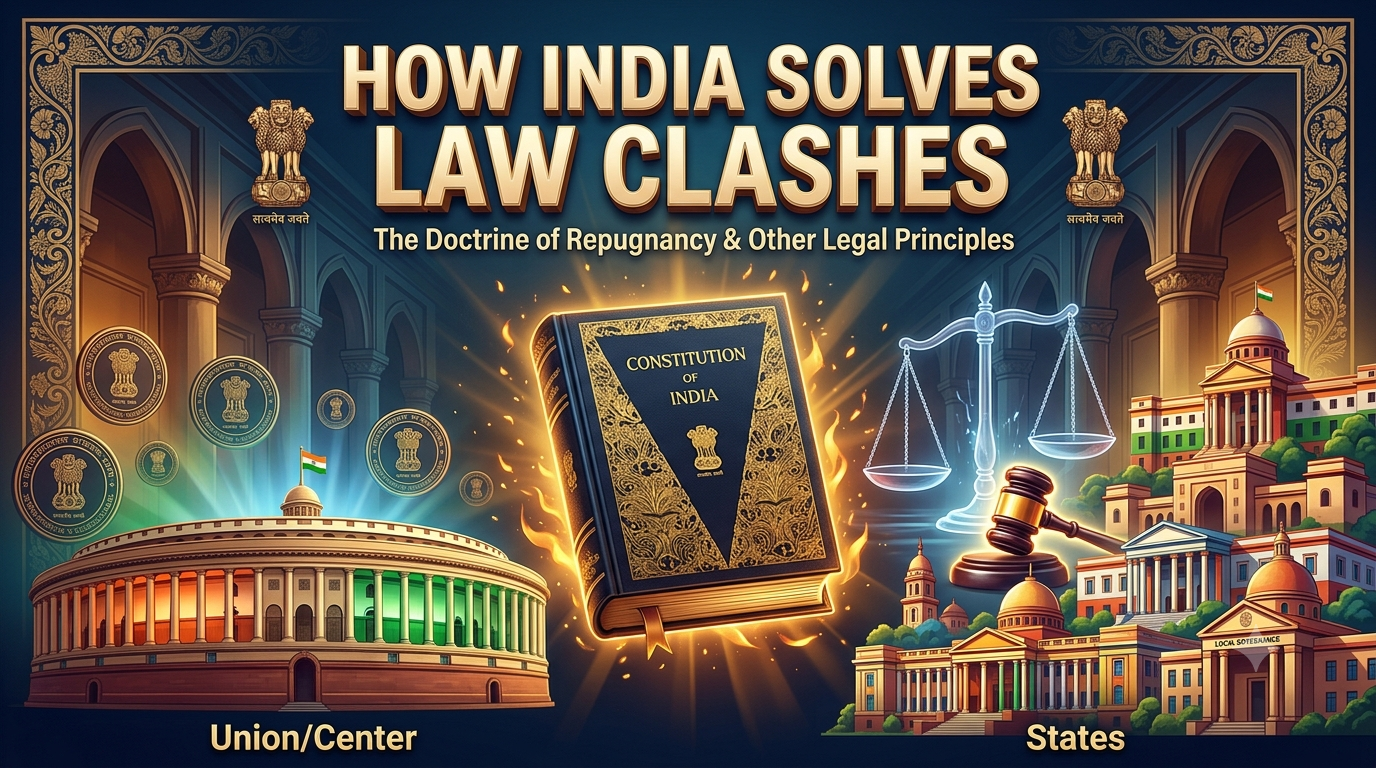
The Indian Constitution is the ultimate rulebook for the country. It sets up how the government runs, protects our basic rights, and keeps society fair.
Because India is a massive country, we have a Central government in New Delhi and individual State governments. To keep things running smoothly, they have to share power. But what happens if the Center and a State make two different laws about the exact same thing, and those laws fight each other?
To solve this, the Constitution uses a smart rule called the Doctrine of Repugnancy.
Who Gets to Make the Rules? (The Three Lists)
To prevent chaos, the Constitution (in its Seventh Schedule) divides law-making powers into three separate “to-do lists”:
The Union List: These are big, national topics like the military, foreign affairs, and banking. Only the Central government can make laws about these.
The State List: These are local issues like police and public health. Only the State governments handle these.
The Concurrent List: This is the “shared” list. It covers topics like education and marriage, where both the Central and State governments are allowed to make laws.
What is the Doctrine of Repugnancy?
“Repugnancy” is just a fancy legal word for a clash or a contradiction.
Problems usually happen on the shared Concurrent List. Let’s say both the Center and a State make a law on the same topic, but the rules completely contradict each other. You can’t follow one without breaking the other. Who wins?
Article 254 of the Constitution acts as the referee and lays out three simple rules:
The Central Law Wins: As a general rule, if a State law and a Central law clash on a shared topic, the Central law takes priority.
Only the Clashing Part is Cancelled: The State law isn’t entirely thrown in the trash. Only the specific parts of the State law that contradict the Central law are declared invalid.
The President’s Exception: There is one major exception. If a State makes a clashing law, but then sends it to the President of India and gets their special stamp of approval, the State’s law will actually win out—but only inside the borders of that specific state.
Other Cool “Rules of Thumb” in the Constitution
To keep the legal system balanced, courts use a few other common-sense rules (called doctrines):
Basic Structure Rule: The government is allowed to update or amend the Constitution, but they are never allowed to destroy its core “soul” (like democracy, secularism, and basic human rights).
Separation of Powers: The people who make laws (Parliament), the people who enforce laws (Government/Police), and the people who judge laws (Courts) all have their own separate lanes. This stops anyone from getting too much power.
Pith and Substance (Finding the Heart of the Law): Sometimes people argue over whether a law belongs on the State list or the Center’s list. Judges will look past the technical wording and examine the “true heart” or main purpose of the law to see who really has the right to make it.
Severability (Cutting out the Bad): If a law has one terrible rule that violates our rights, courts won’t always cancel the entire law. They will just “sever” or cut out the bad part and let the rest of the good law survive.
Colorable Legislation (No Cheating): This rule simply says: If you aren’t allowed to do something directly, you can’t use a sneaky trick to do it indirectly.
Harmonious Construction (Playing Nice): If two rules in the Constitution seem to fight each other, judges will try their best to interpret them in a way where both can work together peacefully.
Summary
The Doctrine of Repugnancy and these other legal principles show just how well-thought-out the Indian Constitution is. It guarantees that even when the Central and State governments disagree, there is always a fair, peaceful, and clear way to figure out which rules apply to the people.