




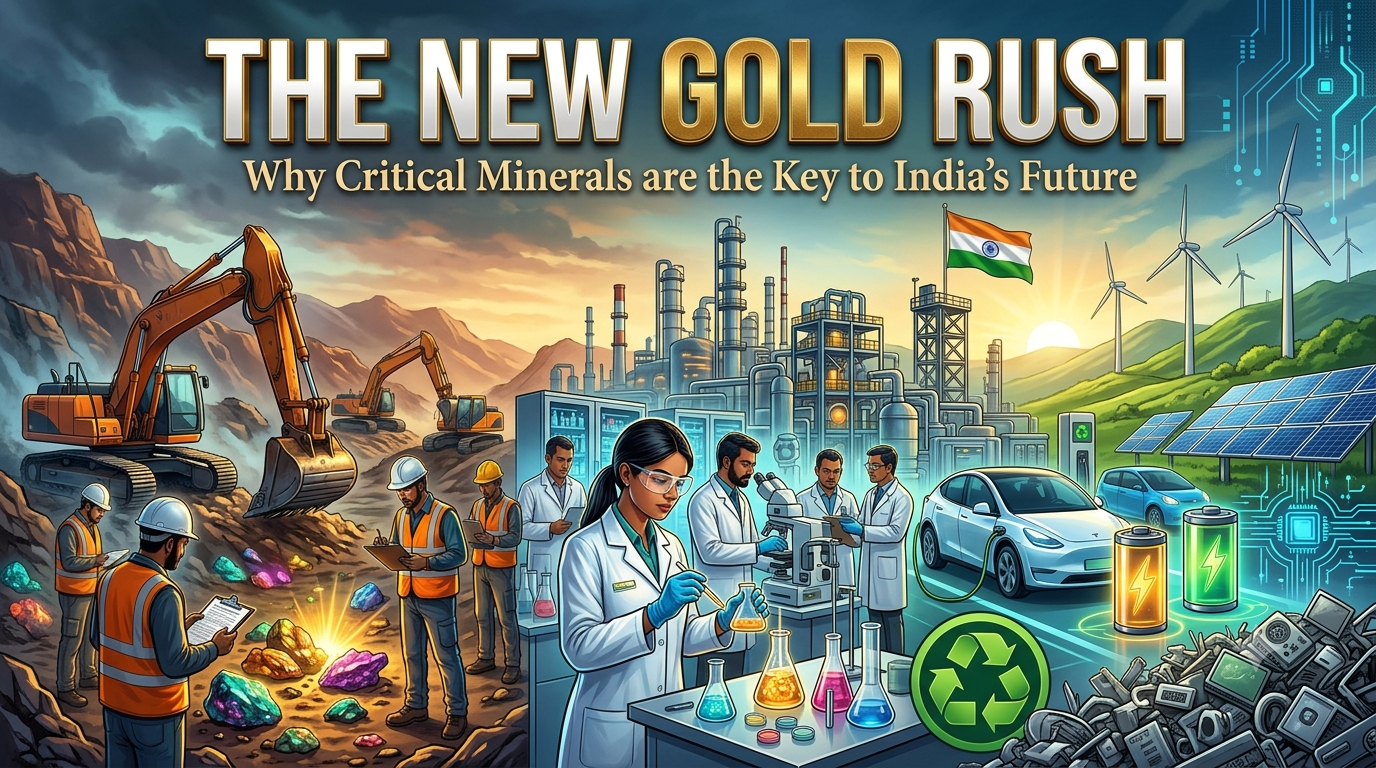
A country’s true power is no longer defined just by its military strength or advanced software; it is increasingly defined by who controls the raw materials needed to build the modern world. From the lithium in our phones to the rare earth elements in defense systems, “critical minerals” are the new foundation of the global economy. Understanding this shift, India is rapidly building a strategy to secure these resources for its future.
What Makes a Mineral “Critical”?
A mineral isn’t called “critical” just because it is rare. It gets this label if it is absolutely essential for a country’s economy and if its supply is at high risk of being disrupted. Because every nation has different industries, their lists of critical minerals vary. In 2023, India officially identified 30 critical minerals—including lithium, cobalt, copper, and graphite—and updated its laws to speed up their domestic mining and production.
The Green Energy Boom
The sudden massive demand for these minerals is being driven by the global shift toward clean energy and technology.
Electric Vehicles (EVs): Batteries rely heavily on lithium, nickel, cobalt, and graphite.
Solar and Wind Power: Solar panels require elements like silicon and gallium, while wind turbines need permanent magnets made from rare earth elements.
Electricity Grids: Upgrading power networks requires massive amounts of copper.
The International Energy Agency predicts that by 2040, the world will need over three times as much lithium as it does today, with similar spikes for other essential materials.
India’s Double-Edged Sword
As India pushes for more electric vehicles, renewable energy, and local electronics manufacturing, its need for these minerals is skyrocketing. However, India currently imports almost all of its supply. In 2022-23, India relied entirely on imports for its lithium and cobalt needs.
While India has recently discovered domestic reserves—including millions of tonnes of lithium and rare earth elements—finding a mineral is only step one. Digging it out of the ground, navigating environmental rules, and processing it commercially takes years of technological and financial investment.
The Processing Bottleneck and India’s Master Plan
The biggest global risk isn’t just who digs the minerals out of the dirt; it’s who turns them into usable materials. Currently, a few places in the world—heavily led by China—dominate this processing stage. If one link in this highly concentrated chain breaks, entire industries stall.
To build self-reliance and protect its economy, India is taking three major steps:
A Focused National Mission: In 2025, the government launched the National Critical Mineral Mission with a massive ₹16,300 crore budget to strengthen everything from domestic exploration to final processing.
Shopping Globally: India is securing resources abroad. Through a joint company called KABIL, India is buying exploration rights in resource-rich countries, such as securing lithium blocks in Argentina and partnering with Australia.
The Power of Recycling: We don’t just need new mines; we can mine our trash. The government is investing ₹1,500 crore into extracting critical minerals from e-waste and dead batteries. This recycling push aims to create 70,000 jobs, protect the environment, and build a reliable secondary supply of materials.
The Road Ahead
The global race for critical minerals is not just about who has the most rocks in the ground. The true winners will be the countries that can successfully mine, process, recycle, and transform these raw materials into high-tech products. By combining local mining, smart global partnerships, and aggressive recycling, India is laying a strong blueprint for an independent and powerful future economy.