




Every day, millions of us throw our trash into the bin, but have you ever wondered where it actually goes? How much of it gets recycled, and how much just ends up piled high in open landfills?
India is tackling this massive challenge with the new Solid Waste Management Rules of 2026. Paired with the national cleanliness drives, the message of these new rules is very simple: keeping the country clean isn’t just the government’s job. It requires the help of every single citizen.
Here is a simple breakdown of what these rules mean and how they affect our daily lives.
The Big Change: Separating Trash at Home
For a long time, waste policies just focused on where to dump our garbage. The 2026 rules focus on tracking the garbage, reducing it, and making sure everyone takes responsibility.
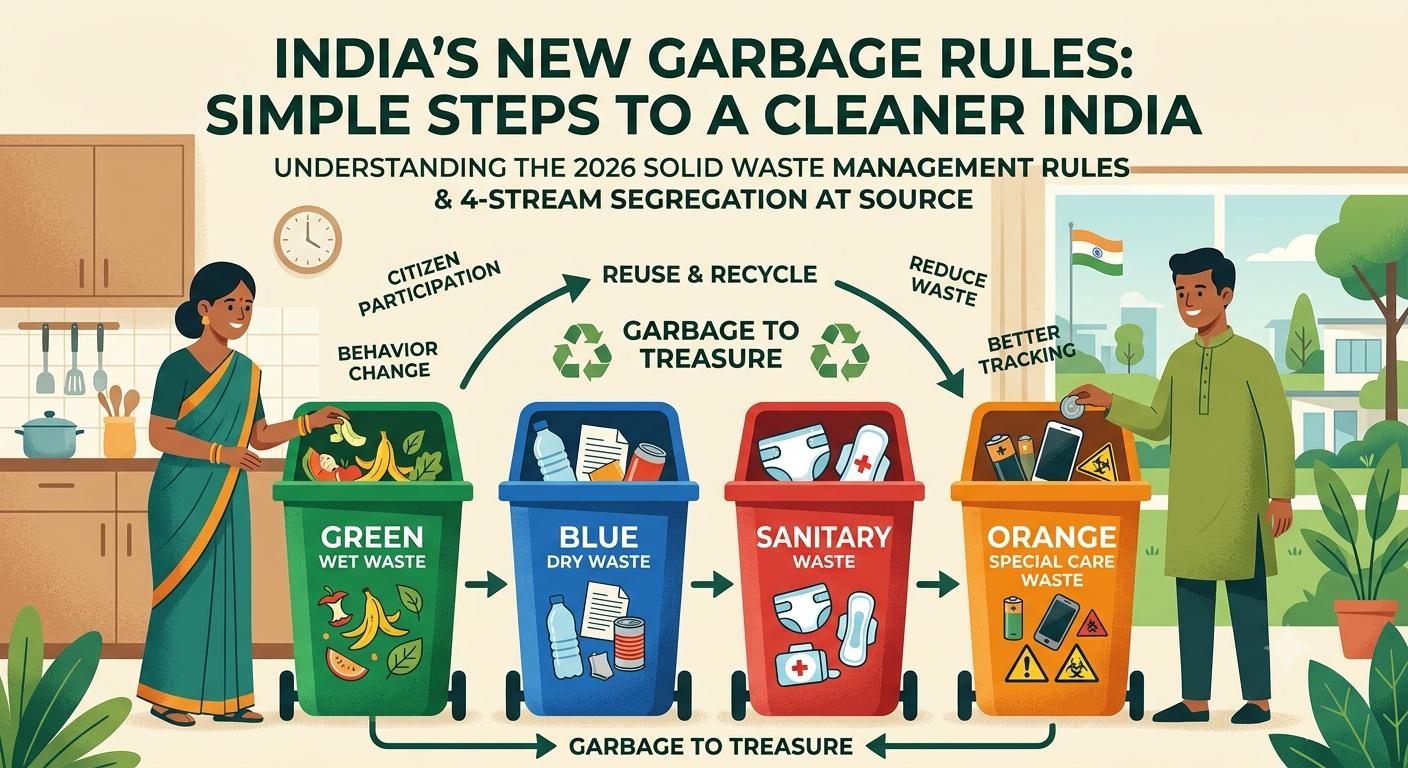
The most important change for regular citizens is the rule to separate waste into four categories right at home:
Wet Waste: Leftover food, vegetable peels, and things that rot.
Dry Waste: Paper, plastic, glass, and cardboard.
Sanitary Waste: Diapers, sanitary pads, and bandages.
Special Care (Hazardous) Waste: E-waste, batteries, paints, and old medicines.
While this might sound like a lot of work, experts say you don’t actually need four separate dustbins in your kitchen. You mainly need a dedicated bin for wet waste (which smells and rots) and a bag for dry waste. Sanitary and hazardous items are generated less often and can just be kept aside safely when you do have them.
From “Trash” to “Treasure”
Why do we need to separate our waste? Because mixed garbage is completely useless and harmful to the earth. But if you separate it, that same garbage becomes a valuable resource. Wet waste can become fertilizer for plants, and dry waste can be recycled into new products. This is called a “circular economy”—where things are reused instead of being thrown away permanently.
Technology is also stepping up to help. Digital tools are now being used by local workers to track garbage collection and smartly sort materials at recycling plants.
The Real Challenge: Changing Our Habits
Even with the best rules on paper, the hardest part is getting people to change their daily habits.
Another big worry for environmental experts is the changing nature of our trash. Today, we buy and throw away a lot more electronics (e-waste) and sanitary products than we used to. If these aren’t handled carefully, they release dangerous chemicals into our air and water.
For the new rules to work, we need strong local leaders and communities that care. Cities like Indore and Pune have proven that when citizens and local governments work together, perfectly clean cities are possible.
A Reason to Hope
The good news is that we are moving in the right direction. Experts note that random public littering is slowly going down, and people are becoming more responsible about looking for a dustbin. Furthermore, India’s ability to recycle dry waste is improving every year.
The 2026 rules give us a great roadmap, but the real solution is in our hands. Our responsibility for our garbage does not end the moment we hand it over to the trash collector. A cleaner, healthier country starts with the simple choice to separate our waste right inside our own homes.