




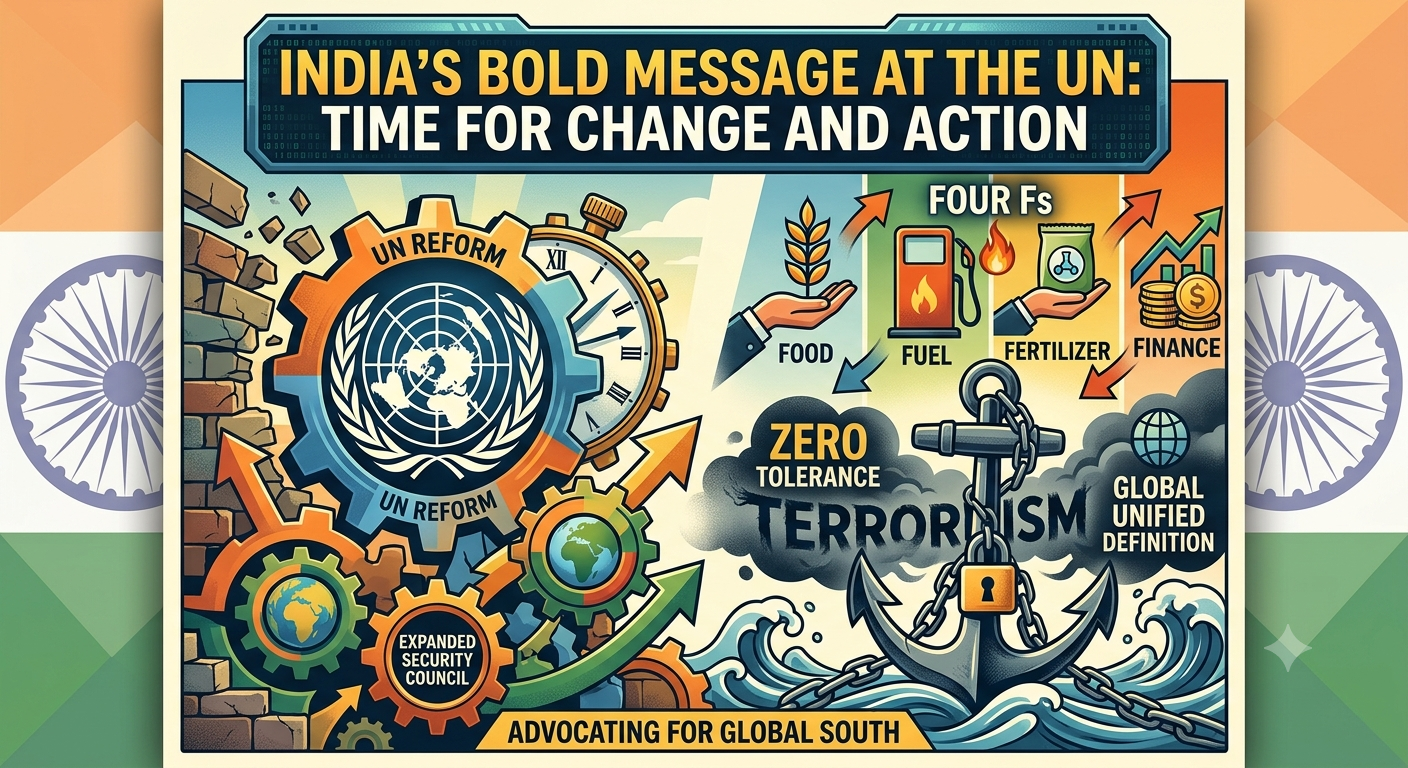
At the 81st United Nations General Assembly (UNGA), India’s External Affairs Minister, Dr. S. Jaishankar, delivered a powerful message to global leaders. He warned the world about growing international crises, demanded urgent updates to the UN system, and took a strict stand against countries that sponsor terrorism.
Here is a simple breakdown of the main points from his speech.
1. The UN Needs an Urgent Update
Jaishankar pointed out that the United Nations is trying to solve today’s modern problems using an outdated system created after World War II in 1945. Right now, the most powerful part of the UN—the Security Council—is heavily controlled by just five permanent member countries.
He argued that a world with over 200 countries cannot be effectively managed by just five nations. India strongly suggested expanding the UN Security Council to include more permanent and non-permanent members, making it fairer and more representative of today’s world.
2. The “Four Fs” Hurting Developing Nations
India used the platform to speak up for the “Global South” (developing and poorer nations). Jaishankar explained that ongoing global wars are causing a massive crisis in four key areas, known as the “Four Fs”:
Food: Wars disrupt trade routes, making it harder and much more expensive for poorer nations to get food.
Fuel: Conflicts, especially in the Middle East, cause oil prices and shipping costs to shoot up.
Fertilizers: Farming heavily relies on fertilizers. When supplies are cut off by war, global agriculture suffers.
Finance: Rising costs in wealthy countries cause financial instability and currency problems in developing nations.
Jaishankar highlighted a major unfairness: developing countries suffer the most from these global shocks, yet they are pushed to the back seat when global leaders make major decisions.
3. A Strict Warning on Terrorism
Without holding back, India delivered a stern message regarding cross-border terrorism, indirectly calling out Pakistan. Jaishankar stressed that the world must stop dividing terrorism into “good” and “bad” categories.
He urged the UN to finally agree on a single, global definition for terrorism. Right now, the lack of a clear definition allows some countries to exploit legal loopholes to fund and hide terrorist groups. He also made it completely clear that India will not treat terrorism as a simple police matter and will strike back forcefully against any attacks.
4. Stance on Global Conflicts and BRICS
Jaishankar also clarified India’s position on a few other major world issues:
Israel-Palestine: India continues to support a “Two-State Solution.” This means they believe both a secure Israel and an independent Palestine should exist peacefully side by side. He called for an immediate end to the fighting and focus on helping the innocent people in Gaza.
BRICS vs. The UN: When asked if the BRICS group (Brazil, Russia, India, China, South Africa) is trying to rival the UN, he said no. BRICS is simply acting as a collective voice to push the UN to improve and modernize.
Ultimately, India’s speech painted the picture of a country that is ready to lead, protect its borders, and fight for the rights of developing nations on the global stage.