




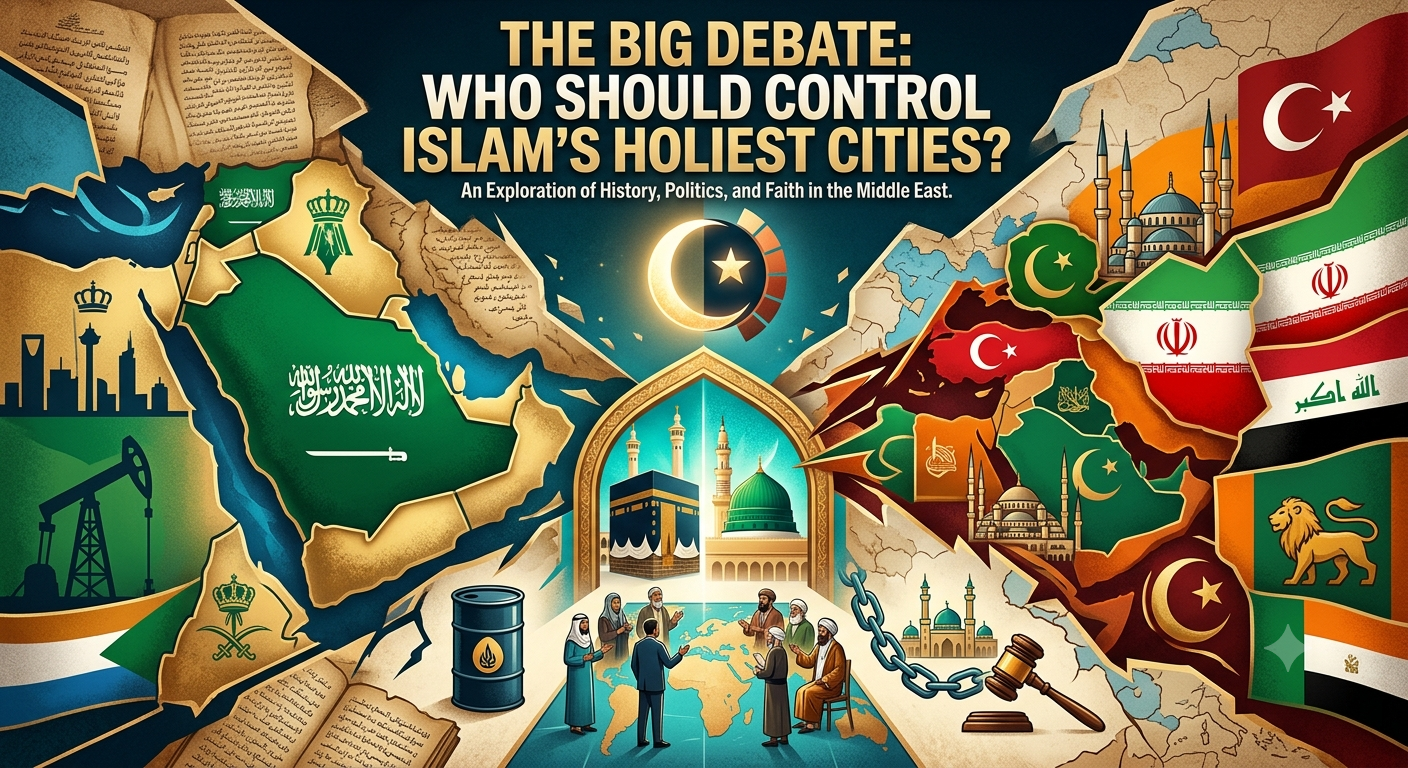
For a long time, Saudi Arabia has proudly served as the guardian of Mecca and Medina. However, a major question is being quietly discussed around the world: Should these two holy cities become an independent, self-governing area, similar to what Vatican City is for Catholics?
If this were to happen, it would completely change the balance of power in the Middle East. Here is a simple breakdown of the history, the politics, and the ongoing debate over who should protect the holiest sites in Islam.
A Look at History
Because Saudi Arabia currently controls Mecca and Medina, many people assume it has always been this way. However, the current Saudi royal family has only managed these cities for about 7% of Islamic history.
For hundreds of years, the holy cities were protected by different empires. Depending on the time period, the people in charge were based in places like Syria, Iraq, Egypt, and Turkey. It was only after the fall of the Ottoman Empire (based in modern-day Turkey) around World War I that the current Saudi rulers expanded their territory and took control of the region.
Mixing Religion and Politics
The King of Saudi Arabia holds the official title of “Custodian of the Two Holy Mosques.” This title gives the country immense respect and “soft power” across the globe.
However, critics argue that Saudi Arabia sometimes uses this religious role to play political games. For example, the Saudi government controls the visas required to attend the annual Hajj pilgrimage. In the past, when Saudi Arabia had political disagreements with other nations—like Qatar, Syria, or Iran—citizens of those countries suddenly found it very difficult, or even impossible, to get permission to visit Mecca.
Recent Conflicts and Security
The debate over safety and control flared up recently due to a drone incident. Saudi Arabia reported that it shot down a drone sent by Houthi rebels (a group from Yemen, backed by Iran) that was heading toward Mecca. Saudi Arabia used this to tell the world that the Houthis were attacking Islam itself.
The Houthis argued they were only aiming at a nearby military and trading base in the city of Jeddah, in response to Saudi Arabia bombing Yemen. Regardless of the exact target, rival countries used the event to ask a tough question: Is Saudi Arabia really capable of keeping the holy cities safe?
The 1979 Challenge
Saudi Arabia’s ability to protect the holy sites has been severely tested before. In 1979, a group of armed militants smuggled weapons into the Grand Mosque in Mecca in wooden coffins and took it over. They declared that the Saudi royal family was corrupt and acting like a puppet for Western countries.
Because non-Muslims are strictly forbidden from entering Mecca, and the Saudi forces lacked the right training to handle the crisis, the situation became a disaster. Eventually, Saudi clerics had to make a special religious exception so that highly trained French military commanders could officially “convert” and enter the city to help end the siege. It was a deeply embarrassing moment for the Saudi government.
What Other Countries Want
Today, powerful neighboring countries are pushing back against Saudi Arabia’s total control:
Turkey often reminds the world of its history, noting that Istanbul was once the leading city of the Islamic world, hinting they should still have a voice today.
Iran strongly believes Saudi Arabia shouldn’t be the leader of the Muslim world. They argue that because Saudi Arabia is a close partner of the United States, it cannot truly protect Islamic interests.
What Happens Next?
If Mecca and Medina were ever turned into an independent state, Saudi Arabia would lose a massive amount of its global influence. Its power in the Middle East is built just as much on its religious guardianship as it is on its oil wealth.
If that power were taken away, countries like Turkey, Iran, and Iraq would suddenly gain much more influence. While Saudi Arabia is firmly in control right now, history proves that the leadership over Mecca and Medina has never been permanent.