




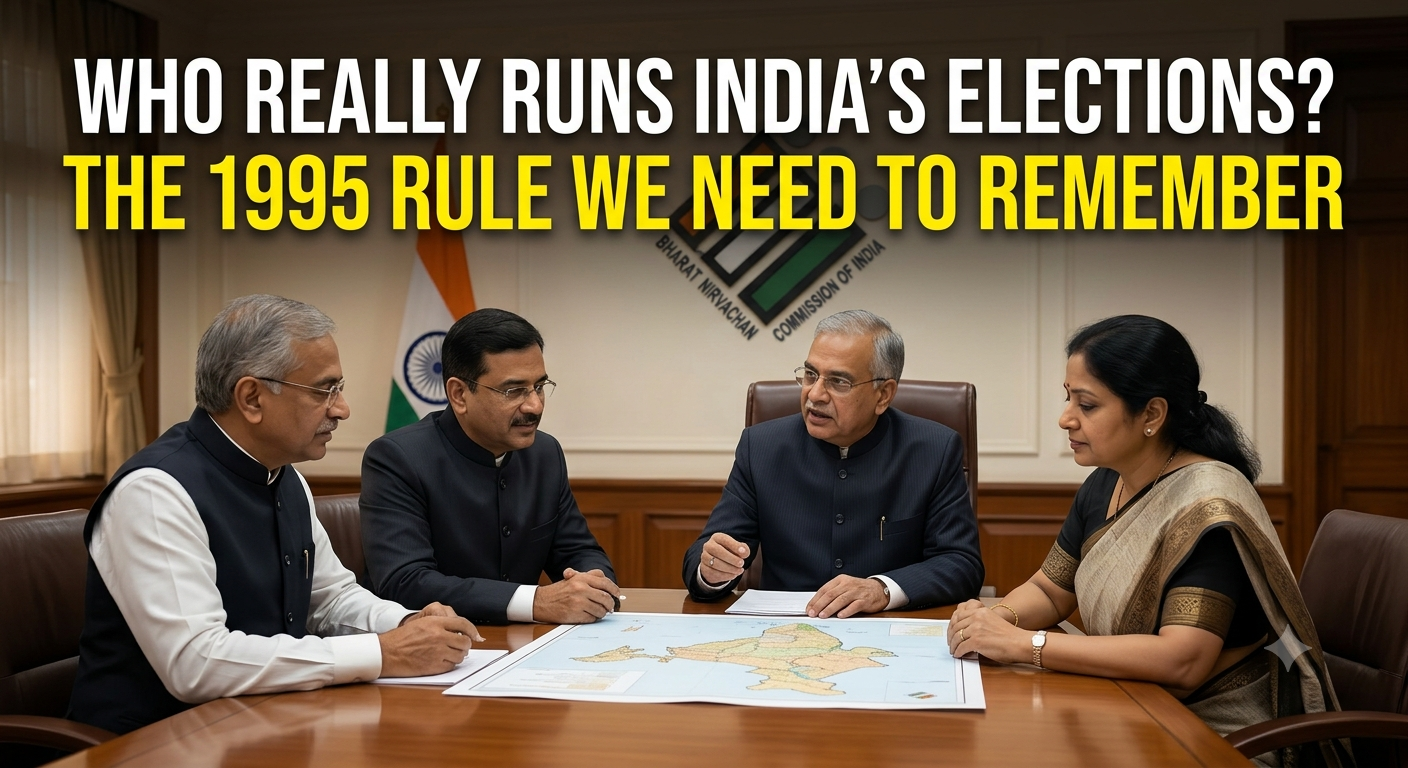
Does the Chief Election Commissioner (CEC) have the power to make all the rules for India’s elections? This question has been in the news lately, but the Supreme Court actually settled the debate way back in 1995. Their answer was simple: the Chief is not a dictator, and decisions must be made as a team.
The Story of T.N. Seshan
In the early 1990s, a man named T.N. Seshan was the Chief Election Commissioner. He is famous for making the Election Commission strict, powerful, and highly respected. Because he did such a massive job cleaning up the election system, he felt he should be the absolute boss of the organization.
However, in 1993, the government changed the structure. Instead of just having one Chief, they added two more Election Commissioners to share the workload. Seshan was deeply unhappy with this. He felt his power was being reduced and went to the Supreme Court, arguing that as the “Chief,” his word should be final.
What the Supreme Court Decided in 1995
In 1995, five Supreme Court judges looked at the case and established some very clear rules that still apply today:
Teamwork is Legal: The court said it is perfectly fine for the Election Commission to have three members instead of one.
“Chief” Doesn’t Mean Boss: The title of Chief Election Commissioner just means they lead the meetings. It does not make them the supreme leader, and they do not have the power to veto the other commissioners.
The Majority Wins: The court stated that the three members should try to agree on everything. But if they cannot agree, they must take a vote, and the majority decision wins. The Chief’s vote does not count more than the others.
Why Are We Talking About This Now?
This old court case is suddenly important again because of recent events. A news investigation recently claimed that two current Election Commissioners raised 14 formal objections over a 10-month period. Despite this, the current Chief Election Commissioner stated that all decisions were made with everyone’s full agreement.
If official objections were made, people are wondering how the decisions could be called unanimous. It brings up the exact same worry from 1995: Are the opinions of the other commissioners being ignored?
The Bottom Line
Managing elections in a massive democracy like India is too big of a job for just one person. That is exactly why the system is designed to be run by a team. The law is clear that the Election Commission must work together and respect majority voting, ensuring that no single individual can control how India votes.