




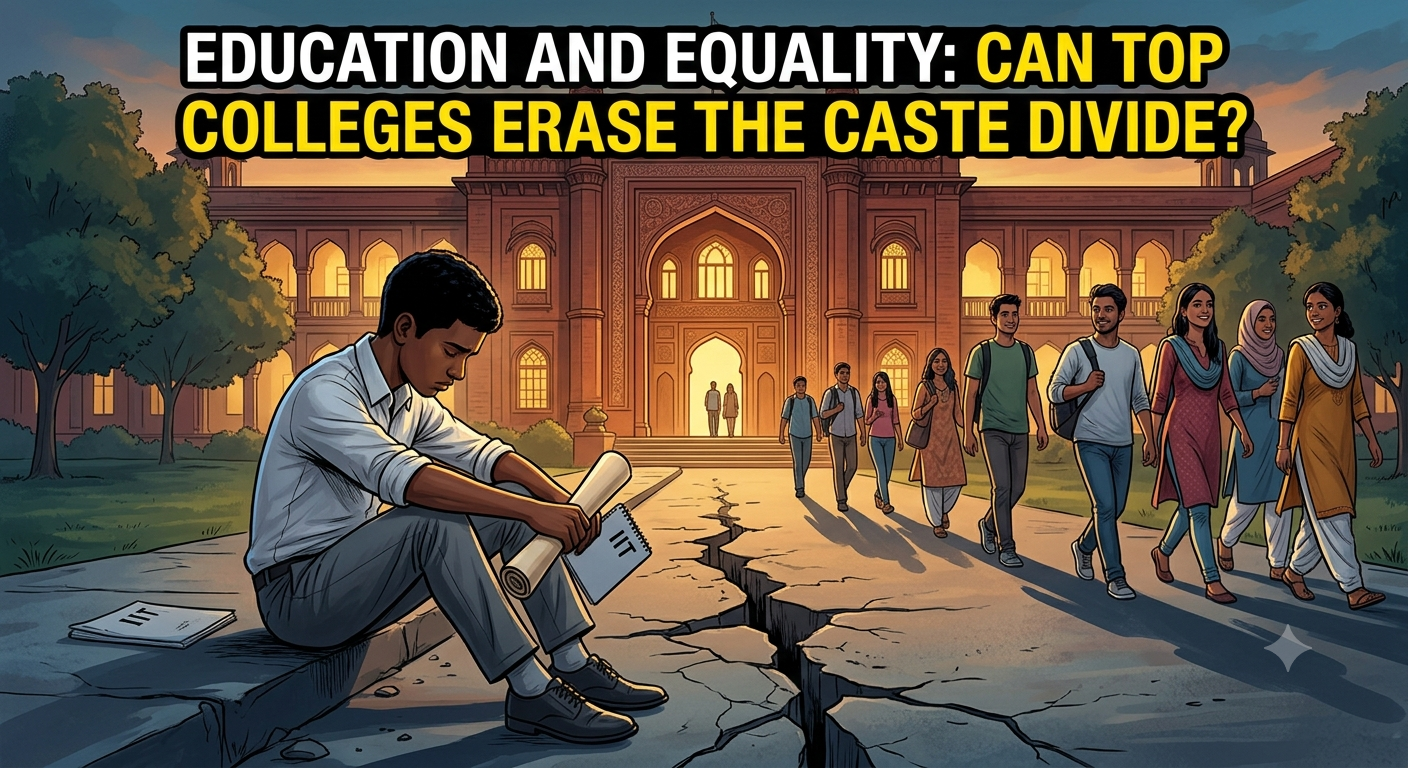
For many people, going to college is just a step toward getting a good job. For others, it is a way out of poverty. But for many marginalized families in India, education represents a powerful hope: a way to finally end generations of caste-based discrimination.
This raises a big question. Can getting a good education truly erase old social divides? While top colleges like the IITs and IIMs are known for rewarding hard work and talent, sad events on their campuses make us wonder if these places are truly equal for everyone.
The Heartbreaking Case at IIT Bombay
Recently, a second-year student named Sahil tragically ended his life at IIT Bombay. This terrible event has started a big debate about how students from lower castes are treated in top schools.
People have different views on what happened. Sahil’s family claims he took this step because a professor made hurtful comments about his caste. On the other hand, the college says Sahil was caught cheating on an exam using his phone and ChatGPT, and that he acted out of guilt.
Whatever the exact truth is in this specific case, it brings a larger, uncomfortable issue into the light. Sahil’s story is not the only one, and it shows that our biggest educational institutes have some deep-rooted problems.
Getting a Seat vs. Feeling Welcome
When we talk about fairness in education, we often focus on whether students from disadvantaged backgrounds are getting admissions. But we forget to ask what happens after they get in.
There is a big difference between simply being allowed into a room and actually feeling welcome. Two students might sit in the same classroom, read the same books, and do the same lab work, but experience college very differently because of their background. Getting a seat in a college is just the first step. If a student doesn’t feel respected and included by their peers and teachers, the system is still unfair.
Hidden Bias in Modern Times
Many Indian parents tell their kids that if they study hard, get into an IIT, and secure a good job, their caste will no longer matter. But this is only half true. While a great education helps reduce financial differences, it doesn’t automatically erase social differences.
Today, discrimination in colleges doesn’t always look like direct bullying. Instead, it is often hidden and quiet. It comes in the form of casual jokes, unfair assumptions that someone only got in because of a “quota,” or doubting a student’s intelligence. These daily, subtle insults slowly make students feel like they don’t belong.
A Problem That Keeps Happening
Sadly, we have seen this happen before. In 2023, another student at IIT Bombay, Darshan Solanki, lost his life under similar claims of caste discrimination. Over the last 20 years, several student suicides have occurred at top colleges across the country.
The problem became so serious that in 2025, the Supreme Court of India created a special team to look into why so many students in higher education were taking their own lives. Yet, here we are, and the problem still exists. We have to stop asking why one single student died and start asking what is wrong with the culture inside our top schools.
The Path Forward
Can education completely wipe out the caste system? Yes and no.
Education definitely helps. It gives people a chance to move up in life, break free from old stereotypes, and dream bigger. But education alone is not enough. Old prejudices are still deeply planted in our society, friendships, and families.
To truly fix this, schools need to build environments where a student’s background does not decide how they are treated. As the great leader Dr. B.R. Ambedkar said, education should be within the reach of everyone, not just a privilege for a few. Only when our schools become places of true equality and respect will education fulfill its promise of changing society.