




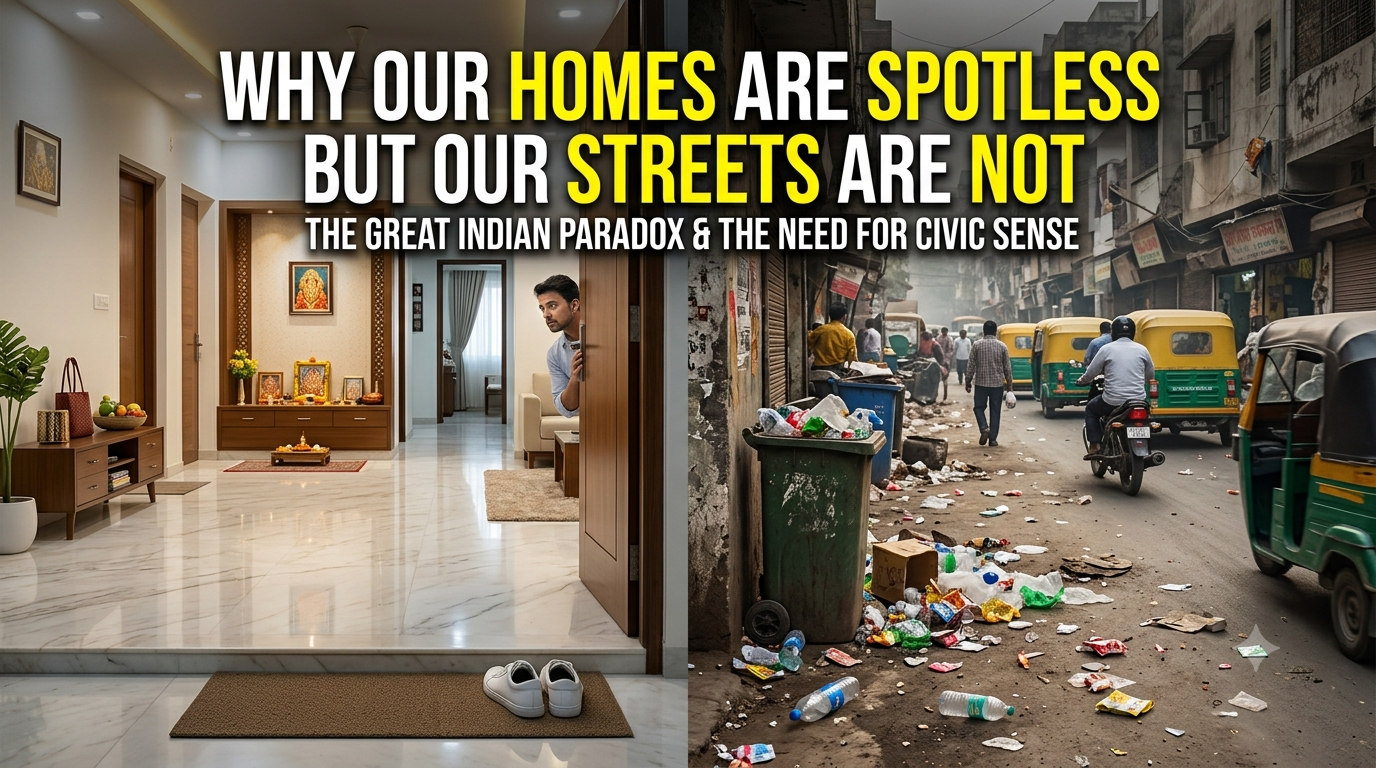
Think about a typical morning commute. We often see cars honking endlessly at red lights, people spitting on the roads, or someone tossing a chips packet out of a train window. We might even see an ambulance struggling to get through traffic because no one is willing to make way. Sadly, we have accepted these everyday rule-breaking behaviors as completely normal.
Three Examples of Public Carelessness
Recent events highlight how poorly we treat our shared spaces:
Littering at Holy Sites: After massive religious festivals, sacred places are often left buried under mountains of garbage. Instead of keeping the areas pure, visitors leave behind plastic, old clothes, and waste, forcing local authorities to spend huge amounts of time and energy cleaning up.
Disrespecting Public Memorials: When public parks are built to honor the armed forces and showcase military history, they are meant to educate the public. However, people often treat these memorials like playgrounds, climbing on exhibits and showing a lack of respect for the space.
Ignoring Health for Free Goods: In some cases, when factories dump expired and unsafe food near highways, crowds of people rush to collect it. Even when warned that the food is spoiled and dangerous to eat, the desire for a freebie takes over basic common sense.
The Great Cleanliness Paradox
Here is the most confusing part: if you visit the home of someone who just littered on the street, you will probably find it sparkling clean.
Inside their house, they might ask you to take off your shoes at the door. The kitchen will be spotless, and the floors might be mopped multiple times a day. This proves a very important point—we do not hate being clean. The real problem is that our desire for cleanliness ends the moment we step outside our own front door.
Is Poverty to Blame?
A common excuse for dirty streets is that developing nations simply do not have the money or resources to stay clean. However, global facts prove this wrong. There are several countries around the world with far less wealth that manage to keep their cities perfectly clean. A clean country is not the result of being rich; it is the result of good habits and civic sense.
A Needed Shift in Mindset
When thousands of tonnes of garbage are left at a holy river, it isn’t because people lack faith. It is because we simply do not view public spaces as our own. We respect our personal property, but we treat public property as if it belongs to no one.
The true success of a country is not measured by how shiny its private living rooms are, but by how well it takes care of its shared spaces. The good news is that we already have highly awarded, incredibly clean cities within our own borders, proving that we are fully capable of change.
It is not about money or destiny; it is about behavior. If we simply start treating the street outside our house with the same respect as our living room, we can transform our communities overnight.