



A recent civil services exam posed a thought-provoking question: If women are not considered a “minority” and do not belong to a “backward class,” on what legal grounds do they receive reservation in India?
To understand how women gained a reserved seat at the political table, we have to look at how the Indian Constitution is designed and how representation has grown over the years.
The Legal Rules: Why Are Women Granted Reservation?
To understand the reasoning, we first need to look at how the law classifies different groups of people:
They Are Not a “Minority”: In India, the law only recognizes minorities based on their religion or the language they speak. Because women make up roughly half of the country’s population, they cannot be labeled as a minority.
They Are Not a “Backward Class”: The Constitution allows the government to reserve jobs and positions for backward classes, but this is strictly based on factors like caste, class, or religion. Gender is not a factor here, so women do not qualify under this category either.
The Actual Legal Basis
Since women do not fit into the above categories, their reservation comes from two different rules:
Special Allowances: While the Constitution bans discrimination based on gender, it includes a specific rule that explicitly allows the government to create special, supportive laws just for women and children.
Creating a Fair Playing Field: The law promises equality for everyone. However, “true equality” means recognizing that women have faced historical disadvantages. To make things genuinely fair, the government is allowed to offer extra protections to help them catch up and compete on equal footing.
The Journey: From Villages to the National Capital
The push to get women into political office has happened in stages, starting from the ground up:
Success in Local Communities: The first major victory for women’s representation happened at the local level. Decades ago, laws were passed that guaranteed reserved seats for women in village councils (Panchayats) and city municipalities. This successfully brought millions of women into local leadership.
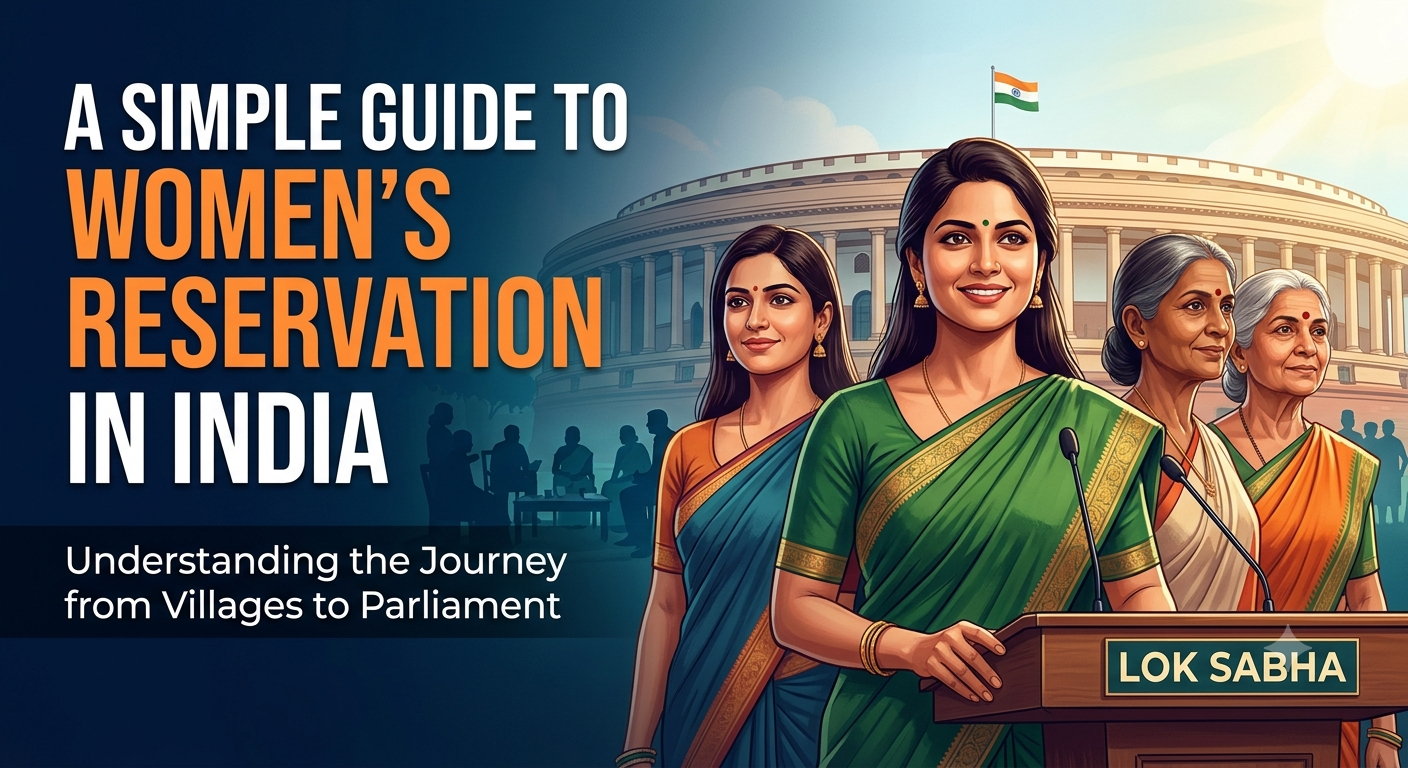
Reaching the Parliament: Even though local representation was strong, it took decades to bring that same fairness to national politics. Recently, a historic law was passed to finally reserve a percentage of seats for women in the national Parliament (Lok Sabha) and state governments.
The Real Reason We Need Women in Power
There is a common misunderstanding in politics and business that female leaders are only needed to deal with “women’s issues”—like workplace safety or maternal health.
This idea completely misses the point. Women are not elected just to solve problems for other women; they are elected to help solve problems for all of society. Whether the government is planning new highways, fixing the economy, or passing national laws, women’s voices are essential. For a country to truly succeed, female leaders must be involved in every single major decision, rather than being sidelined to topics that society decides are meant for women.