




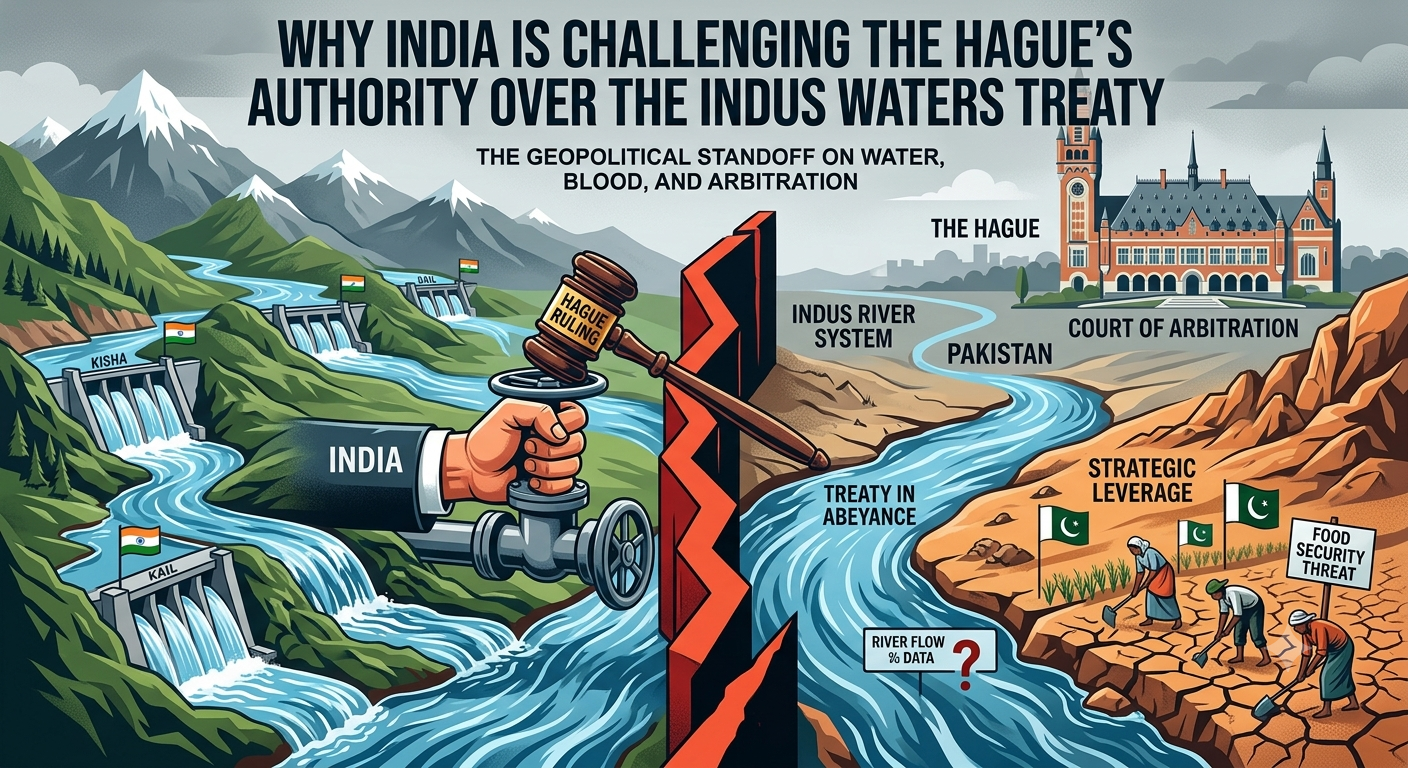
Recently, a global court based in The Hague (a city in the Netherlands) told India that it must continue following the rules of the Indus Waters Treaty with Pakistan. However, India completely rejected this decision. India argued that it does not recognize the court’s authority and refused to participate in the case. To understand why India took this strong stand, we have to look at the history of how the two countries share river water.
How the Water is Shared
Back in 1960, India and Pakistan signed the Indus Waters Treaty. This agreement decided how the two countries would share the water from the Indus River and its branches.
Under this deal, Pakistan got the lion’s share—about 80% of the water. Pakistan was given control over the three western rivers (Indus, Jhelum, and Chenab), while India got control over the three eastern rivers (Ravi, Beas, and Sutlej), making up the remaining 20%. Even though Pakistan controlled the western rivers, the treaty allowed India to use some of that water for basic needs and to generate electricity.
The Turning Point
Things changed drastically in April 2025 after a major terror attack. Following the attack, the Indian government stated that “water and blood cannot flow together.”
As a result, India decided to put the treaty on pause—or in “abeyance.” While India didn’t completely cancel the agreement, they stopped cooperating. Most importantly, India stopped sharing daily updates and data about water flow with Pakistan.
The Argument Over the Rules
When the treaty was created in 1960, the leaders knew there would be disagreements. So, they created a clear, step-by-step rulebook for solving fights:
First Step: A local joint committee to handle basic, everyday problems.
Second Step: A “Neutral Expert” to solve technical problems, like disagreements over how a dam is built.
Third Step: A “Court of Arbitration” (like the one in The Hague) for major legal disputes about the treaty itself.
The current fight happened because Pakistan skipped the second step. They had an issue with some of India’s dam projects and went straight to the Court of Arbitration. Meanwhile, India was already following the rules and talking to a Neutral Expert about the very same issue.
India argued that it is unfair and against the rules to have two different judges looking at the same problem at the exact same time. Because of this, India ignored the Hague court and is waiting for the Neutral Expert to give their decision next year.
Using Water to Send a Message
India’s choice to pause the treaty and ignore the court is a calculated political move. India is using water to put pressure on Pakistan.
Pakistan’s economy is fragile, and it relies heavily on farming to feed its people. Farming requires a predictable water supply. Because India has stopped sharing water data, Pakistan is left guessing about when the rivers will be high or low. By making Pakistan’s water supply unpredictable, India is using economic pressure to push Pakistan to stop supporting cross-border terrorism.
Summary
In simple terms, India’s rejection of the Hague court’s ruling isn’t just a legal disagreement. India insists that Pakistan must follow the proper, step-by-step rules of the 1960 agreement. At the same time, India is using its geographic advantage over the rivers to send a strict message to Pakistan: national security comes first.