


When lawmakers in India vote on a new law or make a major decision, they don’t always use the same voting rules. The Indian Constitution has different requirements depending on how serious the decision is.
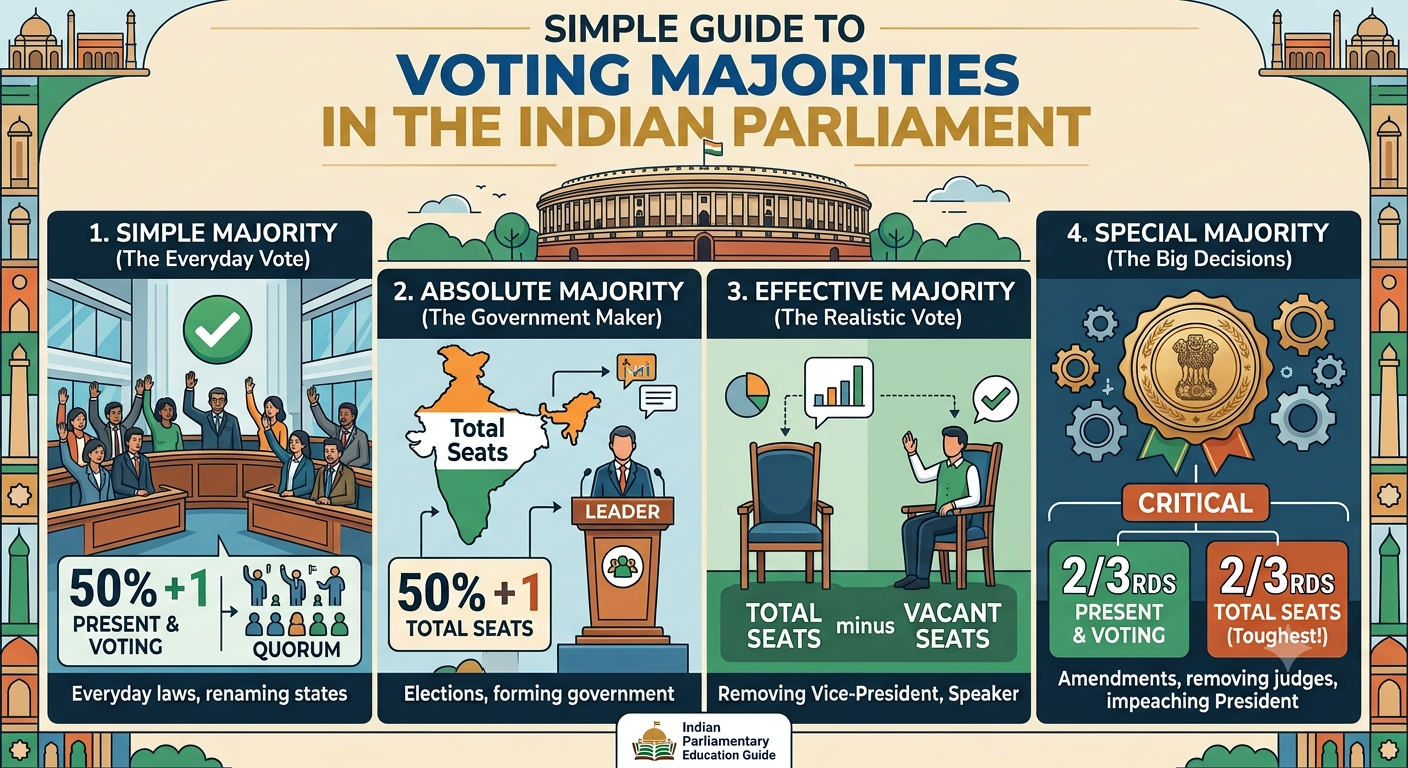
Broadly, there are four main types of majorities used in Parliament: Simple, Absolute, Effective, and Special. Here is an easy-to-understand breakdown of how each one works.
1. Simple Majority (The Everyday Vote)
This is the most common way to pass standard laws. It only looks at the people who actually show up to Parliament on that specific day and decide to vote.
The Rule: More than half (50% + 1) of the members who are present and actively voting.
The Catch: A vote can only happen if a minimum number of members are present in the room. This minimum requirement is called a “quorum” and is 1/10th of the total house seats.
When is it used? Passing everyday laws, renaming states, changing state borders, or handling financial emergencies.
2. Absolute Majority (The Government Maker)
This rule ignores who is absent or sick. It looks strictly at the total number of seats in the house.
The Rule: More than half (50% + 1) of the total seats in the house.
Example: The Lok Sabha has 545 seats. Half of that is 272.5, so you need exactly 273 votes to win this majority, no matter how many people actually showed up that day.
When is it used? During elections. A political party must reach this “magic number” to prove they have enough support to form the government.
3. Effective Majority (The Realistic Vote)
Sometimes, seats in Parliament are completely empty (vacant) because a member has resigned, been disqualified, or passed away. This majority adjusts the math to only count the seats that currently have active members.
The Rule: More than half (50% + 1) of the effective strength (Total Seats minus Vacant Seats).
When is it used? Removing the leaders who run the Parliament sessions, such as the Vice-President, the Speaker, or the Deputy Speaker.
4. Special Majority (The Big Decisions)
If a vote doesn’t fit into the first three categories, it is a Special Majority. These are used for critical constitutional changes and are much harder to achieve. There are four distinct types:
Type 1 (For State and Service Matters): Requires 2/3rds of the members who are present and voting. This is used when the central government needs to make a law on a state-level topic or create a new national government service.
Type 2 (For Constitutional Changes): This is a double test. You need 2/3rds of the members present and voting, AND that final number must also cross the Absolute Majority line (more than half of the total house seats). This is used for amending the Constitution, removing Supreme Court Judges, or declaring a National Emergency.
Type 3 (The Hardest Vote): This requires 2/3rds of the total seats in the entire house, regardless of who is absent or if seats are vacant. It must be passed this way in both houses. Because it is so difficult, it is used for only one thing: removing (impeaching) the President of India.
Type 4 (The State Partnership): This requires the Type 2 vote in Parliament, PLUS more than half of India’s individual State Governments must also agree to it. It is used when a constitutional change impacts the states directly, such as introducing the Goods and Services Tax (GST).
Summary
India’s voting rules are designed with a careful balance. Simple rules allow the government to do its daily work smoothly, while very strict rules ensure that no single group can easily change the core structure of the country’s Constitution or remove its highest officials without overwhelming agreement.
Would you like to explore a specific historical event or bill where one of these strict special majorities was actually put to the test?