




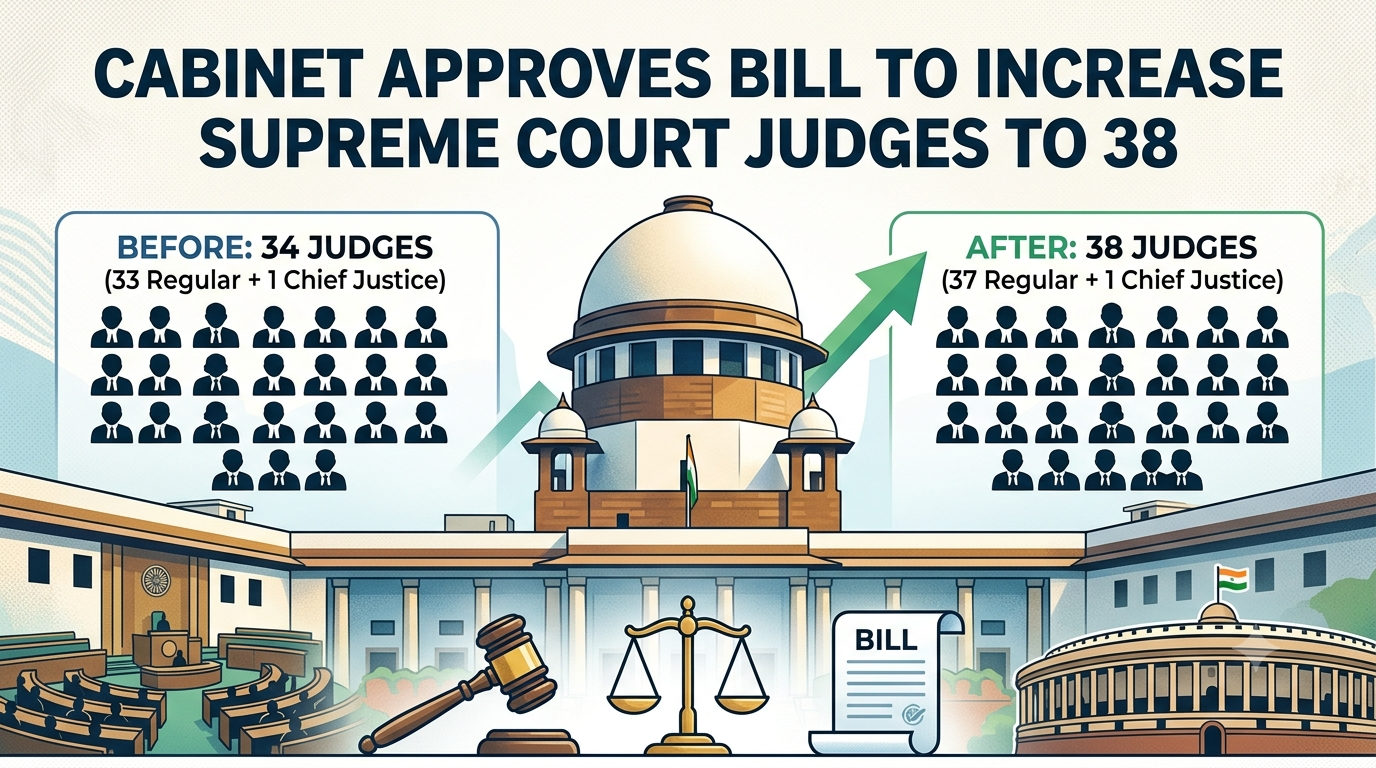
Recently, during its Monsoon Session, the Indian Parliament passed a new law to increase the number of judges in the Supreme Court. This move was made to help clear the massive pile-up of delayed court cases across the country.
What is the Big Change?
The new law is called the Supreme Court Number of Judges Amendment Bill 2026. Its main goal is to raise the maximum number of judges who can sit in the Supreme Court.
Before: Since 2019, the limit was 34 judges (which means 33 regular judges plus 1 Chief Justice of India).
Now: The new limit is 38 judges (37 regular judges plus 1 Chief Justice of India).
How Are New Judges Added?
The rules for adding judges are different depending on the type of court:
For the Supreme Court: According to Article 124 of the Constitution, only the Parliament has the power to add more judges. They must vote and pass a specific law to make it happen.
For High Courts: According to Article 216, it is much easier. The Parliament doesn’t need to pass a new law. Instead, the President of India can simply decide to add more judges after getting advice from the Chief Justice and the government.
A Quick Look Back in Time
When the Supreme Court’s rules were first created in 1956, there were only 8 judges in total (1 Chief Justice and 7 judges). As India’s population grew and legal issues became more complex, Parliament had to increase this number several times—moving to 10, 13, 17, 25, and 34 over the decades, before reaching 38 today.
Why Was This Law Needed?
The biggest reason is the sheer number of pending cases. People are seeking justice more often, and because filing a case online is now very easy, the Supreme Court is overwhelmed. The government hopes that having more judges will speed up the process of delivering justice.
What Are the Real Challenges?
While adding four new judges sounds good, experts say it won’t magically solve the problem of delayed justice. Here are a few reasons why:
The “Uncle Judge” Problem: This is a popular term used to describe favoritism or nepotism in the courts, where people are sometimes picked for top jobs because of their family connections rather than just their skills.
Slow Hiring: There are already many empty judge seats across the country, and the process of hiring new ones is very slow.
Expert Warnings: The 18th Law Commission previously warned that simply increasing the head-count of judges does not guarantee that cases will move faster.
What Should Be Done Next?
To really clear the backlog, the justice system needs better planning and better facilities. For example, courts could set aside specific days just to finish older cases.
Additionally, India has special, smaller courts called “Tribunals” meant to handle specific issues (like business disputes or family matters). However, if people lose their case in a Tribunal, they often just appeal to the Supreme Court anyway, which brings the burden right back. To fix the system, these smaller Tribunals need to be made stronger and more reliable so that people trust their decisions without always running to the higher courts