



For years, major competitive exams in India, such as NEET and UGC-NET, have struggled with a massive problem: paper leaks. When exam papers are stolen and sold by cheating gangs, honest and hardworking students suffer the most. It destroys the idea of a fair competition and causes huge mental and financial stress for students who have to retake exams.
To finally put an end to this, the government has introduced the Public Examinations (Prevention of Unfair Means) Amendment Bill 2026. This new law brings much stricter punishments and uses smart technology to make sure exams are completely safe and fair.
Here is a simple look at what the new law changes:
Strict New Punishments
To stop people from even thinking about leaking papers, the 2026 law has greatly increased the penalties:
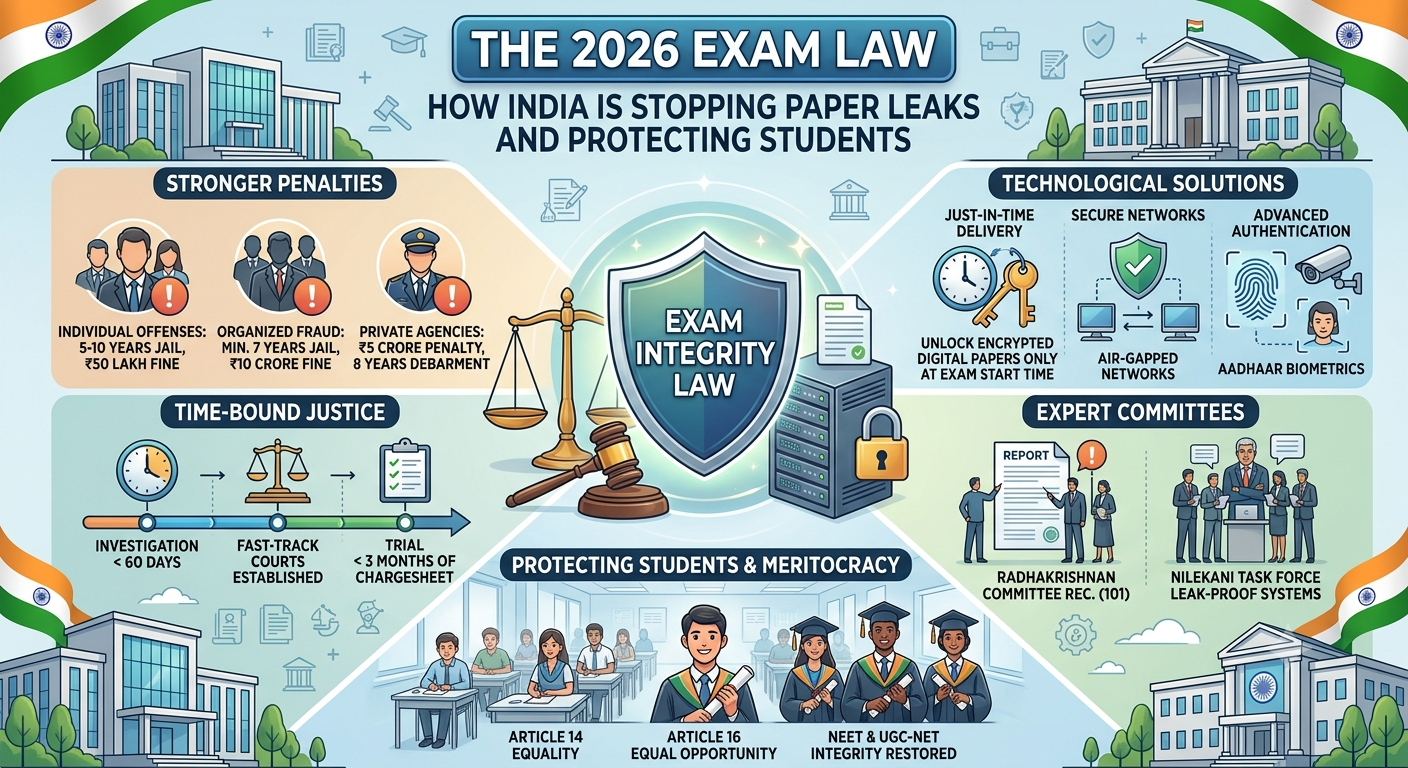
For Individuals: Anyone caught helping to leak a paper can be sent to jail for 5 to 10 years. On top of that, the fine has been increased from ₹10 lakh to a massive ₹50 lakh.
For Organized Gangs: Groups or syndicates whose main business is cheating and hacking exams face a minimum of 7 years in jail. Their fines have been increased from ₹1 Crore to an unbelievable ₹10 Crore.
For Private Exam Centers: Many exams are run by private companies. If these companies are found guilty of cheating or failing to secure the exam, they can be fined up to ₹5 Crore. They will also be banned from conducting any government exams for up to 8 years.
Faster Justice
The new rules make sure that cheaters are punished quickly. Police must finish their investigations within 60 days. Special fast-track courts will be set up just for exam frauds, and trials must begin within 3 months of charges being filed.
Expert Advice and Better Technology
The government is taking advice from top experts to fix the root of the problem:
Expert Committees: A recent committee led by former ISRO chief K. Radhakrishnan gave 101 ideas to improve exams, such as relying more on secure government centers instead of private ones. Currently, a special tech team led by Nandan Nilekani (one of the creators of Aadhaar) is working to make the exam system entirely leak-proof using modern technology.
Smart Security: Instead of sending out papers days in advance, the new system aims for “just-in-time” delivery. This means digital question papers are securely unlocked only minutes before the exam starts. The government is also pushing for secure computer networks, last-minute local printing for paper exams, and strict fingerprint and camera checks at exam centers.
Looking Ahead
While strict laws and high-tech security are necessary right now to stop cheating, long-term changes are also on the way. Programs under the new National Education Policy aim to change how students learn—focusing on actual understanding rather than just memorizing answers.
By combining heavy fines, quick jail time, and smart technology, the 2026 law is a major step toward making sure that every student in India gets a fair and equal chance at success.