




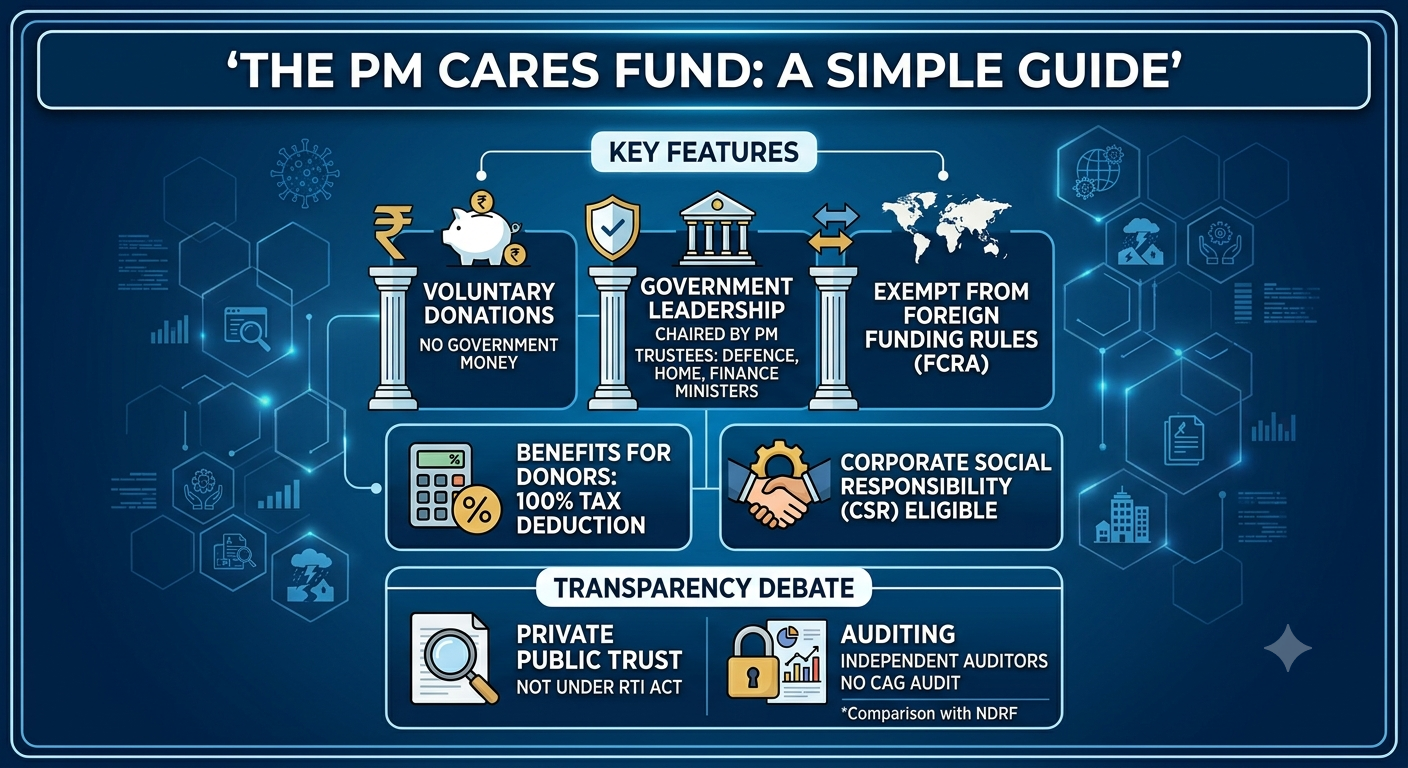
The PM CARES Fund (Prime Minister’s Citizen Assistance and Relief in Emergency Situations Fund) was established in March 2020 as a public charitable trust to tackle the COVID-19 pandemic and other emergencies. It is chaired by the Prime Minister, with the Defence, Home, and Finance Ministers as trustees. While it receives significant contributions—offering tax benefits and counting towards corporate social responsibility (CSR)—and is exempt from foreign contribution regulations, its legal status and auditing processes have sparked considerable debate.
What is the PM CARES Fund?
The PM CARES Fund is a dedicated pool of money created primarily to provide relief during public health crises, natural disasters, or man-made calamities. It operates entirely on voluntary donations from individuals, companies, and foreign entities, receiving no direct budgetary support from the government.
Tax Benefits: Donations to PM CARES are 100% tax-deductible under Section 80G.
CSR Contributions: Corporate donations count toward a company’s Corporate Social Responsibility (CSR) requirements.
Foreign Funds: The fund is exempt from the Foreign Contribution Regulation Act (FCRA), meaning it can accept foreign money without the typical hurdles faced by NGOs.
Why the Controversy Over Transparency?
Despite its high-profile government leadership, the PM CARES Fund operates in a “legal gray zone,” leading to questions regarding its transparency.
1. It is Not a Government Fund (Legally Speaking)
Even though the Prime Minister chairs it and government ministers are trustees, PM CARES is officially classified as a private “public charitable trust”. The government has argued that it is not a “public authority” under the Right to Information (RTI) Act, which means it can dismiss queries about its operations and how funds are spent.
2. The Auditing Dispute
A common misconception is that the fund is “unaudited.” It is audited, but by independent chartered accountants appointed by the trust, not by the Comptroller and Auditor General (CAG). The Supreme Court ruled in 2020 that because PM CARES does not use government budgetary money, it does not require a CAG audit.
3. Comparison to the NDRF
Critics often ask why the fund was needed when the National Disaster Response Fund (NDRF) already existed. The NDRF is a statutory government fund that is heavily regulated and CAG-audited. The Supreme Court rejected petitions to transfer PM CARES money into the NDRF, stating that they serve different institutional purposes.
4. Delay in Financial Disclosures
While the fund initially released some financial statements, recent concerns have highlighted a gap in public disclosures, with audited statements reported only up to the 2022-23 financial year. Without timely, detailed reporting on how the accumulated thousands of crores are being spent (or saved for future emergencies), transparency advocates argue that public trust is undermined.
Summary
The PM CARES Fund was highly successful in raising money quickly during a national crisis. However, because it enjoys the prestige and benefits of a government initiative while maintaining the legal privacy of a private trust, it faces ongoing calls for greater accountability and clearer public reporting.