




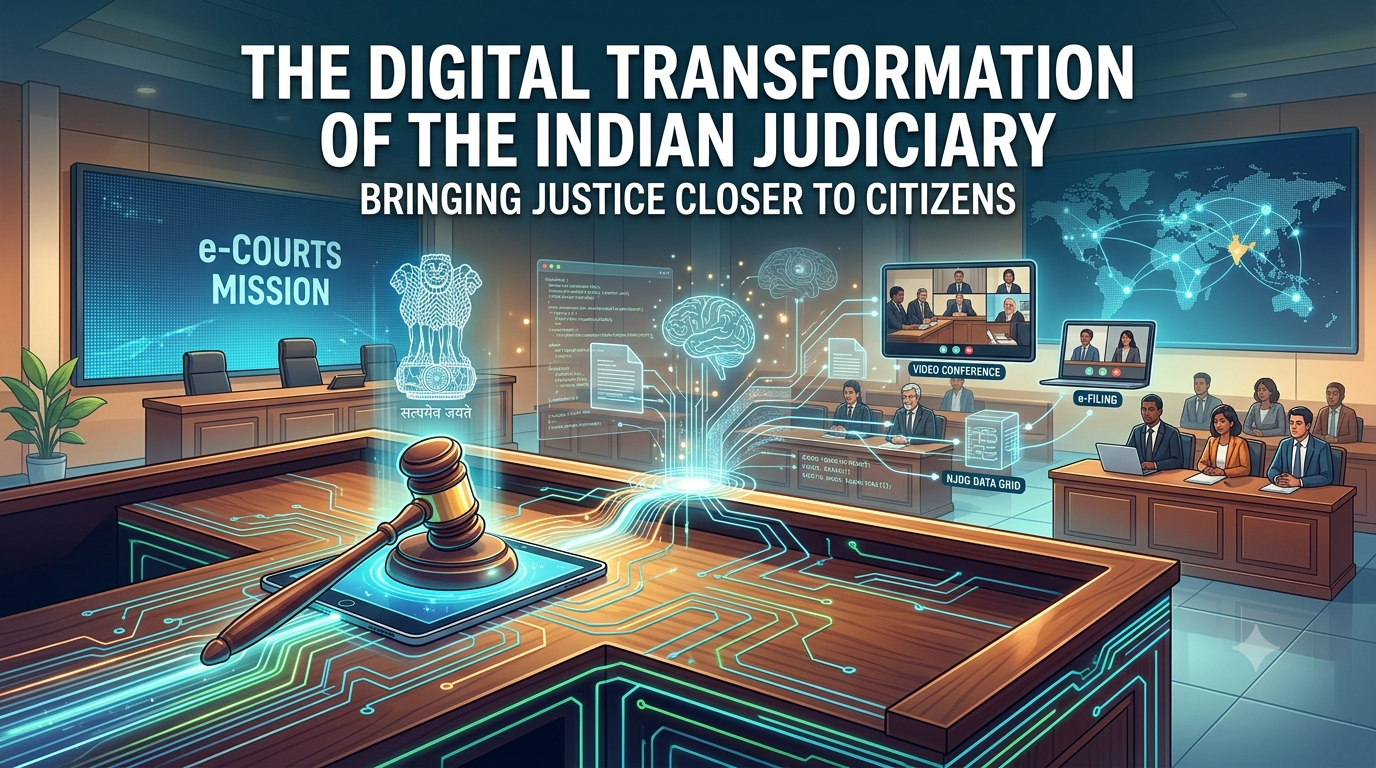
For a long time, seeking justice in India meant spending a lot of time and money. People had to travel to courts repeatedly, deal with huge stacks of paperwork, and wait in long lines just to find out their next hearing date. Today, this is changing quickly. The Indian justice system is upgrading from physical, paper-filled courtrooms to a modern digital world, making it much easier for ordinary citizens to get the help they need.
The “e-Courts” Project
To fix the slow, traditional system, the government started a special project to bring courts into the digital age. This was done in three steps:
Step 1 (2011–2015): Thousands of local courts were given computers and connected to the internet.
Step 2 (2015–2023): New online services were created, and cameras and screens were installed so people could attend court via video calls.
Step 3 (2023–2027): Currently, the focus is on making courts completely “paperless” and using smart technology like Artificial Intelligence (AI) to speed up court work.
Big Changes Making Life Easier
1. Tracking Cases Online
In the past, finding out what was happening with a case was difficult. Now, there is a public online website called the National Judicial Data Grid (NJDG). Anyone can use it to check case details, read past judgments, and see how many cases are pending. This makes the whole system much more open and honest.
2. Filing Papers from Home
Thanks to “e-Filing,” lawyers and regular people no longer have to visit the courthouse just to hand in a document. They can submit legal papers, pay court fees, and sign documents online from anywhere. Millions of cases have already been filed this way.
3. Saving Old Records
Indian courts have millions of old paper files that take up space and can get damaged easily. To solve this, the government is scanning them. So far, over 7.5 billion pages of old court records have been saved digitally, meaning they can now be searched and found in seconds on a computer.
4. Video Calls and Virtual Courts
Video conferencing has completely changed how courts work. People don’t always have to travel to another city for a hearing anymore. Also, special “Virtual Courts” have been set up just for handling simple things like traffic tickets online. Millions of traffic fines have been paid this way, keeping minor issues out of the physical courtrooms.
Connecting Police, Courts, and Prisons
The digital upgrade isn’t just for judges; it connects the whole legal system. A new secure network allows police stations, courts, prisons, and science labs to share information instantly. For example, when the police finish a report, they can send it directly to the court’s computers without printing a single page.
Helping Everyone Use the Technology
Technology is only good if people know how to use it. To make sure no one is left behind, the courts have introduced a few helpful features:
Help Centers: “e-Sewa Kendras” (help centers) have been set up in court buildings. If someone doesn’t know how to use the internet, the staff there will help them check their case status or file papers.
Phone Updates: People now get text messages (SMS) and emails telling them when their next court date is. There is also a free mobile app to track cases.
Local Languages: Legal words can be confusing, especially if they are only in English. To fix this, court decisions are now being translated into local Indian languages (like Hindi) so that everyone can understand their own case.
What’s Next: Artificial Intelligence (AI)
The courts are starting to use Artificial Intelligence (AI) to help with time-consuming tasks. AI is being used to quickly translate documents, research old laws, and type out what people are saying during hearings. However, the system is very clear about one thing: AI will never replace human judges. It is simply a helpful tool to let judges focus on making fair decisions faster.
Conclusion
Upgrading India’s courts is about much more than buying computers. It is a complete change in how citizens experience the law. By cutting down travel time, saving paper, and bringing legal updates straight to people’s phones, technology is doing exactly what it was meant to do: bringing justice closer to the people.