


Large-scale infrastructure projects often highlight the delicate balance between national development and the rights of local communities. India’s pioneering river-interlinking initiative, the Ken-Betwa Project, has recently brought this tension to the forefront. Driven by the promise of solving severe water scarcity, the project has nonetheless sparked intense grassroots resistance, culminating in a 15-day demonstration that was unexpectedly dispersed by authorities.
Here is a closer look at what the project entails, why local communities are pushing back, and the ecological debates surrounding it.
The Vision Behind the Ken-Betwa Link
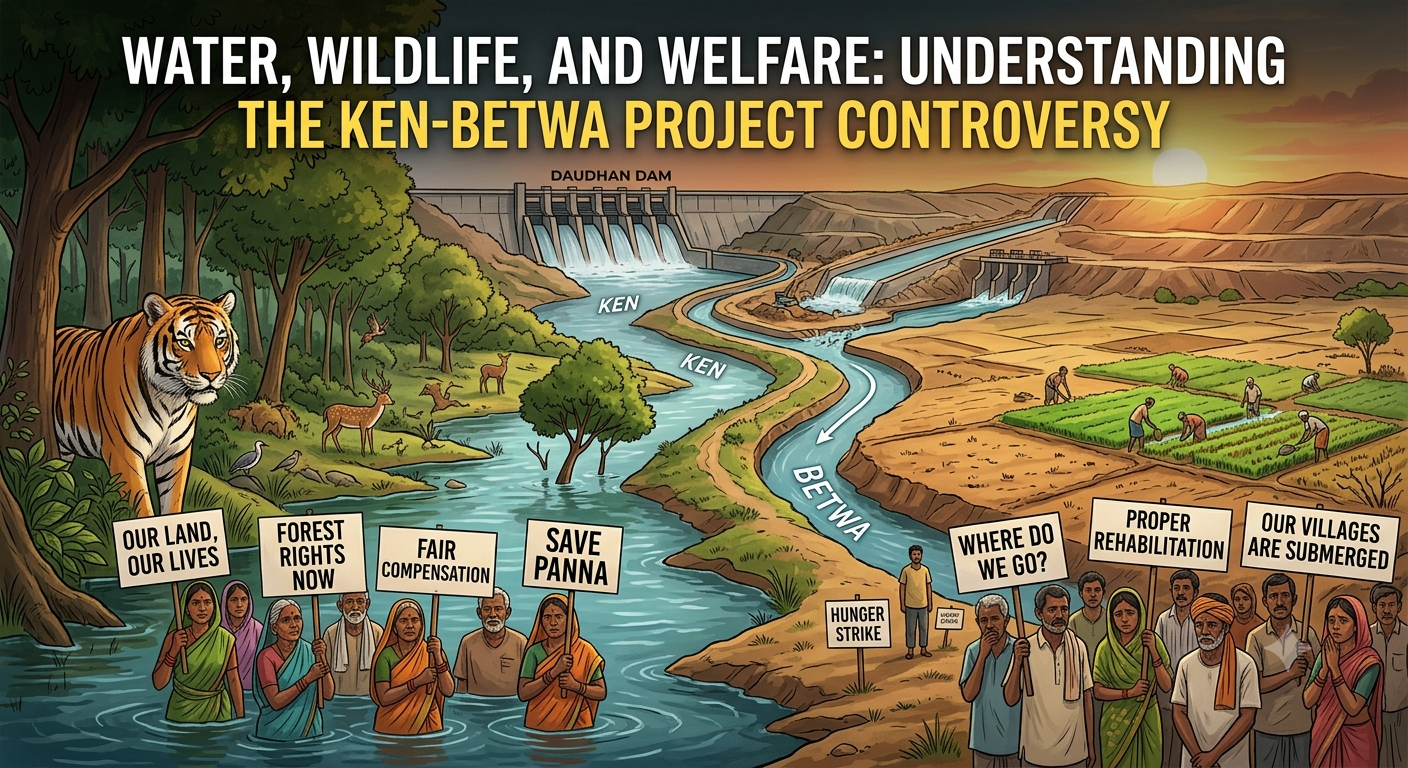
As the first major inter-basin water transfer initiative under India’s National Perspective Plan, the Ken-Betwa project is designed to redirect surplus water from the Ken River into the Betwa River via a massive artificial canal.
The primary target for this diverted water is Bundelkhand, a region spanning parts of Madhya Pradesh and Uttar Pradesh that has historically been plagued by devastating droughts, groundwater depletion, and frequent crop failures.
Core Project Statistics:
Financial Investment: Estimated at over ₹44,000 crore.
Key Infrastructure: Centers around the construction of the Daudhan Dam and a 221-kilometer connecting canal.
Energy Production: Designed to generate a combined 130 MW of renewable energy (103 MW of hydroelectric and 27 MW of solar power).
Human Impact: Aims to provide secure drinking water to approximately 6.5 million people while irrigating vast tracts of agricultural land.
The Roots of Local Resistance
Despite its overarching goals, the initiative has faced heavy criticism from the people living directly in its path. In early July 2026, rural farmers, women, and indigenous tribal groups gathered near the Daudhan Dam site in Chhatarpur district to voice their opposition.
Under the leadership of social activist Amit Bhatnagar—who initiated an indefinite hunger strike—the demonstrators laid out three primary demands:
Equitable Compensation: Locals claim they are not being offered fair market value for the land they are being forced to surrender.
Comprehensive Relocation: Displaced residents are demanding that their new settlement areas come equipped with functional infrastructure, including paved roads, schools, housing, and viable agricultural plots.
Protection of Forest Rights: Many tribal families rely entirely on the local forests for fuel, grazing, and food, and are demanding formal recognition of these traditional rights before being displaced.
Symbolic Forms of Protest
To draw attention to their cause, the demonstrators utilized highly creative and emotionally charged methods of dissent:
Jal Satyagraha: Protestors stood waist-deep in the river for hours, illustrating how the very waters that sustain them are being used to drown their ancestral homes.
Cheetah Satyagraha: Participants lay upon effigies of cheetahs, visually connecting their own survival to the preservation of local wildlife and natural habitats.
Phansi Satyagraha: Mock hangings were staged to demonstrate the life-threatening economic and emotional despair caused by forced displacement.
The Sudden Dispersal
The peaceful, albeit intense, demonstrations ended abruptly on their 15th day. At 5:00 AM, local police and administration officials moved in to dismantle the encampment. Amit Bhatnagar was transported to a local hospital, while the remaining villagers were loaded onto buses and returned to their homes.
Authorities defended the intervention as a necessary public safety measure rather than an attempt to stifle free speech. They pointed to rising river waters brought on by monsoon rains, the hazardous proximity of an active bridge construction site, and the rapidly failing health of the hunger-striking leader as urgent reasons for clearing the area.
However, many protestors pushed back against this narrative, alleging that the eviction was a strategic move by the administration to prevent the demonstrators from exposing widespread corruption and irregularities within the project’s management.
The Ecological Cost
Beyond human displacement, the Ken-Betwa link has alarmed environmental scientists and conservationists. A significant portion of the planned infrastructure intersects with the Panna Tiger Reserve.
Submerging this protected woodland threatens to fragment critical wildlife habitats and trigger a massive loss of biodiversity. Furthermore, ecologists warn that artificially altering river courses can devastate downstream ecosystems, harm fish populations, and disrupt natural wetland cycles. There is also the looming threat of climate change; critics argue that shifting weather patterns could soon render the Ken River itself deficient in water, making the multi-billion-rupee transfer canal essentially useless.
The Official Standpoint
Despite the pushback, both the State Government of Madhya Pradesh and the Union Government remain steadfast in their support for the project. Officials emphasize that all necessary legal and environmental clearances have been secured.
From the government’s perspective, the immediate rehabilitation packages are being actively implemented, and the temporary disruption of local communities is a necessary sacrifice for a project that will ultimately secure the economic and agricultural future of millions in the drought-stricken Bundelkhand region.