




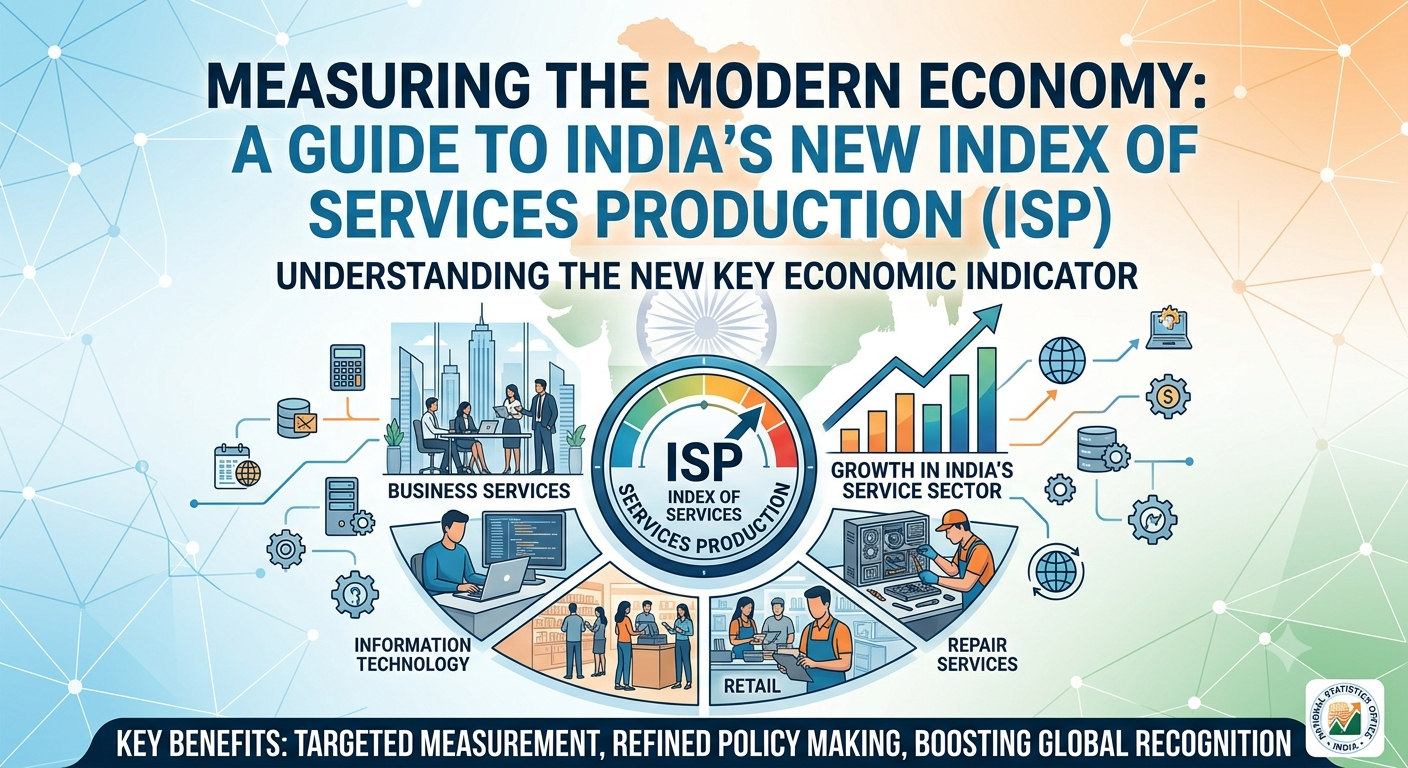
For a long time, India has closely tracked how well its factories and industries are doing using tools like the Index of Industrial Production (IIP). However, there was a big missing piece in the puzzle: the services sector.
To fix this, the government (specifically the Ministry of Statistics and Programme Implementation and the National Statistics Office) has introduced a brand-new tool called the Index of Services Production (ISP).
Here is a simple breakdown of what this new index is and why it matters.
Why Do We Need a Services Index?
While industries are important, the services sector (which includes businesses like retail, IT, and repair services) is actually the biggest driver of India’s economy today.
Massive Contribution: Since 2013-2014, services have made up more than half (around 52% to 53%) of India’s total economic output.
Job Creation: It employs about 30% of the country’s workforce and has created roughly 40 million jobs in just the last six years.
Global Trade: India exports a massive amount of services, which brings in valuable foreign money and investments. The government even hopes that by 2047, Indian services will make up 10% of all global exports.
Despite being this important, we didn’t have a dedicated monthly tool to measure its growth. The ISP finally fills that gap.
How Will the ISP Work?
The government has laid out clear rules for how this new index will track the economy:
What it covers: The index will monitor 19 different categories within the services sector, such as wholesale trade, retail stores, and repair businesses.
Official businesses only: The ISP will only track the “formal” sector. This means it will only look at registered, official companies, not informal or unregistered street vendors.
The Starting Point (Base Year): To measure growth, you have to compare current numbers to a starting point. The ISP will use the financial year 2024-2025 as its base year.
A 60-Day Delay: Gathering all this information takes time. Because of this, the ISP reports will come out two months (60 days) after the month being tracked. For example, the data for April will be officially published at the end of June.
Where Is the Data Coming From?
In the past, trying to measure the entire services sector was too difficult. Today, because everything is more digital, it is finally possible.
The government will gather information primarily using GST records and an annual survey of registered service businesses.
A special committee, led by expert D. Jani Goss, helped design how the math will work. They decided to use a well-known statistical formula (called the Fixed-weight Laspeyres Volume Index). In simple terms, this just means the government will collect detailed data and weightages during the 2024-2025 base year, and use those fixed numbers as a measuring stick for all future years.
The Big Picture
By launching the ISP, India is catching up with other major economies like the United Kingdom, South Korea, and countries in the European Union, which already track their service sectors this way. Moving forward, the ISP will give leaders, businesses, and citizens a much clearer and more accurate picture of how India’s economy is truly performing.