


A healthy and stable economy is the backbone of any successful country. When a country’s finances are stable, everyday citizens and foreign businesses trust the system enough to save, spend, and invest their money.
To make sure India’s economy stays on track, the Reserve Bank of India (RBI) regularly checks the health of the country’s finances. They share their findings in a document called the Financial Stability Report (FSR). Here is a simple breakdown of the 2026 report and what it means for the country.
The Basics: What is the FSR?
How often does it come out? The RBI releases this report twice a year (every six months).
When did it start? The very first report was published back in March 2010.
Who helps make it? The RBI doesn’t write it alone. They get help from the Financial Stability and Development Council (FSDC). This is a special group set up in 2010 by the government to keep the financial system safe. It works under the Ministry of Finance and is led by the Union Finance Minister.
Why Do We Need This Report?
Think of the report as a routine health checkup for the economy. Its main goals are to:
Find Weak Spots: Spot any early problems in the banking system before they turn into major crises.
Watch Big Risks: Keep an eye on domino effects—like how one failing bank could hurt others.
Test Strength: Check if the economy is tough enough to bounce back from unexpected global or local shocks.
Help Leaders: Give policymakers the right facts so they can make smart decisions for the country.
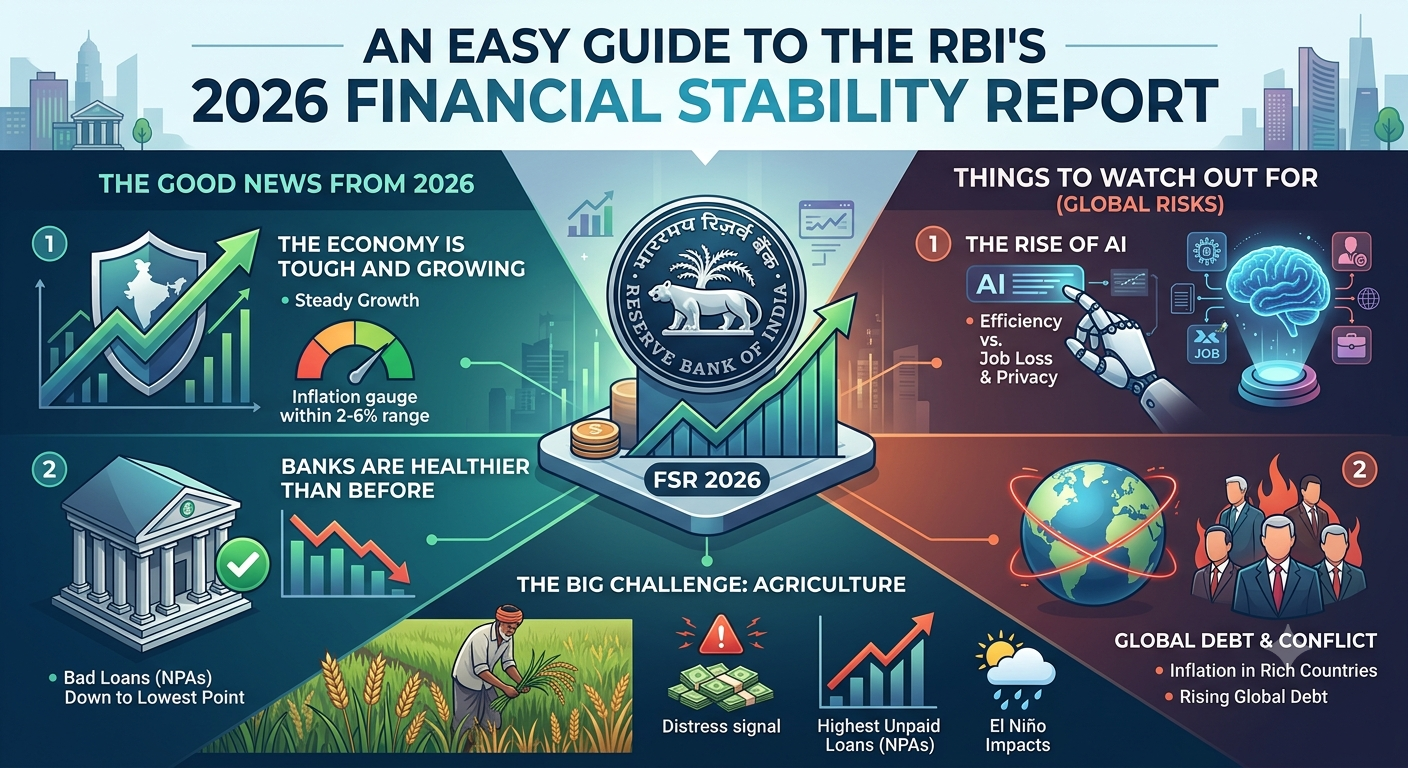
The Good News from 2026
1. The Economy is Tough and Growing
Even with conflicts happening around the world, India’s financial system has stood strong. This is because the country’s growth is steady and inflation (the rate at which prices go up) is under control—staying in the healthy range of 2% to 6%. On top of this, banks have built up good emergency funds to protect themselves during hard times.
2. Banks are Healthier Than Before
One of the best signs of a good economy is that people are paying back their loans.
When someone doesn’t pay back their bank loan for over 90 days, it is called a “bad loan” or a Non-Performing Asset (NPA). The new report shows that bad loans have dropped significantly, hitting their lowest point in decades. Furthermore, the rate at which good loans turn into bad loans is also going down.
Things to Watch Out For (Global Risks)
Even though the homefront looks great, the RBI warned about a few global trends that could cause trouble:
The Rise of AI: Artificial Intelligence is making work faster, but it brings new dangers like data privacy leaks and the risk of people losing their traditional jobs.
Inflation in Rich Countries: When countries like the US struggle with high prices, their central banks raise interest rates. This tempts foreign investors to pull their money out of India to get better returns in the US, which can lower the value of the Indian Rupee.
Global Debt and Conflict: Rising government debts worldwide and ongoing tensions between countries also threaten global financial peace.
The Big Challenge: Agriculture
While most businesses are doing a great job at repaying their loans, the farming sector is struggling.
According to the report, agriculture has the highest rate of unpaid loans. In fact, over 37% of all the bad loans sitting in commercial banks come from the farming sector. This means farmers are having a very tough time paying back what they owe, a problem made even worse by bad weather patterns like El Niño, which hurt crop production.
Summary
Overall, the RBI’s 2026 report paints a highly positive picture. India’s banks are stronger, and the economy is well-prepared to handle global bumps in the road. However, the government will need to keep a close eye on the struggles of everyday farmers, as well as prepare for the rapid changes brought by AI and global money shifts.