


In India’s Parliament, the “Question Hour” is a very important time. It is the part of the day when Members of Parliament (MPs) get to ask the government direct questions. Because so many MPs want to ask questions, Parliament uses a fair lottery system—called the ballot process—to decide which questions will be answered.
With the 2026 Monsoon Session scheduled to run from July 20 to August 13, preparations are already underway to get everything ready.
How the Questions Were Picked
To decide the agenda for the first three days of the session (July 20, 21, and 22), a special meeting was held in Committee Room ‘E’ at the Parliament House Annexe. To make sure the process was completely fair and open, it was overseen by MP Ram Bhawal Nishad and Gulmohan Singh Arora, a senior official from the Lok Sabha Secretariat.
The Final Numbers
During this process, thousands of requests were sorted. Here is the final count of the questions chosen for the first three days:
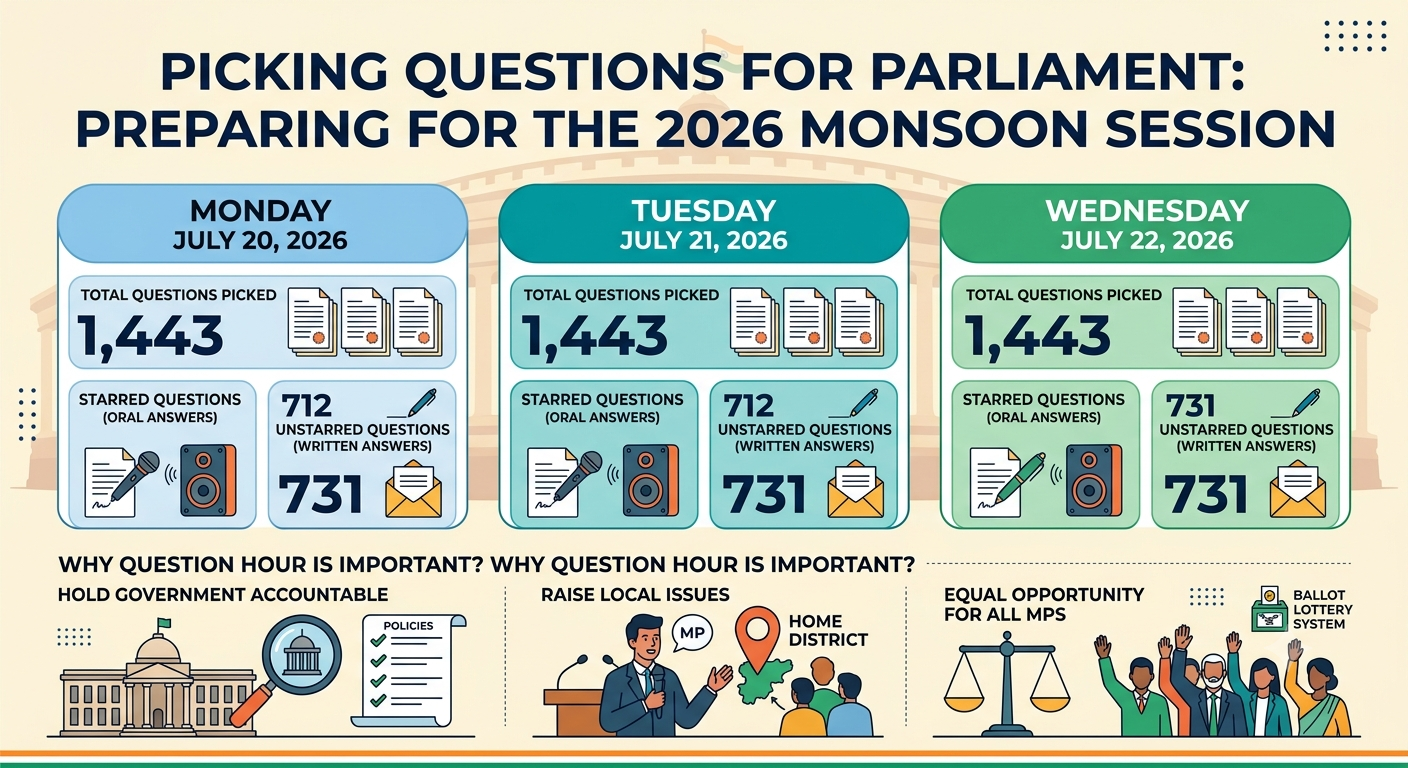
- For July 20, 2026: A total of 1,443 questions were picked. This includes 712 “Starred” questions (which the government must answer out loud in Parliament) and 731 “Unstarred” questions (which are answered in writing).
- For July 21, 2026: A total of 1,358 questions were selected. Out of these, 677 are Starred and 681 are Unstarred.
- For July 22, 2026: The system picked 1,283 questions. This is made up of 637 Starred questions and 646 Unstarred questions.
Why is Question Hour So Important?
Every normal working day in the Lok Sabha kicks off with the Question Hour. It is a vital tool for democracy. During this hour, MPs can hold the government accountable by asking about new policies, checking on the progress of projects in their home districts, and raising important issues that affect regular citizens.
By using the ballot process, Parliament ensures that every single MP gets an equal and fair chance to voice the concerns of the people they represent.