




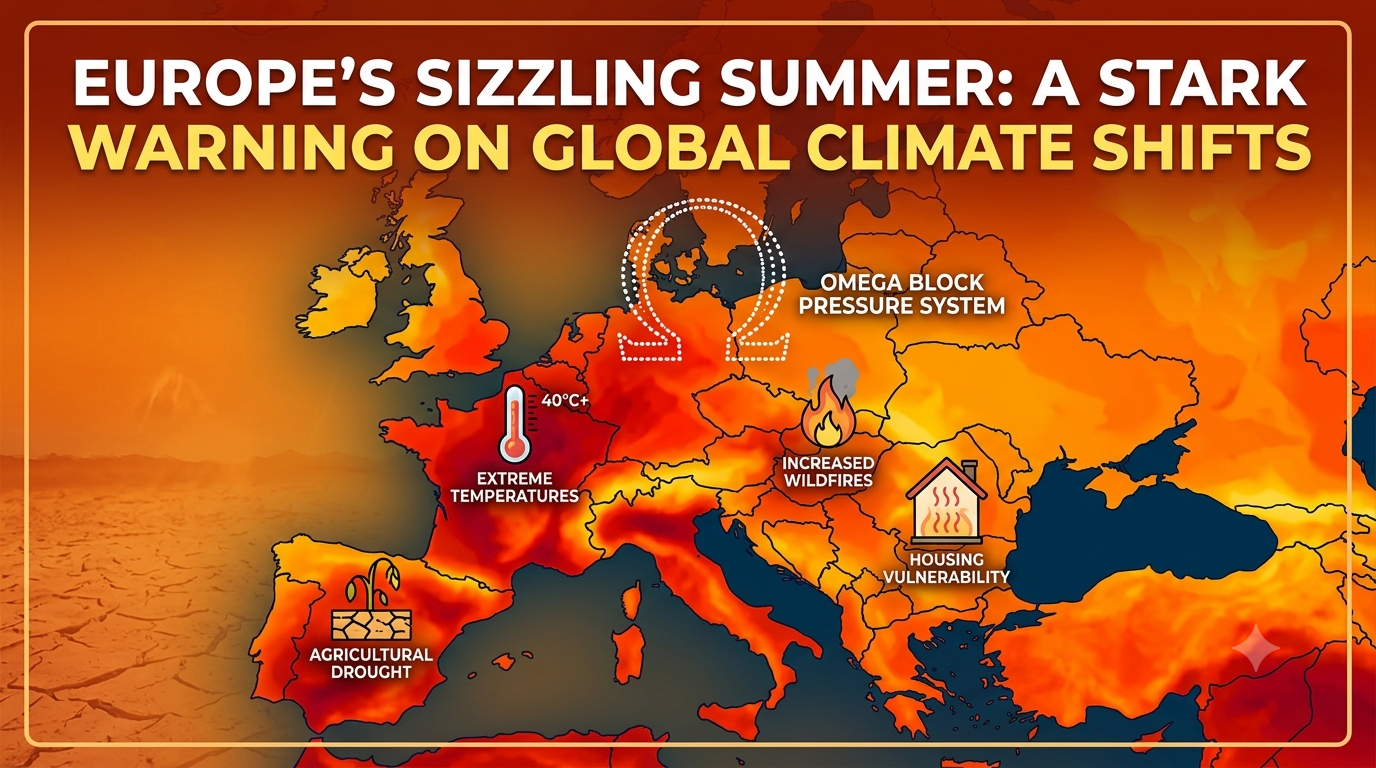
Historically celebrated for its mild, cool climates, Europe is currently navigating uncharted territory as extreme heatwaves sweep across the continent. From the snowy peaks of the Alps to the typically chilly Scandinavian regions, temperatures have surged past 40°C. Nations like Germany, France, and Denmark are witnessing historical weather records shatter. The heat has become so severe that it is disrupting daily life, even prompting the suspension of train services to prevent warped railway tracks. This raises a critical question: is this a fleeting weather event, or a permanent glimpse into a warming world?
The “Omega Block” Effect
Meteorologists attribute this extreme weather largely to a phenomenon called the “Omega Block.” This occurs when a massive, high-pressure atmospheric system forms a dome (shaped like the Greek letter Omega) over a specific region. This dome effectively traps hot air in place and acts as a shield, preventing cooler weather systems from moving in.
This natural occurrence is being severely amplified by human-driven climate change. Data indicates that Europe is warming at a rate twice the global average. When combined with dense urbanization, vast stretches of concrete, and a lack of natural water bodies in modern cities, it creates “urban heat islands” that push local temperatures to dangerous extremes.
The Architectural Trap
One of the biggest vulnerabilities for European residents right now is their own homes. For centuries, European architecture has prioritized surviving harsh, freezing winters. Buildings are constructed with heavy insulation designed to trap heat indoors.
During a prolonged heatwave, this design becomes a serious hazard. Without proper natural ventilation, these homes absorb the daytime heat and fail to cool down overnight, essentially acting like ovens. While the immediate reaction might be to install air conditioners, experts warn against this. Millions of individual AC units pumping out 50°C exhaust air would only drastically increase the outdoor temperature of the cities, making the broader problem much worse.
Casualties and Economic Strain
The extreme heat has taken a tragic human toll, with thousands of casualties reported and millions more affected. The crisis disproportionately impacts the most vulnerable: the elderly, young infants, and laborers who spend their days working outdoors.
The consequences also extend deeply into the economy and the environment. Baking temperatures are drying out soil, creating agricultural droughts that threaten crop yields and food supply. Furthermore, Central Europe is seeing a frightening surge in wildfires, which are destroying local biodiversity. In the long term, these factors will likely lead to disrupted supply chains, higher food prices, and massive spikes in energy consumption.
The Path Forward: Global Lessons
To survive this changing climate, Europe must urgently adapt its infrastructure and policies. Immediate solutions include retrofitting existing buildings for better airflow and adopting sustainable cooling technologies, such as centralized “district cooling” networks, rather than individual window AC units. Urban planners must also prioritize planting trees and integrating water bodies into city landscapes to naturally cool the air.
Interestingly, Europe can draw vital lessons from developing, tropical nations that have long battled severe heat. India is a prime example. Since 2014, India has rolled out localized “Heat Action Plans” across hundreds of cities. These plans include early warning systems, public hydration strategies, and dedicated heatstroke wards in major hospitals equipped with specialized medical staff.
Europe’s current crisis is a wake-up call for the entire world. It serves as undeniable proof that even the most scientifically and economically advanced regions are vulnerable to the raw power of a changing climate. Building global climate resilience is no longer an option for the future; it is a necessity for today.