




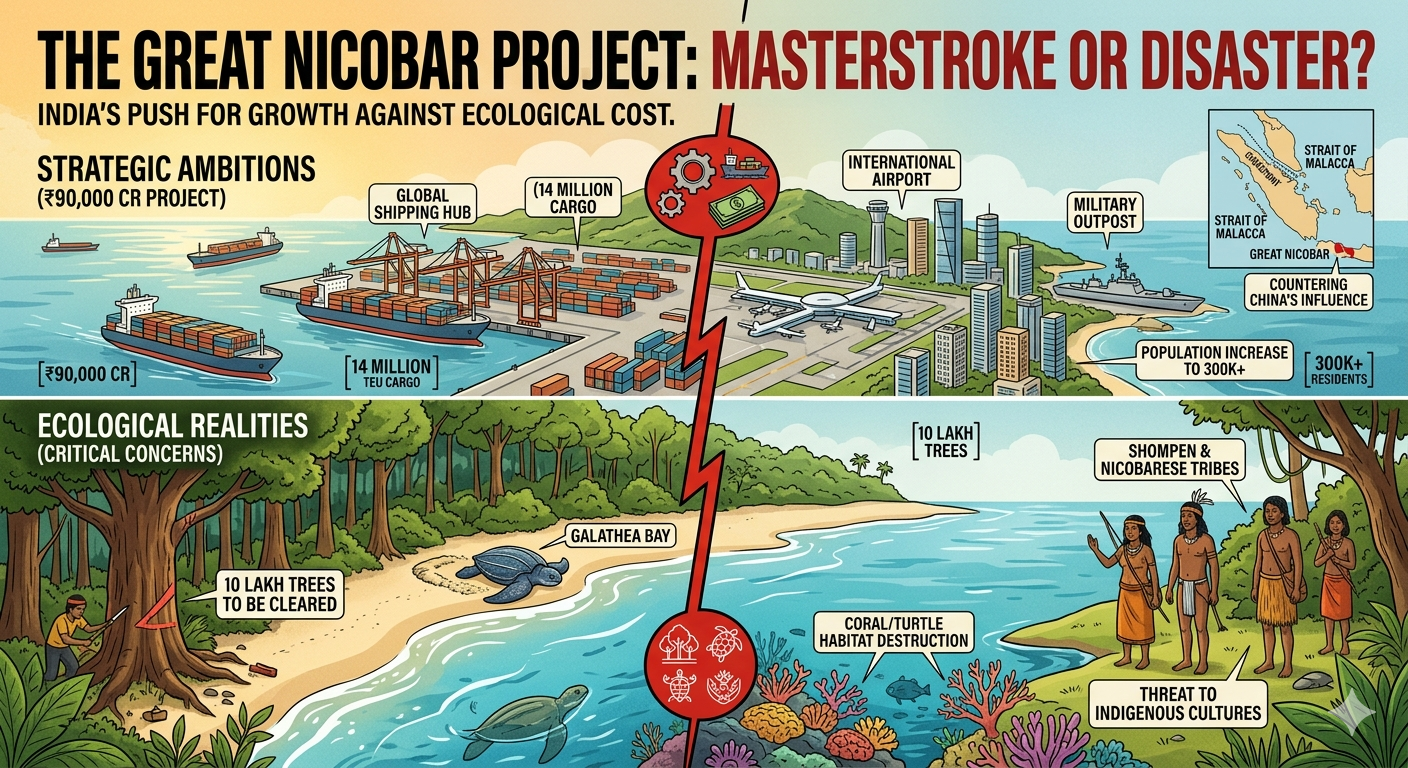
India has initiated a massive ₹90,000 crore infrastructure overhaul on Great Nicobar Island, the southernmost tip of the Andaman and Nicobar archipelago. While authorities champion the initiative as a crucial step for future economic growth and national defense, the plans have ignited a fierce debate. Opponents, ranging from environmental experts to political figures, are raising the alarm over the potential destruction of pristine ecosystems and the displacement of vulnerable indigenous communities.
Here is an overview of what the mega-project entails, its geopolitical goals, and the primary concerns surrounding its implementation.
The Blueprint for Transformation
The proposed development will span around 165 square kilometers—roughly 18% of the island’s total land area—and aims to convert the isolated region into a bustling commercial and military center. The core components include:
A Deep-Water Cargo Hub: Located in Galathea Bay, this transshipment terminal is designed to accommodate the world’s largest freight vessels. Planners hope it will capture a significant portion of international shipping traffic, eventually processing up to 14 million TEUs of cargo.
A Dual-Use Airport: A newly constructed, round-the-clock international airport will serve both civilian travelers and the military, acting as an advanced logistical and surveillance base in the Indian Ocean.
Massive Urban Expansion: The project includes a township designed to increase the island’s current population of roughly 8,000 to over 300,000 residents over the next three decades, fundamentally altering the region’s demographic and physical landscape.
Geopolitical and Economic Motivations
Supporters of the initiative highlight the island’s highly strategic geography. It sits adjacent to the western entrance of the Strait of Malacca, a critical maritime choke point that handles a massive share of global commerce, including the vast majority of China’s energy imports.
Regional Security: By fortifying its presence in this area, India seeks to establish a counterbalance to China’s growing maritime footprint, ensuring the ability to monitor and potentially control vital shipping lanes during geopolitical disputes.
Boosting Trade Autonomy: Currently, the majority of India’s international transshipment cargo is routed through foreign ports. Building a domestic deep-water facility would significantly cut down on logistical expenses and keep maritime revenues within the country.
Ecological and Humanitarian Alarms
Despite the economic and defensive justifications, the scale of the proposed construction has led to intense backlash due to its inevitable environmental and social fallout.
Risks to Indigenous Populations: The island is the traditional home of the Nicobarese and the Shompen. The Shompen are a highly vulnerable, semi-nomadic group with virtually no contact with the outside world. Anthropologists warn that introducing hundreds of thousands of outsiders and heavy industrial activity could effectively decimate these tribes.
Biodiversity Loss: Constructing the new facilities will require the clearing of approximately one million trees. Furthermore, the development directly threatens the habitats of rare wildlife, including vital nesting grounds for giant Leatherback turtles and thousands of living coral reefs located in Galathea Bay.
Regulatory Controversies: Critics note that to pave the way for construction, the government swiftly rolled back long-standing legal protections for tribal reserves and ecologically sensitive coastal zones (such as CRZ-1A areas) where building is traditionally strictly forbidden.
Financial Viability and Political Resistance
The initiative has also faced strong headwinds from political opposition and economic analysts.
Questions of Feasibility: Experts have questioned the financial logic of building a massive port in such an isolated location without a pre-existing industrial hinterland or cargo network. Competing against established, highly efficient hubs like Colombo poses a massive financial risk.
Allegations of Cronyism and Secrecy: Political opponents have accused the ruling government of pushing the project through to benefit allied corporate conglomerates rather than the national interest. Additionally, local communities report being kept in the dark, with minimal public consultation and allegations that scientific environmental assessments were rushed under the pretext of national security.
Conclusion
The Great Nicobar development represents a profound crossroads for India. On one hand, it offers a pathway to secure crucial maritime borders and assert economic independence in the Indian Ocean. On the other hand, executing this vision risks causing irreversible harm to one of the country’s most untouched natural environments and erasing the heritage of its indigenous people. As the massive investment begins to take shape, the tension between aggressive modernization and ecological preservation remains unresolved.